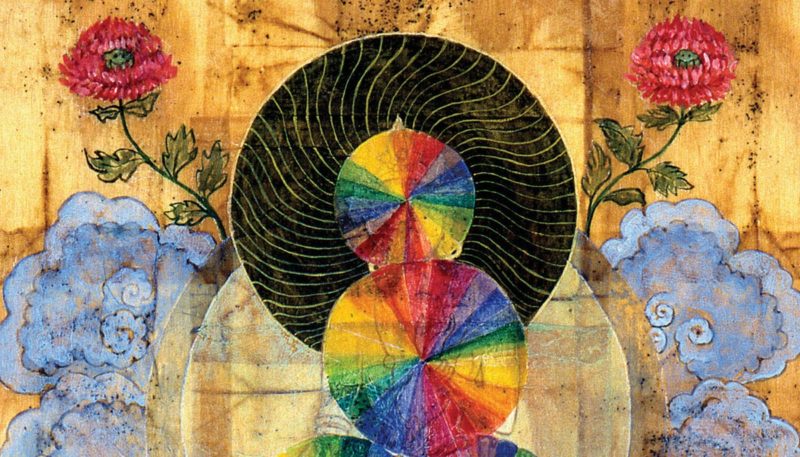
Michael Sheehy reviews Rainbow Body and Resurrection by Francis V. Tiso. From the Winter 2016 issue of Buddhadharma. Blogger ref https://wiki.p2pfoundation.net/Multi-Dimensional_Science

Art by Mary Devincentis Herzog.
Though we find practices of bodily abandonment and denigration throughout Indian spirituality, the Vajrayana Buddhist traditions that were received and developed in Tibet—due to the synthetic collaborations of Buddhism with the arts and sciences of medicine, astrology, alchemy, and physiology that occurred during the formative period of tantra during the seventh through ninth centuries—place an emphasis on the body as a locus of transformation. Similar to Daoist traditions of alchemical transformation, there are Vajrayana traditions that say that all tangible matter consists of congealed forms of the five elements: space, air, fire, water, and earth. As described in The Tibetan Book of the Dead and illustrated in the murals of the Lukhang or so-called Secret Temple of the Fifth Dalai Lama in Lhasa, there are cosmogonies that suggest the elemental energies that make up the cosmos are undifferentiated from those that make up the human body, and as such the body is a holon, simultaneously the individual person and the cosmic whole.
Vajrayana traditions view our bodies to be an evolutionary product of billions of years of bathing in bright light.
In Dzogchen cosmology, the primordial space of the cosmos is envisioned as being utterly open and translucent. Due to the natural effortless play of the cosmos itself, movement ensues. With this initial gesture, however slight, the element of air stirs up wind that oscillates rapidly into fire; from fire emerges the liquidity of water, and from water the solidity of rock and earth are stabilized. With this gradual gravitational collapse into the elemental forces that comprise the cosmos, a concomitant spiraling reconfigures matter into worlds wherein embodied beings emergently form. As such, the body is conceived to be a part of the whole, seemingly fragmented from itself. Not unlike contemporary astrophysics, Vajrayana traditions view our bodies to be an evolutionary product of billions of years of bathing in bright light.Describing the reversal of this gestation process, The Tibetan Book of the Dead details the dissolution of these five elements during the time of death. First the body becomes heavy and sags as the earth element dissolves, saliva and mucus are excreted as the water element dissolves, the eyes roll backward as the fire element dissolves, the breath becomes wheezy as the air element dissolves, and finally consciousness flashes and flickers with turbulent visions as the space element dissolves from the physical body.
According to Dzogchen tradition, under certain circumstances the cosmic evolutionary process of gravitational collapse into solidity can turn itself back into a swirling, highly radiating configuration. That is, there are Tibetan traditions that suggest that meditative technologies can intentionally reverse this process of collapse, thereby altering the gravitational field so the inherent radiance of these condensed elements blossom. When this happens, the five elements of the body transform into the five lights of the color spectrum. The Tibetan name given to this fluorescence is jalu, literally translated as “rainbow body.”
Material bodies dissolving into light is the subject of Rainbow Body and Resurrection by Father Francis V. Tiso, a priest of the Diocese of Isernia–Venafro who holds a PhD in Tibetan Buddhism. Exploring the body as a vehicle of spiritual transformation, this book presents Father Tiso’s research on postmortem accounts of the rainbow body of Khenpo A Chö (1918–98) in eastern Tibet, historical background on Dzogchen and early Christianity, and a comparative discussion of the rainbow body and the mystical body of Christ.
Father Tiso introduces his work by acknowledging that because research on postmortem paranormal phenomena cannot be conducted in a laboratory, there are inherent tensions that exist in conducting scientific investigations while relying on the good word of faithful informants. Seeking to take the approach of a participant observer in the tradition of anthropology, Tiso’s chapter on Khenpo A Chö is largely a series of journal logs from fieldwork in eastern Tibet and India and transcripts from interviews with local eyewitnesses.

Rainbow Body and Resurrection
by Francis V. Tiso
North Atlantic Books, 2016
408 pages; $24.95
by Francis V. Tiso
North Atlantic Books, 2016
408 pages; $24.95
One particularly fascinating social dynamic that has emerged since the Cultural Revolution—and this has affected the reporting of numerous cases—is that the Chinese government has declared going rainbow to be illegal. In effect, because the phenomena so dramatically challenge the normative paradigm, there has essentially become a “don’t ask, don’t tell” policy about masters going rainbow in Tibet. For instance, Changchub Dorje’s shrunken bodily remains were hidden from authorities for years until the proper ceremonies could be openly performed.
So what exactly does rainbow body look like? According to these traditions, there are signs that indicate an adept has stabilized meditative realization of the mind’s innate basic radiance. While alive, it is said that the bodies of these beings do not cast a shadow in either lamplight or sunlight; at death, signs include their physical bodies dramatically shrinking in size, and their corpses exuding fragrances and perfumes rather than the odors of decomposition. A common Tibetan metric for the shrunken corpse of a body gone rainbow is the “length of a forearm.” In the case of Khenpo A Chö, as Father Tiso notes, the local Chinese press reported that his body “shrank to the size of a bean on the eighth day and disappeared on the tenth day. What remain are hair and nails.” Other signs are the sudden blooming of exotic plants and flowers anytime of year and, of course, rainbows appearing in the sky.
These signs mark someone who has attained rainbow body, and some are said to have occurred in each of the cases mentioned above. However, there is also a special kind of rainbow body known as the great transference into rainbow body, or jalu powa chemo. This is the complete transference of the material body into radiance so that the only residue of the body is hair and fingernails. Great transference is a deathless state. Realized by Dzogchen meditation masters such as Garab Dorje and Padmasambhava, the great transference rainbow body is understood to be the actual enlightened qualities of these realized masters. Not unlike Christian saints, these qualities are understood to be continually available for beings to receive through the reception of light.
While it is tempting to draw parallels between the luminous bodies of Dzogchen meditation masters and saints, or even with the risen mystical body of Christ, Father Tiso goes one step further. Discussing the exchange of religious ideas along the Silk Route, and possible historical influences of Syriac Christianity and Manichaeism in the pre-Buddhist civilization of Tibet, he asks if the first human teacher of Dzogchen, Garab Dorje, could have been a Christian master imported from the Middle East—or even the messiah himself.
The strength of Father Tiso’s book is its tremendous and ambitious breadth. He brings to the reader’s attention a broad spectrum of doctrinal and historical information not only about what he refers to as the “Church of the East” and possible doctrinal influences of Christian light mysticism on Tibetan religion but also about early Dzogchen practice. Discussing encounters of Christianity with Buddhism and Daoism, he cites little-known Christian mystics, including the Desert Fathers of Egypt, Evagrius, Abraham of Kashkar (ca 501–586), and John of Dalyatha (ca 690–786), all of whom he argues were critical figures in spreading the “religion of light.”
One example of this cross-fertilization with which Father Tiso tantalizes us is the Jesus Sutras, seventh-century Christian texts that were preserved among the caches of manuscripts discovered in the Central Asian cave complexes at Dunhuang. Thought to be have been produced by the Church of the East and Syro–Oriental Christian communities who traveled along the Silk Route, these texts remarkably borrow literary forms and devices employed in Buddhist sutra literature while echoing doctrinal claims of Christian theology in typical Buddhist parlance. For instance, similar in arrangement to many Mahayana Buddhist sutras, these texts present a question-and-answer dialogue about topics of spiritual self-cultivation, except instead of speaking with the Buddha, the interlocutor is the Messiah Christ.
Am I convinced that a Church of the East influenced Dzogchen in Tibet? Was Garab Dorje actually Jesus Christ? Did Christian light mysticism have a significant historical impact on the formation of yogic technologies that culminated in Tibetan expressions of rainbow body? These are certainly alluring questions. However, that’s not entirely the point. Father Tiso makes a compelling case by bringing his reader an intercultural, cross-historical, and interreligious discussion of the esoteric arts. To what extent there was bona fide synthesis among these meditative traditions from Egypt and Syria to China and Tibet is a discussion that warrants more attention and that this book propels forward. What’s most important, however, is that this work brings attention to the shared human experiment of contemplative transformation.
---------------------------------
What Is Rainbow Body?
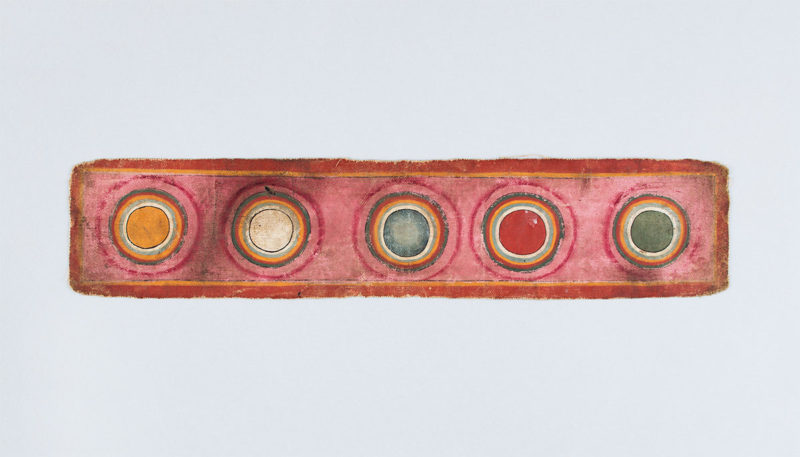
In Tibetan Buddhism, it is said that certain meditation practices can alter the appearance of the body, transforming it into five radiant lights. The name given to this physical fluorescence is “rainbow body.”

Five Cosmogenic Elements. Tibet; ca. 15th century, pigment on cloth. Rubin Museum of Art. F1998.16.5.2 (HAR 68878).
In Vajrayana traditions of Tibetan Buddhism, tangible matter is considered to be made up of five elements: space, air, fire, water, and earth. As described in Tibetan literary sources, including The Tibetan Book of the Dead, the elemental energies that make up the cosmos are understood to be undifferentiated from those that make up the human body. Therefore, the body is simultaneously an individual person and the cosmic whole.
Certain Buddhist meditation practices are meant to alter the gravitational field of these five elements that constitute the body, transforming them into the five radiant lights of the color spectrum. The Tibetan name given to this physical fluorescence is jalu, literally meaning, “rainbow body.” Rainbow body is also the name given to the transformation of the ordinary physical body as a result of years of specific disciplined practices.
Reports from inside Tibet of rainbow bodies have emerged sporadically over the past century.
Tibetan traditions have identified signs that indicate when a practitioner has achieved rainbow body. While alive, it is said that the bodies of these beings do not cast a shadow in either lamplight or sunlight. At death, it is said that the physical body dramatically shrinks in size, exuding fragrances and perfumes rather than the odors of decomposition. A common Tibetan metric for the shrunken corpse of a rainbow body is the “length of a forearm.” Other signs are the sudden blooming of exotic plants and flowers anytime of year, as well as rainbows appearing in the sky.
There is also a special kind of rainbow body known as the “great transference into rainbow body,” or jalu powa chemo. This is the complete transference of the material body into radiance so that the only thing left of the body is hair and fingernails. While the historical origins of this phenomena are not well studied, the concept of the rainbow body is associated with the eighth-century Dzogchen meditation master Padmasambhava who, according to legend, achieved great transference and entered into a deathless state of being.
Reports from inside Tibet of rainbow bodies have emerged sporadically over the past century, though there has been an upturn of accounts over the past decades. The best known case is that of Yilungpa Sonam Namgyel, who achieved rainbow body in 1952, as recounted by Chögyam Trungpa Rinpoche in his memoir, Born in Tibet. There is also the case of Changchub Dorje, a medical doctor and leader of a Dzogchen community in the Nyarong region of eastern Tibet, about whom Chogyal Namkhai Norbu recounts in The Crystal and the Way of Light.




From these readings, you would realize that the Radhasoami Faith is consistent with science. The only requirement for those who wish to experience Higher Consciousness or Super Intelligence through Ultra Transcendence of their soul is to follow the prescribed behavior and practices under the Guidance of a True Adept. Some of the scientists like Price and Barrell have acknowledged the importance of experiential knowledge in scientific pursuit of consciousness.
In order to get an idea about the manner in which spiritual ascendance to Higher Regions of Consciousness can be explained, the Graph Theoretic Modeling Approach to quantum information processing, discernible from the following papers, may be referred.
1. Graph-theoretic quantum system modelling for information/computation processing circuits, Volume 40, 2011 - Issue 8, International Journal of General Systems.
http://www.tandfonline.com/doi/abs/10.1080/03081079.2011.602016
2. Graph-theoretic quantum system modelling for neuronal microtubules as hierarchical clustered quantum Hopfield networks, Volume 43, 2014 - Issue 6, International Journal of General Systems.
http://www.tandfonline.com/doi/full/10.1080/03081079.2014.893298
3. Modelling microtubules in the brain as n-qudit quantum Hopfield network and beyond, Volume 45, 2016 - Issue 1, International Journal of General Systems.
http://www.tandfonline.com/doi/full/10.1080/03081079.2015.1076405
Mr Emile Pellerin first came to India in 1967, after reading the book written by Paul Brunton entitled "A search in secret India". He was a true seeker and he felt that by visiting Dayalbagh and meeting Sir Anand Swarup Knight, the Fifth Revered Leader of Radhasoami Faith his desire to find the absolute truth will be fulfilled. In his visit to Dayalbagh, he met the Sixth Revered Leader of Radhasoami Faith, Param Guru Mehtaji Maharaj. He sought initiation got the same by following the conditions of becoming a vegetarian, abstaining from meat including eggs and alcohol and accepted Huzur Radhasoami Dayal as the Supreme Father of the entire Universe.
He started performing meditation and was named "Melaramji" in his subsequent visits to Dayalbagh by the spiritual mentor. During the course of his life, he suffered hereditary retinal degeneration and lost his eyesight. In his subsequent visit to Dayalbagh, which he made with the help of his son, he met Most Revered Gracious Huzur Mehtaji Saheb and submitted to him "How can I see you now when I have lost my vision?". The merciful spiritual teacher was moved by his request and granted him inner vision and told him that " Melaram, you will have my Darshan whenever you want".
After the departure of Gracious Huzur Mehtaji Maharaj, Melaramji visited Dayalbagh again and met the 7th Revered Leader of Radhasoami Faith, Param Guru Dr M.B. Lal Saheb. He was immediately consoled by the merciful teacher with the words: "Melaramji you can have my Darshan (Vision) whenever you want".
I happened to get in contact with PB. Melaramji in the year 2000 when I had visited France on an academic visit. After the departure of Param Guru Dr M.B. Lal Saheb, I telephoned PB. Melaramji and informed him of this sad news. He immediately consoled me by saying that "Hans Raj do not worry, Gracious Huzur is in Dayalbagh and he will reveal himself to you when the time comes".
In 2005 while I was invited by Prof. Anand Srivastav, the University of Kiel for Research interaction and also was going to Helsinki to attend a conference, I was advised by Param Guru Prof. P.S. Satsangi Saheb, the 8th Revered Leader of Radhasoami faith to visit PB. Melaramji at France and to invite him to Dayalbagh, which I did with the help of PB. Vijay Madan, of Frankfurt.
Melaramji again visited Dayalbagh in 2005 and during this trip, I accompanied him to Agricultural fields to meet Most Revered Gracious Huzur Prof. P.S. Satsangi Saheb, The 8th Revered Leader of Radhasoami Faith. The merciful Spiritual Teacher immediately recognised him with kind words " Melaramji how are you? What do you want?". To these loving words, Melaramji replied " Huzur I have no desire but to be with you. I want to be near you at Dayalbagh". To my amazement, Gracious Huzur replied, " Melaramji, You know how to concentrate and you can bring your consciousness whenever you want to Dayalbagh". PB. Melaramji replied to this saying "Yes Huzur I do morning and evening Satsang here". Gracious Huzur got pleased and gave him Prasad.
I am submitting the above with due consent of Mr. Emile Pellerin as he cannot do it himself.
With warm regards to all
K. Hans Raj
I am also enclosing herewith the recent telephonic message of PB. Melaramji gave on 18th March 2017 at 2:15 PM for the benefit of all.
"On 14th April 1967 (50 Years ago I came to Dayalbagh in search of Truth) I got the initiation into Radhasoami Faith. I was the first French person to receive initiation. I am 84yrs old now but this age is insignificant in comparison to the eternity. Practising meditation correctly and regularly enables one to have inspiration, intuition and to see the true spiritual light. All devotees must practice meditation regularly and correctly to get inner experience which is a must for understanding reality.
The World is not real. It is a delusion and it is important to have a strong detachment from the world. It is necessary during life to practice meditation all time. Necessary to experience the reality. At times I feel alone as a human. When I feel my wife is sick and may leave me alone in the world I feel sad. However, when I practice meditation I feel happy for Radhasoami is present always internally in me so I become happy. God calls me internally. There is no need to worry. I have full faith and confidence in Radhasoami, in my heart in my mind and in my soul. Bad is in everyone, so they are separate from God. Worldly people cannot understand reality. Satsangis know true spirituality and true light. Only at Dayalbagh, at Radhasoami Faith true path exists. After finding Satsang at Dayalbagh I had no need for the search in the world. Satsang is very interesting and very important".
I am submitting the above with due consent of Mr. Emile Pellerin.
With warm regards to all
K. Hans Raj
ONE IS BY MEDITATION SUPPORTING A THOUGHT INTERNALLY.NEXT ONE IS
BY MEDITATION SUPPORTING SATGURU SWAROOP ,BUT CONDITION IS THAT
MEDITATION SHOULD BE WITH PURIFICATION OF HEART.
RADHASOAMI Faith,Dayalbagh, in which some experiences are described
I fully believe in all the experiences .These all experiences are
quite new in my life.Meditation is advantageous for the life of
Human-Being for which consciousness must.In my opinion some classes
should organised on consciousness in Qntm & Nano Cntr. RS.
There are infinite spirits with nearly equal spirituality levels and you are welcome to continue with your spiritual pursuits through Satsang and sewa (community service). At the same time, there can be only one Living Master or Sant Satguru. The present Master is Revered Prof. Prem Saran Satsangi Sahab since December 5, 2002.
The question on spiritual experiences can be best answered by pursuit of the scientifically well-accepted additional references below.
1. Price D. and Barrell J. (2012), Inner Experience and Neuroscience : Merging both Perspectives, MIT Press, USA, 2012.
We acknowledge considerable rapport and support derived from the seminal work of Price and Barrell (Price and Barrell, 2012). We fully endorse them in their use of four-fold paradigms for integrating inner experience with scientific methodology and concede their assertion that ordinarily questions, not hypotheses may guide the first three stages of observing, reporting and understanding from the first person perspective of co-investigators and it is not necessary to frame the hypotheses in advance but it is through first person account of phenomenology that these hypotheses may be formulated later and tested; and it is the last stage when the scientific methodology is invoked in using psychometric methods and quantitative psychophysics, for hypothesis-testing.
2. Satsangi P.S. (2010), “Cosmology from the twin vantage points of Radhasoami Faith and Systems Science”, Vision Talk, International Seminar on Religion of Saints (‘Sants’) – Radhasoami Faith, DEI, Dayalbagh, Agra, Nov. 2010 (also Chapter 23 of Expositions on Truth, Ultimate Reality and Supreme Being, Radhasoami Satsang Sabha, Dayalbagh, Agra, 2010, ISBN : 978-81-89288-60-0), Also in P. Sriramamurti, Prem Prashant and Anand Mohan (Eds.), Spiritual Consciousness, New Age Books, 2013, New Delhi, pp. 21-40.
3. Satsangi P.S., Hameroff S.R. (2016), Consciousness : Integrating Eastern and Western Perspectives, New Age Books, 2016, ISBN 978-81-7822-493-0, New Delhi.
This reference is especially useful as it includes both eastern and western viewpoints mentioned in your post.
4. Walling P. (2016), The Neurodynamics of Consciousness, Chapter 7, Consciousness : Integrating Eastern and Western Perspectives, New Age Books, 2016, ISBN 978-81-7822-493-0, New Delhi, pp. 147-166.
5. Walling P. (2017), The Science of Angels, Author House, USA, 2017, ISBN 978-1-5246-7034-4.
S.No. 4 and 5 are works of a Western theoretical physiologist and retired anaesthesiologist who has worked at Baylor University Medical Centre, USA for 35 years.
For understanding arts and philosophy of consciousness please go through the book - 'Consciousness - integrating Eastern and western perspectives' whose snapshot is given in beginning of the blog. Answers to your questions are elaborated their.If you go by the topic of the blog in other words it can be briefly explained as measuring of the environmental correlates (in terms of science - science which originated from west) of consciousness while meditation (based on meditation methods which originated from east). There is no confusion in terminology and it is clearly defined if you go through the chapters if the referred book which is the mother content of this blog.
Purpose of describing inner experience is described in the last line of the blog I.e. to have larger samples of subject code names so that their experiences can be measured in terms of environmental correlates of consciousness to form a bigger experimental database and hence prove the phenomenology and metaphysics of Radhasoami faith. When such experiences are expressed in terms of scientific measurements (of Western origin), they are repeatable, measurable and verifiable by anyone.
With Regards,
MS
We should be more concerned with the Fundamentals of Radhasoami Faith. One such Fundamental is Moksha (Redemption) in Four Births. But Christianity and Islam, also part of Eastern Philosophy, do not believe in Rebirth and Reincarnation. Christians and Muslims constitute more than half of the world population. Have Radhasoami Satsang Sabha ever thought over this problem and decided to initiate a suitable action for the Integration of Varied Eastern Philosophies?
Ravi Kiran Maddali
Also, Such Mystic internal experiences are in a kind of proof for the scholars of spiritual consciousness. And that they are verified by the Mentor(Adept) makes it highly interesting. Thanks.. really insightful
Sometime in late 1950’s, one such case is of Professor of English, Late G.V.L.N Sharma, Regional Engineering College, Warangal (Now a part of Telangana, India) as narrated by his nephew Mr. K. Gurcharan Das, gives us an example of how firm faith and belief in the name “Radhasoami” has led to miracles beyond one’s imagination.
Professor G.V.L.N Sharma was diagnosed with “Tumor” in his lungs and was at a very advanced stage while he was working as manager in Dayal Ink Factory, Kakinada (now a part of Andhra Pradesh, India) and it was stated by doctors at that time that he won’t survive for more than six months and they had given up all hope. He lived along with his widowed mother (Late Sitamahalakshmi) and four younger sisters (Late V.B.Sundari, Late V. Radha Pyari, Late K. Maharaj Kumari & Late N.Radha) who were totally dependent on him and he had a very meager salary at that point of time. As this news broke out, the family members of Professor Sharma were crestfallen and tried to get his treatment done with different doctors. However, Professor Sharma was of the firm belief that almighty Huzur Radhasoami Dayal would take care of his health as well as his family and that the hand of protection was always with them.
After sometime, the then sixth Revered Leader of Radhasoami faith, Param Guru Huzur Mehtaji Maharaj was on his satsang tour and happened to visit Kakinada. Many people from Kakinada had got an opportunity to attend the satsang and some people went up to him for discussing their personal matters and miseries. Professor Sharma also happened to attended satsang of Param Guru Huzur Mehta ji Maharaj during this visit. Param Guru Huzur Mehta ji Maharaj personally called Professor Sharma and enquired him about his health. Professor Sharma had never in the past described the condition of his health to Param Guru Huzur Mehta ji Maharaj. On the enquiry, Professor Sharma had kept silent with his hands folded. Huzur Mehta ji Maharaj then instructed him in satsang to shout three times “Main thik hoon” (English translation – I am alright). He followed his orders diligently and to everyone’s amazement and astonishment Professor Sharma started showing remarkable improvements in his overall health. After three to four months, when he went for his regular check-up, the same doctors who had diagnosed him of Tumor had given a report that it got completely cured and he is perfectly fine. The doctors were amazed to see that the Tumor had got completely dissolved and he lived hale and hearty after that for nearly 30 years.
Such is the experience that people receive from Huzur Radhasoami Dayal and greater is the hand of protection felt; the more you rely on Huzur Radhasoami Dayal for all your matters.
I am writing with consent of Mr. K. Gurcharan Das (nephew of Professor G.V.L.N. Sharma) to whom this experience was shared by all four sisters of Professor G.V.L.N Sharma who unfortunately are no longer with us today.
Great to learn about this incident in the life of Late Prof. Sharma... In fact, Professor Sharma wrote an article in the book 'Great Indian social reformers and philanthropists'. I am sure that he mentioned about Param Guru Huzur Mehtaji Maharaj in this article. I tried to contact it's publisher but came to learn that this company is no more into the business of publishing. Later on, I tried with several libraries both India and abroad for this article and also wrote to a few satsangis of Warangal branch but all these efforts remained unsuccessful. Now, I came to learn that Prof. Sharma was from Kakinada.
Thanks for this great incident and as you mentioned that you are in touch with Pb. K. Gurucharan Das, I request you to try for this article published in the mentioned book. I am sure that Pb. Gurucharan Das ji might help us.
I shall wait for further updates on this article...
Best wishes,
Ravi Kiran Maddali
I went around India and Sri Lanka. There in Kataragamma, I saw two people walking and I expierienced a very special feeling, so I got the desire to meet them.
One was a yogi, I stayed in his ashram for some weeks and when leaving he gave me the address of his friend who did live in Dayalbagh.
This friend, P.B. Krishnanand turned out to be the perfect guide to me.
I met Param Guru Huzur Mehtaji Maharaj in the fields and after some month's I got initiation, which I consider as being the most important in my life.
I like to relate one story of the help I got: one early morning I was swimming in the sea and nobody was there on the beach.
Due to very strong currants I could not reach the shore. At the end I got deadly tired by trying and trying, started floating on my back, closed my eyes and surrendered to Huzur Radhasoami Dayal. After some time I opened my eyes, turned around and I was so close to the beach that I could easely walk out of the water.
Very glad to learn that you got initiated during the time of Huzur Mehtaji Maharaj. Your experience once again established that Supreme Father Radhasoami Dayal will always look after His children. We should just surrender to His Holy Feet leaving behind all the worries.
Thanks a ton for posting. By the way, please share information about your location and how often do you visit India and Dayalbagh?
Such experiences from the senior satsangis like you will always encourage and motivate the devotees who are travelling in the PATH OF LOVE.
Keep posting....
RADHASOAMI...
faith is an individual process of a deep yearning for spiritual development.
Grown up in a small village of Germany without any influence of my family or other
cultural or personal connections I was – I would call it – simply a seeker. From the
early youth on I was reading christian and eastern philosophy literature and seeking
for experience of spirituality. But not until the age of 50 years my first visit to
Dayalbagh took place. Meeting the Satguru of that time – Param Guru Dr. Lal Sahab-
I was so overwhelmed that my inner wish manifested strongly to become a Satsangin.
The process of being accepted for initiation was accompanied also by inner
hinderance, partly doubts, but the force of attraction was always stronger and after all
the question of Param Guru Dr. Prem Saran Satsangi whether I had made my decision
I could answer with a clear „Yes“.
Today I find a lot of similarities between my original Christian Faith and the
Radhasoami Faith, but the most outstanding and important point is the existence of
a living Guru in Radhasoami Faith. Through HIS guidance I had spiritual experiences
I never had before. While the presence of the Satguru or in meditation I feel being led
by a strong power coming from an elevated level. Allthough this condition sometimes
gets disturbed by wordly matters of daily life, the association and contact through the
meditational practise is established immediately again. Shukrana !
P. Bn. Eva Henningsen
Spiritual Guru