Showing posts with label com. Show all posts

Friday, 25 October 2013

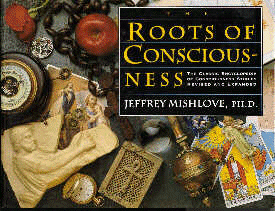
The Roots of Conciousness


Jeffrey Mishlove, PhD

Contents
INTRODUCTION
Dedication
Acknowledgments and Permissions
Introduction to Revised Edition
  • We Are All Ourselves
Introduction to the Original Edition
 
SECTION I: THE HISTORY OF CONSCIOUSNESS EXPLORATION
Shamanistic Traditions
Ancient Mesopotamia
  • Dream Portents
Ancient India
  • The Language of Consciousness
  • The Discipline of Yoga
Ancient China
  • Taoism
Ancient Greece
  • Mystery Traditions
  • Oracles
  • Pythagoras
  • Democritus
  • Socrates
  • Plato
  • Aristotle
  • Neoplatonism
Ancient Rome
  • Appolonius of Tyana
Ancient Hebrews and Early Christians
  • Prophecy
  • The Teachings of Jesus
  • Christian Saints
  • The Monastic Tradition
Hermeticism
Islamic Exploration of Consciousness
  • Theories of Occult Radiation
Medieval and Renaissance Exploration of Consciousness
  • Maimonides
  • Albertus Magnus
  • Cornelius Agrippa
  • Paracelsus
  • John Dee
  • The Rosicrucians
The Age of Enlightenment
  • Descartes and Mind-Body Dualism
  • Leibnitz and Monadology
  • Idealism
  • Sir Isaac Newton
SECTION II: THE FOLKLORE OF CONSCIOUSNESS EXPLORATION
Astrology
  • Ptolmaic Astrology
  • Kepler and Astrology
  • Astrology in Contemporary Times
  • Astro-Biology
  • Chronotopology
  • Arthur M. Young's "Geometry of Meaning"
  • Concluding Thoughts on Astrology
Astral Projection and Out-Of-Body Experiences
  • Ramacharaka's Theosophical Perspective
  • An Accidental Projection
  • OBE In A Dream
  • Conscious Astral Projection
  • Sylvan Muldoon's Method 
  • Robert Monroe's Method
  • Robert Crookall's Observations
  • Contemporary Perspectives About OBEs
Healing
  • Healing Temples
  • An Inner Healing Advisor
  • Mesmerism
  • Animal Magnetism
  • Holistic Faith Healing
  • Radionics
  • Edgar Cayce
  • Psychic Surgery
  • Delusion and Fraud
  • Healing at Lourdes
  • Mental Imagery
  • Omega Seminar Techniques
  • A Case Study
  • Ramacharaka's Healing Exercise
  • Deep Healing
Spiritual Anatomy
  • Thoughtforms
  • The Aura
  • Experimental Tests
  • The Vital Body
  • The Chakras
  • Chinese Acupuncture
  • Wilhelm Reich and Orgone Energy
  • The Soviet Concept of Biological Plasma
  • Kirlian Photography
  • Kirlian Photography Anecdotes
  • The Phantom Leaf Effect
  • Kurt Lewin's Field Theory
Communication with Higher Intelligence
  • Angels and Guardian Spirits
  • The Glance of the Master
  • Cabala
  • Emmanuel Swedenborg
  • Gustav Theodor Fechner and Psychophysics
  • The Theosophical Society
  • A Course in Miracles
  • The Invisible College
Other Worlds
  • Swedenborg
  • From India to the Planet Mars
  • The Fatima Appearances
  • UFOs As Apparitions
  • Carl Jung's Interpretation of UFOs
  • Uri Geller and UFOs
  • UFO Research Today
  • The Stella Lansing Case 
  • Automobile Teleportation
  • The Strange Case of Dr. X
  • Biological Effects of UFO Contact
  • The Betty and Barney Hill Case
  • Robert Monroe UFO Encounter
  • UFO Contactee Cults
  • Ray Stanford UFO Research
  • Earth's Ambassador
  • Close Encounters
  • Jacques Vallee's Analysis
Life Within Death -- Death Within Life
  • Survival of Consciousness After Death
  • Ancient Egypt
  • The Tibetan Book of the Dead
  • The Visions of Gustav Theodore Fechner
  • Spiritualism
  • The Spiritism of Allan Kardec
  • Founding of the Society for Psychical Research
  • Human Personality and Its Survival of Bodily Death
  • The Watseka Wonder
  • Apparitions and Hauntings
  • Near Death Experiences
  • Mediumship
  • Mrs. Piper
  • Cross-Correspondences
  • The "Marjory" Mediumship
  • Reincarnation
  • Xenoglossy
  • Unusual Powers of Mind Over Matter
    • D. D. Home -- The Greatest Medium Who Ever Lived
    • Sir William Crookes' Researches
    • Marthe Beraud
    • Paraffin Hands
    • Eusapia Palladino
    • Psychic Photography
    • Nina Kulagina
    • Uri Geller 
    • Poltergeist Cases
    • Matthew Manning
    • Philip the Ghost
    • Ted Owens -- The "PK Man"
    • Lightning Striking
    • Weather Control
    Firewalking
    Psionics -- Practical Application of Psychic Awareness
    • Harmful Purposes
    • National Security Applications 
    • Ancient History and Folklore
    • The World Wars
    • Eastern Europe 
    • United States 
    • Accident prevention
    • Dowsing
    • Treasure Hunting
    • Accuracy of Information Transmission
    • Psychic Archeology
    • Psychic Police Work
    • Journalism and Investigative Reporting
    • History
    • Precognition in Business Management
    • Public Safety 
    • Communication
    • Creativity in Art, Literature and Music
    • Agriculture and pest control 
    • Athletics and Sports 
    • Finding Lost Objects
    • Scientific Discovery
    • Weather Prediction and Control
    • Animal Training and Interspecies Communication
    • Intuitive Consensus

    SECTION III: THE SCIENTIFIC EXPLORATION OF CONSCIOUSNESS
    Introduction
    The Problem of Consciousness
    To Err is Human
    • The Psychology of Cognitive Biases
    • The Illusion of Self-Awareness
    • The Illusion of Control
    • The Need to be Consistent
    • The Sleeper Effect
    • The Effect of Formal Research 
    Extrasensory Perception (ESP)
    • Introduction
    • J. B. Rhine's Early Research at Duke University
    • Criticisms of ESP Research
    • Unconscious ESP
    • Dream Telepathy
    • Hypnosis and ESP
    • Exceptional ESP Laboratory Performers
    • Pavel Stepanek
    • Bill Delmore 
    • Uri Geller
    • Ganzfeld Research
    • The Experimenter Effect
    • The Sheep-Goat Effect
    • Psi-Missing
    • ESP and Personality Traits
    • Extraversion/Introversion. 
    • Effects of Different ESP Targets
    • Psi Mediated Instrumental Response
    • Stanford's Conformance Behavior Model
    • Precognition
    Psychokinesis
    • Rhine's Early Studies
    • PK With Random Number Generators (RNGs)
    • Chinese Reports of Psychokinesis Associated with ESP 
    • PK Metal-Bending
    • Bio-PK
    Psionics -- Practical Application of Psychic Awareness
    • Casino Gambling Simulation 
    • Possible Psi Healing
    • Bernard Grad's Research at McGill University
    • Conceptual Replications of Grad's Research
    • The Transpersonal Imagery Effect
    Proper Scientific Controls for ESP Experimentation
    • Randomization
    • Sensory Leakage 
    • Subject Cheating
    • Recording Errors
    • Classification and Scoring Errors
    • Statistical Violations
    • Reporting Failures
    • Experimenter Fraud
    Evaluating Psi Research
    SECTION IV: THEORIES OF CONSCIOUSNESS
    Introduction
    The Biological Perspective
    • The Nervous System
    • The Endocrine System
    • The Temporal Lobe Factor in Psychic Experience
    • The Ecology of Consciousness
    • Challenges to the Biological Identity Model 
    Consciousness and the New Physics
    • Space-Time According to Einstein
    • Folded Space 
    • Multidimensional Spacetime 
    • The EPR Effect and Bell's Theorem
    • The Implicate Order
    • Observational Theories
    • Unified Field Theory and Consciousness
    • Evaluating Implications of the New Physics 
    The Reflexive Universe
    APPENDIX: CONSCIOUSNESS -- A HYPERSPACE VIEW BY SAUL-PAUL SIRAG
    • Introduction
    • Consciousness as Reflection Space
    • Coda
    • References
    • Glossary
    Note: This Appendix is a 9 mb .pdf file (allow time to download)
    The Thinking Allowed and InnerWork Video Collections
    About the Author
    Click here to learn about Jeffrey Mishlove's work in the area of financial forecasting.
    Return to WilliamJames.com
    More than a Bookstore


    Blogger Reference Link  http://www.p2pfoundation.net/Multi-Dimensional_Science


    Evaluating Psi Research

     
    How are we to evaluate the evidence for psychic interactions? Psi research offers a mass of experimental evidence that prima facie requires us to take psi seriously. If we apply the same standards used to judge non-controversial claims in the behavioral and social sciences, we would have little choice but to accept that extra-sensorimotor interactions have been experimentally established.  The critics argue that psi claims, if accepted, would dramatically change our self-image and world view. Therefore, they claim, we must use extraordinary care in evaluating the data. As extraordinary claims require extraordinary evidence, it is reasonable to use a higher standard in looking at psi. They are correct; and psi research, after more than a century, has yet to meet such a higher standard. Often the skeptics' arguments go even further and assert that psi research is a pseudoscience that mimics the methods of science, but has no real subject matter (since psi does not exist). Over 100 years of research, they assert, have failed to produce solid scientific evidence. Therefore, they maintain that scientists are entitled to ignore psi research, or even formally disaffiliate psi researchers from scientific organizations. The claim that we should abandon an empirical discipline is, itself, an extraordinary claim; and, as such, requires extraordinary evidence. For the skeptics to make this claim stick, it would be incumbent upon them to demonstrate that the beyond-chance findings of psi research can reasonably be attributed to various artifacts, fraud, or other conventional hypotheses. At the current time, the skeptics are much farther from this goal than the psi researchers are from establishing psi. Thus, according to Trevor Pinch, a sociologist of science: 
    Psi will not lie down and die; neither will it stand up and be counted.
    Psi researchers, by adopting the methods, procedures, and institutions of orthodox science, have been quietly attempting to gain the acceptance and approval of the scientific community, by increasing their rigorous adherence to scientific method and conducting new experiments that meet all published criticisms. Most scientists generally ignore these new studies until, eventually, critics develop new lines of attack against them.
    Critics also reserve for themselves the right to take a great deal of time in examining studies for flaws. Psychologist Ray Hyman, a prominent skeptic, once suggested with regard to Helmut Schmidt's PK studies with random number generators that, although he could find no serious flaws in these studies, he would like to have another twenty-five or thirty years to examine them more carefully. This strategy leaves the critics grinning in confidence, for it is highly unlikely (but not impossible) that any scientific study (or series of studies) would be found "completely flawless" after twenty-five or thirty years of further technological progress. Psi researchers respond to this approach by claiming that potential flaws in their studies do not suffice to disqualify their findings. They claim that the burden is on the skeptics not only to find flaws but, additionally, to demonstrate that these flaws could have contributed somehow to the beyond chance results they have obtained. Otherwise, they argue, the alleged flaws may simply be trivial. To support this argument, they point to meta-analyses in which studies that were free of particular flaws showed as strong a psi effect as other studies in which the flaws had not been eliminated.  In response, the critics have suggested that the ostensible psi effects may have been contributed by artifacts other than the particular methodological flaws that were being examined in the meta-analysis comparisons. The only way to be certain that this is not occurring, they claim, is for experiments to be completely flawless. Psi researchers counter by claiming that the demand for completely flawless experiments is, for good reason, not required in any other field of science -- it is scientifically sterile:
    ...resort to the "dirty test tube" metaphor provides an unrestricted license for the wholesale dismissal of research findings on the basis of vague and ad hoc "weaknesses." Whole domains of research are dismissed through allusions to "inadequate documentation," "inadquate controls," "overcomplicated experimental setups," and "lack of experimental rigor." Yet if the measure of good scientific methodology is its capacity to rule out plausible alternatives, such attributions are clearly inappropriate. No scientific experiment is so pristine that it can withstand the efforts of a sufficiently determined critic, but the fact remains that by any reasonable standard the methodology of many successful psi experiments is fundamentally sound.
    In effect, the psi researchers are accusing their critics of unscientifically taking a position that is unfalsifiable, e.g. no matter what evidence is produced in favor of a psi effect, skeptics will come up with some argument in favor is dismissing it. Skeptics counter by claiming that the psi hypothesis, itself, is unfalsifiable and therefore unscientific. They claim that no matter how many experiments fail to obtain positive results, or how many studies are shown to be faulty, researchers will claim that they have not disproven psi's existence.
    Thus the convoluted arguments reach deep into the philosophy of science, causing us to question almost every premise of ontology and epistemology. However, the tone of the debate between proponents and opponents of psi's existence is not always polite. Name calling is common enough that outside observers have come to assume that there exists "an extraordinarily annoying 'tendency' to sloppiness among parapsychological experimenters." Of course, name-calling occurs on both sides of the debate, as examplified by William James' earlier use of the term "ignoramus." Such characterizations, however, are often unfair., Several independent critics have concluded that psi experiments are comparable to research studies in the field of psychology., The problem of image is one that has plagued psi research from its very beginnings. Yet, even at the turn of the century, the level of critical intelligence among researchers affiliated with the Society for Psychical Research was extremely high, according to William James (whom many still regard as America's greatest psychologist):
    According to the newspaper and drawing-room myth, softheadedness and idiotic credulity are the bond of sympathy in this Society, and general wonder-sickness its dynamic principle. A glance at the membership fails, however, to corroborate this view. The president is Professor Henry Sidgewick, known by his other deeds as the most incorrigibly and exasperatingly critical and skeptical mind in England....Such men as Professor Lodge, the eminent English physicist and Professor Richet, the eminent French physiologist, are among the most active contributors to the Society's Proceedings; and through the catalogue of membership are sprinkled names honored throughout the world for their scientific capacity. In fact, were I asked to point to a scientific journal where hard-headedness and never-sleeping suspicion of sources of error might be seen in their full bloom, I think I should have to fall back on the Proceedings of the Society for Psychical Research. The common run of papers, say on physiological subjects, which one finds in other professional organs, are apt to show a far lower level of critical consciousness.
    There is, of course, another perspective. For example, Eric Dingwall, a British anthropologist who has spent sixty years affiliated with psychical research, eventually left the field in exasperation with the low standards he found and convinced that irrational, popular occult groups were thriving on misinformation propagated by psychical researchers.
    The fact -- that, after more than a century of inquiry, psi researchers have yet to firmly establish the phenomena which they purport to study -- cannot help but reflect on the quality of the research itself (or the researchers themselves) in comparison to work in other related disciplines. Yet, considering the low level of funding for psi research, one might well argue that both the quality and quantity of research studies has been surprisingly high. The strategy of psi researchers is to obtain from their critics the most complete description possible of the methodological requirements that would suffice to prove psi's existence. However, in order to meet these requirements, the field of psi research will undoubtedly itself require levels of funding comparable to that available for other fields of science in which a high level of methodological rigor is standard practice. Skeptics wish to see experiments independently replicated in many laboratories, using tamper-proof, automated equipment whose parameters are well understood. Psi researchers seem to be closing in on this goal and, perhaps, with additional levels of funding, they will over the next several decades begin to attract the serious attention from mainstream science which they feel they deserve.  Since before the turn of the century, breakthroughs have periodically appeared to be just around the corner, but somehow they never seem to have arrived. This situation led William James to comment, when writing in 1909 about the first twenty-five years of psychical research: 
    It is hard to believe, however, that the Creator has really put any big array of phenomena into the world merely to defy and mock our scientific tendencies; so my deeper belief is that we psychical researchers have been too precipitate with our hopes, and that we must expect to mark progress not by quarter-centuries, but by half-centuries or whole centuries.
    The history and sociology of science shows that the arguments surrounding psi research are not atypical., Even in the hard sciences, it is possible to find experimental evidence that is compelling to some scientists but contested by others. The outcomes of experiments can always be contested by challenging one or more of the many assumptions upon which those outcomes rely. Such arguments are in most cases resolved fairly quickly by means of further experimentation and argument. In most cases the process of criticism will come to an end. One feature of psi research is that consensus never seems to emerge.
    While the cycle seems like pointless repetition to some, my own opinion is that the debate, over the generations, has increased in both subtlety and sophistication. This is the best progress we can expect until such time as a decisive case can be made. The debate is an ancient one. Perhaps it will be finally solved in our lifetime; however, until then, the wisest course is to tolerate the ambiguities, uncertainties and multiplicities of perspective. This is not always easy. Often, we are tempted to seek the comfort that comes from certainty. Were I to do so, I would echo, as a starting point, the words of William James:
    In psychology, physiology, and medicine, wherever a debate between the mystics and the scientifics has been once for all decided, it is the mystics who have usually proved to be right about the facts, while the scientifics had the better of it in respect to the theories.
    Science today is incomplete in many respects. We lack a unified theory of the physical forces. We lack a theory of consciousness itself. Our ability to integrate psi (if it exists) into our scientific worldview is extremely limited until we can develop adequate theories of these fundamental constituents of the universe.
    Interestingly, in the past fifteen years since the original publication of The Roots of Consciousness, there has been considerable development in the area of grand unified field theory. While a final solution to this basic problem in physics has not been arrived at, the outlines of what such a solution will look like seem to be emerging. Section IV, following, discusses theoretical progress in the area of consciousness and psi research with a particular focus, as elaborated on in the Appendix, on a potential theoretical environment for integrating consciousness and psi with grand unified field theory.
     
    References
    . Martin Gardner, "Quantum Theory or Quack Theory," New York Review, May 17, 1979. Here journalist and skeptic Gardner reports on the (failed) effort of noted physicist John Archibald Wheeler to persuade the American Association for the Advancement of Science (AAAS) to consider a process for disaffiliation with the Parapsychological Association. Gardner incorporates Wheeler's essay titled "Drive the Pseudos Out of the Workshop of Science." . Trevor Pinch, "Some Suggestions from the Sociology of Science to Advance the Psi Debate," Brain and Behavior, 10(4), December 1987, 603-605. This issue is devoted to many articles regarding the controversy among psi researchers and their critics. It offers a window into the rhetoric of the debate. . Skeptical Inquirer . John A. Palmer, Charles Honorton, and Jessica Utts, Reply to the National Research Council Study on Parapsychology. Research Triangle Park, NC: Parapsychological Association, 1988. . John T. Sanders, "Are There Any 'Communications Anomalies'?" Brain and Behavior, 10(4), December 1987, 608. . Jeffrey Mishlove, "Parapsychology Research: Interview with Ray Hyman," Skeptical Inquirer, V(1), Fall 1980, 63-67. Hyman described his attendence at the 1979 conference of the Parapsychological Association as follows: "Coming here as a skeptic, I would say that my overwhelming impression is the high quality of the research I have heard reported and the impressive insights and awareness of the problems demonstrated by the people I have met." While not accepting the existence of ESP or PK, Hyman acknowledged that "most of the criticism of current parapsychological research is uninformed and misrepresents what is actually taking place." . I myself received a $30,000 settlement in a libel suit resulting from an October 1980 article in Psychology Today which claimed that my dissertation work at Berkeley was "incompetent" and that I possibly did not receive or deserve my doctoral diploma in parapsychology. . Monica J. Harris & Robert Rosenthal, Human Performance Research: An Overview. Washington, DC: National Academy Press, 1988. This paper compares psi ganzfeld research favorably in quality with other areas of human performance research. . Psychologist Donald Hebb made the following statement in his presidential address to the American Psychological Association: "Why do we not accept E.S.P. as a psychological fact? Rhine has offered us enough evidence to have convinced us on any other issue....I cannot see what other basis my colleagues have for rejecting it....My own rejection of [Rhine's] views in in a literal sense prejudice." See Harry M. Collins and Trevor J. Pinch, "The Construction of the Paranormal," in R. Wallace (ed.), On the Margins of Science. Sociological Review Monograph 27, University of Keele, 1979. . William James, "What Psychical Research Has Accomplished," in Gardner Murphy and Robert O. Ballou (eds.), William James on Psychical Research. London: Chatto and Windus, 1961. Originally published in The Will to Believe and Other Essays, 1897. . Eric J. Dingwall, "Responsibility in Parapsychology," in A. Angoff & B. Shapin (eds.), A Century of Psychical Research: The Continuing Doubts and Affirmations. New York: Parapsychology Foundation, 1971. . William James, "The Final Impressions of a Psychical Researcher," The American Magazine, October 1909. Reprinted in Gardner Murphy and Robert O. Ballou (eds.), William James on Psychical Research. London: Chatto and Windus, 1961. . Harry M. Collins, Changing Order. Newbury Park, CA: Sage, 1985. . S. Shapin & S. Schaffer, Leviathan and the Air Pump: Hobbes, Boyle and the Experimental Life. Princeton, NJ: Princeton University Press, 1985. . Trevor J. Pinch, "Theory Testing in Science -- The Case of Solar Neutrinos: Do Crucial Experiments Test Theories or Theorists?" Philosophy of the Social Sciences, 15, 1985, 167-187. . William James, "What Psychical Research Has Accomplished."
    Return to WilliamJames.com
    More than a bookstore Return to Roots of Consciousness Contents


    Blogger Reference Link http://www.p2pfoundation.net/Multi-Dimensional_Science


    "Scientific Mysticism" of Michael Whiteman

      The previous post gave reference to the book below by an academic. It is similiar but not identical to the ideas of my paradigm known as ...