 Inside every human being there is a network of nerves and sensory organs that interprets the outside physical world. At the same time, within us resides a subtle system of channels (nadis) and centers of energy (chakras) which look after our physical, intellectual, emotional and spiritual being. Each of the seven chakras has several spiritual qualities. These qualities are intact within us, and even though they might not always be manifest, they can never be destroyed. When the Kundalini is awakened, these qualities start manifesting spontaneously and express themselves in our life. Thus, through regular meditation, we become automatically very dynamic, creative, confident and at the same time very humble, loving and compassionate. It is a process which starts to develop by itself when the Kundalini rises and starts to nourish our chakras. Mooladhara Chakra The first chakra is situated below the sacrum bone in which resides the Kundalini, and its main aspect is the innocence. Innocence is the quality by which we experience pure, childlike joy, without the limitations of prejudice or conditionings. Innocence gives us dignity, balance, and a tremendous sense of direction and purpose in life. It is nothing but simplicity, purity and joy. It is the inner wisdom that is ever present in the little children, and gets sometimes clouded by our modern lifestyles. But it is a quality which exists eternally within us and cannot be destroyed, waiting to be manifest as pure joy when the Kundalini rises. Swadishthan Chakra The second chakra is the chakra of creativity, pure attention and pure knowledge. It is the one which connects us to the inner source of inspiration, and enables us to experience the beauty around us. The pure knowledge given by this chakra is not mental, but it is direct perception of the Reality, that can be felt in our palms and indicates our subtle blockages. Also this is the center of pure, steady attention and power of concentration. On the physical level it looks after our liver, kidneys, and the lower abdomen. When we think too much, this center gets drained of energy and diseases like diabetes or blood cancer can occur when this chakra goes completely out of balance. Nabhi Chakra The third chakra is the one that gives us the sense of generosity, complete satisfaction and contentment. On the left side, the main quality of this center is peace - clearing this chakra can relieve stress and tensions. On the right side, it looks after our liver which is the organ of our attention and power of concentration. When enlightened by the Kundalini, the Nabhi chakra gives us our spiritual ascent, righteousness and inner sense of morality, and complete balance at all levels in our life. The Void Surrounding the second and the third chakra is the Void which stands for the principle of mastery (guru principle) within us. In many spiritual traditions, this area is the "ocean of illusions" that needs to be crossed with the help of a spiritual guide. When the Kundalini is awakened and passes through the Void, this principle of mastery is established within us. Thus, as Shri Mataji says, in Sahaja Yoga you become your own guru, your own spiritual guide since you can feel on your fingertips all your subtle problems and have the power to cure them using your own Kundalini. Moreover, establishing this center helps us get rid of all our habits, laziness, gross attachments, and everything that enslaves us in a way or another: we become our own master. Following false "gurus" who are more interested in power tricks or your purse can damage very much the Void area. But after Self Realization, everything can be cured through the purifying power of the Kundalini in meditation. The Heart Chakra or Anahat Chakra The fourth chakra, the chakra of the heart, is the place where resides our Spirit, our true Self, which is eternally pure and unaffected by anything, like a shining diamond hidden within us which witnesses all our actions. After Self Realization, our attention becomes for the first time connected to our Spirit and we gradually become aware of it. Our misidentifications with our ego or conditionings drop and we start becoming identified with our Spirit, which is our true nature. On the physical level, this chakra looks after our heart and lungs - if affected it can cause asthma or various heart conditions. It is from our heart that the compassion and love manifests, and also the heart chakra is the one that gives us the sense of responsibility and pure behaviour towards others. The heart chakra manifests in the center (at the level of the sternum bone) as complete security and confidence. All our worries, doubts and fears are destroyed when the heart chakra is fully enlightened by the Kundalini. Vishuddhi Chakra The fifth chakra is the chakra of diplomacy, of pure relationships with others, and of playful detachment. It removes all our guilts and remorses when it is opened by the Kundalini, and gives us a kind and compassionate voice. The tendencies to dominate others or to feel dominated by others, the feelings of superiority or inferiority and all jealousies are removed when this chakra is nourished by the Kundalini. Also, the Vishuddhi is the chakra which gives us the connection with the whole, enabling us to feel our oneness and the fact that we are all part and parcel of the whole. The Agnya Chakra The sixth chakra is the chakra of forgiveness and compassion. Forgiveness is the power to let go of anger, hatred and resentment and to discover, in humility, the nobility and generosity of the Spirit. It is the one that dissolves all our ego, conditionings, habits, false ideas of racialism, and all our misidentifications. It is the narrow gate which opens the way for our consciousness to ascend to its final destination, which is the seventh center. Roving eyes, watching impure things, or self-centeredness damage this chakra. Watching the sky, earth or nature can help cleanse it. The Sahasrara Chakra The seventh center integrates all the chakras with their respective qualities. It is the last milestone of the evolution of human awareness. Nowadays, we are at a level which corresponds to this chakra, and our consciousness is able to easily enter into this new realm of perception, which is beyond our limited mind and concepts, and which becomes absolute at the level of the Sahasrara.This chakra gives us the direct, absolute perception of Reality on our central nervous system. This is precisely what is achieved by Self Realization, through the spontaneous awakening of the Kundalini given by Sahaja Yoga.  A word about the three channels of energy. The left channel (blue) corresponds to our past, emotions, desires, affectivity. Its termination is the superego, which is the storehouse of all our memories, habits and conditionings. The right channel (yellow) corresponds to our actions and planning, to our physical and mental activity. Its termination is the ego, which gives us the idea of I-ness, the sense that we are separate from the world. The central channel is the channel of ascent, it is the power which sustains our evolution and guides us, consciously or unconsciously, towards the higher awareness of the Sahasrara (seventh chakra). The workings of Self Realization and subtle aspects of the chakras and channels are too extensive to be explained here. They are part of a knowledge which is not only to be studied at the mental level, but to be experienced directly. This new level of consciousness can be achieved after Self Realization, through the regular practice of Sahaja Yoga meditation techniques that are taught, always free of charge, in over 75 countries around the world. Go to our Worldwide Contacts List to find the closest center to you.
| |||||
Blogger Ref Link http://www.p2pfoundation.net/Multi-Dimensional_Science | |||||
Showing posts with label energy. Show all posts
Showing posts with label energy. Show all posts
Tuesday, 22 July 2014
Chakras and the Channels of Energy

Wednesday, 9 October 2013
Levitation
From Wikipedia, the free encyclopedia

Contents
Religious views[edit]

Hinduism[edit]
- In Hinduism, it is believed that some Hindu gurus who have become siddhas (those who have achieved spiritual powers) have the siddhi (power) of being able to levitate. The power of levitation is called in Sanskrit[6] laghiman (lightness)[7] or dardura-siddhi (the frog power).[8] It is said that Hindu Sadhus have a history of paranormal levitation and that when one progresses on the path of spiritualism levitation comes naturally. Autobiography of a Yogi has accounts of Hindu Yogis who used to levitate in the course of their meditation.
- Yogi Subbayah Pullavar, was reported to have levitated into the air for four minutes in front of a crowd of 150 witnesses, June 6, 1936. He was seen suspended horizontally several feet above the ground, in a trance, lightly resting his hand on top of a cloth covered stick. Pullavar's arms and legs could not be bent from their locked position once on the ground.
- Shirdi Sai Baba an Indian yogi is described in the Sri Sai Satcharitra to have mastered the art of levitation while sleeping.
- The Transcendental Meditation movement claim that practitioners of the TM-Sidhi program of Maharishi Mahesh Yogi achieve what they call "Yogic Flying". They say that there are three stages on Yogic Flying – hopping, floating, and flying – and that they have so far achieved just the first stage. Transcendental meditation groups have held annual "Yogic Flying Contests" to see who could hop the farthest or the fastest. Proponents say the hopping occurs spontaneously with no effort while skeptics say they appear to bouncing in the lotus position with the use of their thighs, and no actual levitation has occurred.
Buddhism[edit]
- It is recounted as one of the Miracles of Buddha that Gautama Buddha walked on water by levitating over a stream in order to convert a brahmin to Buddhism.[5]
- Yogi Milarepa, a Vajrayana Buddhist guru, was rumored to have possessed a range of additional abilities during levitation, such as the ability to walk, rest and sleep, however such were deemed as occult powers[citation needed].
Hellenism[edit]
- It was believed in Hellenism (the pagan religion of Ancient Greece and Ancient Rome) on the testimony of Philostratus that upon his death, Apollonius of Tyana underwent heavenly assumption by levitating into Elysium.[9]

Christianity[edit]
See also: Saints and levitation
- Saint Bessarion of Egypt (d. 466) walked across the waters of a river (Nile).[10][11]
- Saint Mary of Egypt also walked across a river, according to St. Zosimas.
- Saint Francis of Assisi is recorded as having been "suspended above the earth, often to a height of three, and often to a height of four cubits" (about 1.3 to 1.8 meters).[12]
- St. Alphonsus Liguori, when preaching at Foggia, was lifted before the eyes of the whole congregation several feet from the ground.[13]
- St. Joseph of Cupertino (mystic, born 17 June 1603; died at Osimo 18 September 1663; feast, 18 September) reportedly levitated high in the air, for extended periods of more than an hour, on many occasions.[14]
- St. Teresa of Avila (born in Avila, Spain, March 28, 1515; died in Alba, October 4, 1582) claimed to have levitated at a height of about a foot and a half for an extended period somewhat less than an hour, in a state of mystical rapture. She called the experience a "spiritual visitation".[15]
- Saint Martín de Porres (December 9, 1579 – November 3, 1639) claimed psychic powers of bilocation, being able to pass through closed doors (teleportation), and levitation.[16]
- Girolamo Savonarola, sentenced to death, allegedly rose off the floor of his cell into midair and remained there for some time.[17]
- Seraphim of Sarov (1759–1833) Russian Orthodox saint had a gift to levitate over the ground for some time. This was witnessed by many educated people of his time, including the emperor Alexander I. A young paralyzed man brought into his cell saw Seraphim raised from the ground during a fervent prayer. Likewise, four Diveyevo sisters saw him walking above the grass lifted up from the air.[18]
- Padre Pio (1887–1968), Catholic saint, who had stigmata, is said to have been able to levitate, as well as being able to bilocate.
- "Demonic" levitation in Christianity
- Clara Germana Cele, a young South African girl, in 1906 reportedly levitated in a rigid position. The effect was apparently only reversed by the application of Holy water, leading to belief that it was caused by demonic possession.[19]
- Magdalena de la Cruz (1487–1560), a Franciscan nun of Cordova, Spain.[20]
- Margaret Rule, a young Boston girl in the 1690s who was believed to be harassed by evil forces shortly after the Salem Witchcraft Trials, reportedly levitated from her bed in the presence of a number of witnesses.[21]
Gnosticism[edit]
- Simon Magus, a Gnostic who claimed to be an incarnation of God (as conceived by the Gnostics), reportedly had the ability to levitate, along with many other magical powers.[22]
Theosophy[edit]

- H.P. Blavatsky described the phenomenon of levitation or "Æthrobacy" in her 1877 book Isis Unveiled. She explained that the earth is a magnetic body, charged with what one could call "positive electricity" while all other forms of matter, including human bodies, produce what could be called "negative electricity." Weight, or gravity, she explains, is "simply the attraction of the earth." Therefore, an individual can levitate by aligning their own electricity with that of the earth, and they would be repelled from the earth in the way two negatively charged magnets repel one another. This can be achieved through human will, a nervous system disease, ecstasy, or other causes.[23]
Levitation by mediums[edit]
Many mediums have claimed to have levitated during séances, especially in the 19th century in Britain and America. Many have been shown to be frauds, using wires and stage magic tricks.[24] Daniel Dunglas Home the most prolific and well documented levitator of himself and other objects, was said by spiritualists to levitate outside of a window, however, skeptics have disputed such claims.[25] The researchers Joseph McCabe and Trevor H. Hall exposed the "levitation" of Home as nothing more than him moving across a connecting ledge between two iron balconies.[26]The magician Joseph Rinn gave a full account of fraudulent behavior observed in a séance of Eusapia Palladino and explained how her levitation trick had been performed. Milbourne Christopher summarized the exposure:
| “ | Joseph F. Rinn and Warner C. Pyne, clad in black coveralls, had crawled into the dining room of Columbia professor Herbert G. Lord's house while a Palladino seance was in progress. Positioning themselves under the table, they saw the medium's foot strike a table leg to produce raps. As the table tilted to the right, due to pressure of her right hand on the surface, they saw her put her left foot under the left table leg. Pressing down on the tabletop with her left hand and up with her left foot under the table leg to form a clamp, she lifted her foot and "levitated" the table from the floor.[27] | ” |
Another early psychical researcher and engineer W. J. Crawford (1881–1920) developed the "Cantilever Theory of Levitation" due to his experiments with the medium Kathleen Goligher. His theory was that levitation of tables and objects by mediums occurred due to "psychic rods" of ectoplasm which comes out of the body of the medium to operate as an invisible cantilever.[31] Crawford later after witnessing a number of séances claimed to have obtained flashlight photographs of the substance, he later described the substance as "plasma". He claimed the substance is not visible to the naked eye but can be felt by the body.[32] William Fletcher Barrett had also claimed to have witnessed the levitation of a table by Goligher, he was also supportive of Crawford's theory as he believed it was evidence for "an unseen intelligence behind these manifestations".[33]
Dr. Edmund Fournier d'Albe later investigated the medium Kathleen Goligher at many sittings and arrived at the opposite conclusions to Crawford, according to D'Albe no paranormal phenomena such as levitation had occurred with Goligher and stated he had found evidence of fraud. D'Albe had claimed that the substance in the photographs of Crawford was ordinary muslin.[34][35] Another psychical researcher Hereward Carrington in his book Story of Psychic Science (1930) wrote that the photographs taken by Crawford look "dubious in appearance" and that "with rare exceptions, no other investigators had an opportunity to check-up his results, since outsiders were rarely admitted to the sittings" however Carrington also stated that some type of genuine phenomena may have been observed by Crawford.[36] A later report written by the Society for Psychical Research in 1939 concluded that the photographs obtained by Crawford were of pieces of muslin and had supported the conclusions of D'Albe.[37]
Levitation in photographies[edit]
A person photographed while bouncing may appear to be levitating. This optical illusion is used by religious groups and by spiritualist mediums, claiming that their meditation techniques allow them to levitate in the air. You can usually find telltale signs in the photography indicating that the subject was in the act of bouncing, like blurry body parts, a flailing scarf, his hair being suspended in the air, etc.[38] Those who practice transcendental meditation (which claims to be able to teach people how to levitate), when quizzed, generally admit they were not actually levitating but bouncing.Popular culture[edit]
- Film
- Regan MacNeil (Linda Blair), the 12-year-old girl possessed by Pazuzu in William Friedkin's The Exorcist (film), exhibits many strange, supernatural powers, including levitation.
- Dana Barrett (Sigourney Weaver) in Ghostbusters levitates when possessed by Zuul.
- In the 1987 horror film, The Gate (film), Glen (Stephen Dorff) levitates while participating in a party levitation game with his sister's teenage friends.
- In Sam Raimi's The Evil Dead, Cheryl Williams (Ellen Sandweiss) becomes a "deadite" and briefly levitates before stabbing Linda (Betsy Baker) in the ankle with a pencil.
- In the 1996 supernatural teen horror film, The Craft (film), Rochelle (Rachel True) levitates while participating in a party levitation game with her coven of witches.
- Games
- In World Of Warcraft, "Priests" have the ability to use the spell "Levitate" with the tooltip: "Allows the friendly party or raid target to levitate, floating a few feet above the ground".
- In The Elder Scrolls III: Morrowind, characters and the player can craft and consume Levitation potions to gain access to normally impossible areas.
- In Street Fighter, the Yoga fanatic Dhalsim has the ability to levitate, which was gained through his Yoga background. He also has other techniques that resemble Siddhi described by Hinduism and Buddhism.
- In Psychonauts levitation is used by the player and several other characters, notably world famous levitator Milla Vodello.
- Literature
- In Richard Brightfield's Choose Your Own Adventure gamebook The Secret Treasure of Tibet, the protagonist aims to find a remote Tibetan monastery where monks have learned levitation.
- In Tintin in Tibet a monk suddenly starts levitating in air as Tintin and Captain Haddock prepare their departure from the monastery. The Captain tries to take a photograph, but it is too late. While floating in the air, the monk also has a vision (remote viewing) about Tintin's missing friend Chang Chong-Chen.
- Television
- In Star Trek: The Original Series, in the episode "Plato's Stepchildren", the Platonians (the inhabitants of the planet Platonius) have telekinetic powers, including the ability to levitate, from consuming plants containing the fictitious mineral "kironide".[39]
- In Charmed Phoebe Halliwell has the power to levitate. This was one of her 'active powers'.
See also[edit]
References[edit]
- ^ Gordon Stein. (1996). The Encyclopedia of the Paranormal. Prometheus Books. ISBN 978-1573920216
- ^ Robert Todd Carroll. (2003). The Skeptic's Dictionary: A Collection of Strange Beliefs, Amusing Deceptions, and Dangerous Delusions. Wiley. p. 198 "Levitation is the act of ascending into the air and floating in apparent defiance of gravity. Spiritual masters or fakirs are often depicted levitating. Some take the ability to levitate as a sign of blessedness. Others see levitation as a conjurer's trick. No one really levitates; they just appear to do so. Clever people can use illusion, "invisible string", and magnets to make things appear to levitate." ISBN 978-0471272427
- ^ Joe Nickell. (2005). Camera Clues: A Handbook for Photographic Investigation. The University Press of Kentucky. p. 177 "Some claims — of levitation, for instance — may be performed either as an illusion for an audience, as a magician's stage trick, or for the camera." ISBN 978-0813191249
- ^ Jonathan Smith. (2009). Pseudoscience and Extraordinary Claims of the Paranormal: A Critical Thinker's Toolkit. Wiley-Blackwell. ISBN 978-1405181228
- ^ a b Schulberg, Lucille Historic India (Great Ages of Man: A History of the World's Cultures) 1968:New York:Time-Life Books Page 69—Stone bas relief depicting the levitation of Buddha
- ^ Bowker, page 576 Names for levitation in Sanskrit
- ^ Bowker, page 567
- ^ Bowker, page 259
- ^ Hornblower, Simon and Spawforth, Antony, editors The Oxford Classical Dictionary Third Edition Oxford/New York: 1996 Oxford University Press—Article on Apollonius of Tyana Page 128
- ^ Holy Trinity Russian Orthodox Church. Calendar: St. Bessarion the Great, wonderworker of Egypt (466).
- ^ Catholic Online. Saints and Angels: St. Bessarion.
- ^ Montague Summers. (1946). Witchcraft and Black Magic. Grand River Books. p. 200
- ^ Rosemary Ellen Guiley. (2001). The Encyclopedia of Saints. Checkmark Books. p. 13
- ^ John F. Michell, Bob Rickard, Robert J. M. Rickard. (2000). Unexplained Phenomena: A Rough Guide Special. Rough Guides Ltd. p. 83
- ^ Rosemary Ellen Guiley. (1993). Encyclopedia of Mystical & Paranormal Experience. Grange Books. p. 327
- ^ Rosemary Ellen Guiley. (2001). The Encyclopedia of Saints. Checkmark Books. p. 227
- ^ Pasquale Villari . (2005). The Life And Times Of Girolamo Savonarola. Kessinger Publishing.
- ^ Zander. "St. Seraphim of Sarov". Yonkers / New York: Vladimir's Seminary Press, 1975, pp 79–81.
- ^ Rosemary Ellen Guiley. (1993). Encyclopedia of Mystical & Paranormal Experience. Grange Books. p. 328
- ^ Gillian T. W. Ahlgren. (1998). Teresa of Ávila and the Politics of Sanctity. Cornell University. p. 21
- ^ Marilynne Roach. (2004). The Salem Witch Trials: A Day-by-Day Chronicle of a Community Under Siege. Taylor Trade Publishing. p. 442. ISBN 978-1589791329
- ^ Jørgen Christiansen. (1999). The History of Mind Control: From Ancient Times Until Now. Turtledove Book Company. p. 25
- ^ H.P. Blavatsky Isis Unveiled: A master-key to the mysteries of ancient and modern science and theology vol. 1, 1877, p. xxx–xxxii Accessed online on 3/5/2012 at Isis Unveiled
- ^ Ruth Brandon. (1984). Spiritualists: The Passion for the Occult in the Nineteenth and Twentieth Centuries. Prometheus Books. ISBN 978-0879752699
- ^ Gordon Stein. (1993). The Sorcerer of Kings. Prometheus Books. ISBN 978-0879758639
- ^ Joseph McCabe. (1920). Is Spiritualism based on Fraud?: The Evidence Given by Sir A.C. Doyle and Others Drastically Examined. London: Watts & Co. pp. 48-50. Also see the review of The Enigma of Daniel Home: Medium or Fraud? by Trevor H. Hall in F. B. Smith. (1986). Victorian Studies. Volume. 29, No. 4. pp. 613-614.
- ^ Milbourne Christopher. (1979). Search for the Soul. T. Y. Crowell. p. 47
- ^ Gambier Bolton. Psychic force: an experimental investigation of a little known power 1904
- ^ Will Goldston. (1942). Tricks Of The Masters. G. Routledge & Sons, Ltd. p. 4
- ^ Julien Proskauer. (1946). The Dead Do Not Talk. Harper & Brothers. p. 94
- ^ The Journal of the American Society for Psychical Research: Volume 32 American Society for Psychical Research, 1938, p. 81
- ^ Bernard M. L. Ernst, Hereward Carrington Houdini and Conan Doyle: The Story of a Strange Friendship Kessinger Reprint Edition, 2003, p. 67
- ^ Edward Clodd Occultism p. 30
- ^ George Nugent Merle Tyrrell Science and psychical phenomena 1938, p. 331
- ^ Julian Franklyn Ed A Survey of the Occult 2005, p. 383
- ^ Hereward Carrington The Story of Psychic Science Kessinger Reprint Edition, 2003, p. 197-200
- ^ Proceedings of the Society for Psychical Research, Volume 45 Society for Psychical Research., 1939, p. 10
- ^ Joe Nickell (2005). Camera Clues: A Handbook for Photographic Investigation (illustrated ed.). University Press of Kentucky. pp. 177–178. ISBN 978-0-8131-9124-9.
- ^ Krauss, Lawrence M. Beyond Star Trek:Physics from Alien Invasions to the End of Time New York: Basic Books, 1997, p. 124
- Bowker, John (editor) The Oxford Dictionary of World Religions Oxford, England, U.K.:1997 Oxford University Press Page 259
External links[edit]
Thursday, 27 June 2013
Quantum Mechanics
From Wikipedia, the free encyclopedia


For a generally accessible and less technical introduction to the topic, see Introduction to quantum mechanics.
| Quantum mechanics |
|---|
| Introduction Glossary · History |
Equations
|
Founders
|
In advanced topics of quantum mechanics, some of these behaviors are macroscopic and emerge at only extreme (i.e., very low or very high) energies or temperatures.[citation needed] The name quantum mechanics derives from the observation that some physical quantities can change only in discrete amounts (Latin quanta), and not in a continuous (cf. analog) way. For example, the angular momentum of an electron bound to an atom or molecule is quantized.[1] In the context of quantum mechanics, the wave–particle duality of energy and matter and the uncertainty principle provide a unified view of the behavior of photons, electrons, and other atomic-scale objects.
The mathematical formulations of quantum mechanics are abstract. A mathematical function known as the wavefunction provides information about the probability amplitude of position, momentum, and other physical properties of a particle. Mathematical manipulations of the wavefunction usually involve the bra-ket notation, which requires an understanding of complex numbers and linear functionals. The wavefunction treats the object as a quantum harmonic oscillator, and the mathematics is akin to that describing acoustic resonance. Many of the results of quantum mechanics are not easily visualized in terms of classical mechanics—for instance, the ground state in a quantum mechanical model is a non-zero energy state that is the lowest permitted energy state of a system, as opposed to a more "traditional" system that is thought of as simply being at rest, with zero kinetic energy. Instead of a traditional static, unchanging zero state, quantum mechanics allows for far more dynamic, chaotic possibilities, according to John Wheeler.
The earliest versions of quantum mechanics were formulated in the first decade of the 20th century. At around the same time, the atomic theory and the corpuscular theory of light (as updated by Einstein) first came to be widely accepted as scientific fact; these latter theories can be viewed as quantum theories of matter and electromagnetic radiation, respectively. Early quantum theory was significantly reformulated in the mid-1920s by Werner Heisenberg, Max Born and Pascual Jordan, who created matrix mechanics; Louis de Broglie and Erwin Schrödinger (Wave Mechanics); and Wolfgang Pauli and Satyendra Nath Bose (statistics of subatomic particles). And the Copenhagen interpretation of Niels Bohr became widely accepted. By 1930, quantum mechanics had been further unified and formalized by the work of David Hilbert, Paul Dirac and John von Neumann,[2] with a greater emphasis placed on measurement in quantum mechanics, the statistical nature of our knowledge of reality, and philosophical speculation about the role of the observer. Quantum mechanics has since branched out into almost every aspect of 20th century physics and other disciplines, such as quantum chemistry, quantum electronics, quantum optics, and quantum information science. Much 19th century physics has been re-evaluated as the "classical limit" of quantum mechanics, and its more advanced developments in terms of quantum field theory, string theory, and speculative quantum gravity theories.
Contents |
History[edit]
| Modern physics |
|---|

|
| History of modern physics |
Founders
|
Scientists
Röntgen ·Becquerel ·Lorentz ·Planck ·Curie ·Wien ·Skłodowska-Curie ·Sommerfeld ·Rutherford ·Soddy ·Onnes ·Einstein · Wilczek · Born ·Weyl · Bohr ·Schrödinger ·de Broglie · Laue ·Bose ·Compton ·Pauli · Walton ·Fermi · Waals ·Heisenberg · Dyson ·Zeeman · Moseley · Hilbert · Gödel · Jordan ·Dirac · Wigner · Hawking · P.W Anderson · Thomson ·Poincaré · Wheeler · Laue ·Penrose · Millikan · Nambu ·von Neumann · Higgs ·Hahn ·Feynman ·Lee ·Lenard · Salam ·'t Hooft ·Bell ·Gell-Mann ·J. J. Thomson ·Raman ·Bragg ·Bardeen ·Shockley ·Chadwick ·Lawrence
|
Main article: History of quantum mechanics
Scientific inquiry into the wave nature of light go back to the 17th and 18th centuries when scientists such as Robert Hooke, Christian Huygens and Leonhard Euler proposed a wave theory of light based on experimental observations.[3] In 1803, Thomas Young, an English polymath, performed the famous double-slit experiment that he later described in a paper entitled "On the nature of light and colours". This experiment played a major role in the general acceptance of the wave theory of light.In 1838, with the discovery of cathode rays by Michael Faraday, these studies were followed by the 1859 statement of the black-body radiation problem by Gustav Kirchhoff, the 1877 suggestion by Ludwig Boltzmann that the energy states of a physical system can be discrete, and the 1900 quantum hypothesis of Max Planck.[4] Planck's hypothesis that energy is radiated and absorbed in discrete "quanta" (or "energy elements") precisely matched the observed patterns of black-body radiation.
In 1896, Wilhelm Wien empirically determined a distribution law of black-body radiation, known as Wien's law in his honor. Ludwig Boltzmann independently arrived at this result by considerations of Maxwell's equations. However, it was valid only at high frequencies, and underestimated the radiance at low frequencies. Later, Max Planck corrected this model using Boltzmann statistical interpretation of thermodynamics and proposed what is now called Planck's law, which led to the development of quantum mechanics.
Among the first to study quantum phenomena in nature were Arthur Compton, C.V. Raman, Pieter Zeeman, each of whom has a quantum effect named after him. Robert A. Millikan studied the Photoelectric effect experimentally and Albert Einstein developed a theory for it. At the same time Niels Bohr developed his theory of the atomic structure which was later confirmed by the experiments of Henry Moseley. In 1913, Peter Debye extended Niels Bohr's theory of atomic structure, introducing elliptical orbits, a concept also introduced by Arnold Sommerfeld.[5] This phase is known as Old quantum theory.
According to Planck, each energy element E is proportional to its frequency ν:


The other exemplar that led to quantum mechanics was the study of electromagnetic waves, such as visible and ultraviolet light. When it was found in 1900 by Max Planck that the energy of waves could be described as consisting of small packets or "quanta", Albert Einstein further developed this idea to show that an electromagnetic wave such as light could also be described as a particle (later called the photon) with a discrete quantum of energy that was dependent on its frequency.[7] As a matter of fact, Einstein was able to use the photon theory of light to explain the photoelectric effect, for which he won the Nobel Prize in 1921. This led to a theory of unity between subatomic particles and electromagnetic waves, called wave–particle duality, in which particles and waves were neither one nor the other, but had certain properties of both. Thus coined the term wave-particle duality.
While quantum mechanics traditionally described the world of the very small, it is also needed to explain certain recently investigated macroscopic systems such as superconductors, superfluids, and larger organic molecules.[8]
The word quantum derives from the Latin, meaning "how great" or "how much".[9] In quantum mechanics, it refers to a discrete unit that quantum theory assigns to certain physical quantities, such as the energy of an atom at rest (see Figure 1). The discovery that particles are discrete packets of energy with wave-like properties led to the branch of physics dealing with atomic and sub-atomic systems which is today called quantum mechanics. It is the underlying mathematical framework of many fields of physics and chemistry, including condensed matter physics, solid-state physics, atomic physics, molecular physics, computational physics, computational chemistry, quantum chemistry, particle physics, nuclear chemistry, and nuclear physics.[10] Some fundamental aspects of the theory are still actively studied.[11]
Quantum mechanics is essential to understanding the behavior of systems at atomic length scales and smaller. In addition, if classical mechanics truly governed the workings of an atom, electrons would really 'orbit' the nucleus. Since bodies in circular motion accelerate, they must emit radiation and collide with the nucleus in the process. This clearly contradicts the existence of stable atoms. However, in the natural world electrons normally remain in an uncertain, non-deterministic, "smeared", probabilistic wave–particle wavefunction orbital path around (or through) the nucleus, defying the traditional assumptions of classical mechanics and electromagnetism.[12]
Quantum mechanics was initially developed to provide a better explanation and description of the atom, especially the differences in the spectra of light emitted by different isotopes of the same element, as well as subatomic particles. In short, the quantum-mechanical atomic model has succeeded spectacularly in the realm where classical mechanics and electromagnetism falter.
Broadly speaking, quantum mechanics incorporates four classes of phenomena for which classical physics cannot account:
- The quantization of certain physical properties
- Wave–particle duality
- The Uncertainty principle
- Quantum entanglement.
Mathematical formulations[edit]
Main article: Mathematical formulations of quantum mechanics
See also: Quantum logic
In the mathematically rigorous formulation of quantum mechanics developed by Paul Dirac[13] David Hilbert,[14] John von Neumann,[15] and Hermann Weyl[16] the possible states of a quantum mechanical system are represented by unit vectors (called "state vectors"). Formally, these reside in a complex separable Hilbert space - variously called the "state space" or the "associated Hilbert space" of the system - that is well defined up to a complex number of norm 1 (the phase factor). In other words, the possible states are points in the projective space of a Hilbert space, usually called the complex projective space. The exact nature of this Hilbert space is dependent on the system - for example, the state space for position and momentum states is the space of square-integrable functions, while the state space for the spin of a single proton is just the product of two complex planes. Each observable is represented by a maximally Hermitian (precisely: by a self-adjoint) linear operator acting on the state space. Each eigenstate of an observable corresponds to an eigenvector of the operator, and the associated eigenvalue corresponds to the value of the observable in that eigenstate. If the operator's spectrum is discrete, the observable can attain only those discrete eigenvalues.In the formalism of quantum mechanics, the state of a system at a given time is described by a complex wave function, also referred to as state vector in a complex vector space.[17] This abstract mathematical object allows for the calculation of probabilities of outcomes of concrete experiments. For example, it allows one to compute the probability of finding an electron in a particular region around the nucleus at a particular time. Contrary to classical mechanics, one can never make simultaneous predictions of conjugate variables, such as position and momentum, with accuracy. For instance, electrons may be considered (to a certain probability) to be located somewhere within a given region of space, but with their exact positions unknown. Contours of constant probability, often referred to as "clouds", may be drawn around the nucleus of an atom to conceptualize where the electron might be located with the most probability. Heisenberg's uncertainty principle quantifies the inability to precisely locate the particle given its conjugate momentum.[18]
According to one interpretation, as the result of a measurement the wave function containing the probability information for a system collapses from a given initial state to a particular eigenstate. The possible results of a measurement are the eigenvalues of the operator representing the observable — which explains the choice of Hermitian operators, for which all the eigenvalues are real. The probability distribution of an observable in a given state can be found by computing the spectral decomposition of the corresponding operator. Heisenberg's uncertainty principle is represented by the statement that the operators corresponding to certain observables do not commute.
The probabilistic nature of quantum mechanics thus stems from the act of measurement. This is one of the most difficult aspects of quantum systems to understand. It was the central topic in the famous Bohr-Einstein debates, in which the two scientists attempted to clarify these fundamental principles by way of thought experiments. In the decades after the formulation of quantum mechanics, the question of what constitutes a "measurement" has been extensively studied. Newer interpretations of quantum mechanics have been formulated that do away with the concept of "wavefunction collapse" (see, for example, the relative state interpretation). The basic idea is that when a quantum system interacts with a measuring apparatus, their respective wavefunctions become entangled, so that the original quantum system ceases to exist as an independent entity. For details, see the article on measurement in quantum mechanics.[19]
Generally, quantum mechanics does not assign definite values. Instead, it makes a prediction using a probability distribution; that is, it describes the probability of obtaining the possible outcomes from measuring an observable. Often these results are skewed by many causes, such as dense probability clouds. Probability clouds are approximate, but better than the Bohr model, whereby electron location is given by a probability function, the wave function eigenvalue, such that the probability is the squared modulus of the complex amplitude, or quantum state nuclear attraction.[20][21] Naturally, these probabilities will depend on the quantum state at the "instant" of the measurement. Hence, uncertainty is involved in the value. There are, however, certain states that are associated with a definite value of a particular observable. These are known as eigenstates of the observable ("eigen" can be translated from German as meaning "inherent" or "characteristic").[22]
In the everyday world, it is natural and intuitive to think of everything (every observable) as being in an eigenstate. Everything appears to have a definite position, a definite momentum, a definite energy, and a definite time of occurrence. However, quantum mechanics does not pinpoint the exact values of a particle's position and momentum (since they are conjugate pairs) or its energy and time (since they too are conjugate pairs); rather, it provides only a range of probabilities in which that particle might be given its momentum and momentum probability. Therefore, it is helpful to use different words to describe states having uncertain values and states having definite values (eigenstates). Usually, a system will not be in an eigenstate of the observable (particle) we are interested in. However, if one measures the observable, the wavefunction will instantaneously be an eigenstate (or "generalized" eigenstate) of that observable. This process is known as wavefunction collapse, a controversial and much-debated process[23] that involves expanding the system under study to include the measurement device. If one knows the corresponding wave function at the instant before the measurement, one will be able to compute the probability of the wavefunction collapsing into each of the possible eigenstates. For example, the free particle in the previous example will usually have a wavefunction that is a wave packet centered around some mean position x0 (neither an eigenstate of position nor of momentum). When one measures the position of the particle, it is impossible to predict with certainty the result.[19] It is probable, but not certain, that it will be near x0, where the amplitude of the wave function is large. After the measurement is performed, having obtained some result x, the wave function collapses into a position eigenstate centered at x.[24]
The time evolution of a quantum state is described by the Schrödinger equation, in which the Hamiltonian (the operator corresponding to the total energy of the system) generates the time evolution. The time evolution of wave functions is deterministic in the sense that - given a wavefunction at an initial time - it makes a definite prediction of what the wavefunction will be at any later time.[25]
During a measurement, on the other hand, the change of the initial wavefunction into another, later wavefunction is not deterministic, it is unpredictable (i.e., random). A time-evolution simulation can be seen here.[26][27]
Wave functions change as time progresses. The Schrödinger equation describes how wavefunctions change in time, playing a role similar to Newton's second law in classical mechanics. The Schrödinger equation, applied to the aforementioned example of the free particle, predicts that the center of a wave packet will move through space at a constant velocity (like a classical particle with no forces acting on it). However, the wave packet will also spread out as time progresses, which means that the position becomes more uncertain with time. This also has the effect of turning a position eigenstate (which can be thought of as an infinitely sharp wave packet) into a broadened wave packet that no longer represents a (definite, certain) position eigenstate.[28]

The Schrödinger equation acts on the entire probability amplitude, not merely its absolute value. Whereas the absolute value of the probability amplitude encodes information about probabilities, its phase encodes information about the interference between quantum states. This gives rise to the "wave-like" behavior of quantum states. As it turns out, analytic solutions of the Schrödinger equation are available for only a very small number of relatively simple model Hamiltonians, of which the quantum harmonic oscillator, the particle in a box, the hydrogen molecular ion, and the hydrogen atom are the most important representatives. Even the helium atom - which contains just one more electron than does the hydrogen atom - has defied all attempts at a fully analytic treatment.
There exist several techniques for generating approximate solutions, however. In the important method known as perturbation theory, one uses the analytic result for a simple quantum mechanical model to generate a result for a more complicated model that is related to the simpler model by (for one example) the addition of a weak potential energy. Another method is the "semi-classical equation of motion" approach, which applies to systems for which quantum mechanics produces only weak (small) deviations from classical behavior. These deviations can then be computed based on the classical motion. This approach is particularly important in the field of quantum chaos.
Mathematically equivalent formulations of quantum mechanics[edit]
There are numerous mathematically equivalent formulations of quantum mechanics. One of the oldest and most commonly used formulations is the "transformation theory" proposed by the late Cambridge theoretical physicist Paul Dirac, which unifies and generalizes the two earliest formulations of quantum mechanics—matrix mechanics (invented by Werner Heisenberg)[30] and wave mechanics (invented by Erwin Schrödinger).[31]Especially since Werner Heisenberg was awarded the Nobel Prize in Physics in 1932 for the creation of quantum mechanics, the role of Max Born in the development of QM has become somewhat confused and overlooked. A 2005 biography of Born details his role as the creator of the matrix formulation of quantum mechanics. This fact was recognized in a paper that Heisenberg himself published in 1940 honoring Max Planck.[32] and In the matrix formulation, the instantaneous state of a quantum system encodes the probabilities of its measurable properties, or "observables". Examples of observables include energy, position, momentum, and angular momentum. Observables can be either continuous (e.g., the position of a particle) or discrete (e.g., the energy of an electron bound to a hydrogen atom).[33] An alternative formulation of quantum mechanics is Feynman's path integral formulation, in which a quantum-mechanical amplitude is considered as a sum over all possible histories between the initial and final states. This is the quantum-mechanical counterpart of the action principle in classical mechanics.
Interactions with other scientific theories[edit]
The rules of quantum mechanics are fundamental. They assert that the state space of a system is a Hilbert space, and that observables of that system are Hermitian operators acting on that space—although they do not tell us which Hilbert space or which operators. These can be chosen appropriately in order to obtain a quantitative description of a quantum system. An important guide for making these choices is the correspondence principle, which states that the predictions of quantum mechanics reduce to those of classical mechanics when a system moves to higher energies or—equivalently—larger quantum numbers, i.e. whereas a single particle exhibits a degree of randomness, in systems incorporating millions of particles averaging takes over and, at the high energy limit, the statistical probability of random behaviour approaches zero. In other words, classical mechanics is simply a quantum mechanics of large systems. This "high energy" limit is known as the classical or correspondence limit. One can even start from an established classical model of a particular system, then attempt to guess the underlying quantum model that would give rise to the classical model in the correspondence limit.| In the correspondence limit of quantum mechanics: Is there a preferred interpretation of quantum mechanics? How does the quantum description of reality, which includes elements such as the "superposition of states" and "wavefunction collapse", give rise to the reality we perceive? |
Early attempts to merge quantum mechanics with special relativity involved the replacement of the Schrödinger equation with a covariant equation such as the Klein-Gordon equation or the Dirac equation. While these theories were successful in explaining many experimental results, they had certain unsatisfactory qualities stemming from their neglect of the relativistic creation and annihilation of particles. A fully relativistic quantum theory required the development of quantum field theory, which applies quantization to a field (rather than a fixed set of particles). The first complete quantum field theory, quantum electrodynamics, provides a fully quantum description of the electromagnetic interaction. The full apparatus of quantum field theory is often unnecessary for describing electrodynamic systems. A simpler approach, one that has been employed since the inception of quantum mechanics, is to treat charged particles as quantum mechanical objects being acted on by a classical electromagnetic field. For example, the elementary quantum model of the hydrogen atom describes the electric field of the hydrogen atom using a classical
 Coulomb potential. This "semi-classical" approach fails if quantum fluctuations in the electromagnetic field play an important role, such as in the emission of photons by charged particles.
Quantum field theories for the strong nuclear force and the weak nuclear force have also been developed. The quantum field theory of the strong nuclear force is called quantum chromodynamics, and describes the interactions of subnuclear particles such as quarks and gluons. The weak nuclear force and the electromagnetic force were unified, in their quantized forms, into a single quantum field theory (known as electroweak theory), by the physicists Abdus Salam, Sheldon Glashow and Steven Weinberg. These three men shared the Nobel Prize in Physics in 1979 for this work.[34]
It has proven difficult to construct quantum models of gravity, the remaining fundamental force. Semi-classical approximations are workable, and have led to predictions such as Hawking radiation. However, the formulation of a complete theory of quantum gravity is hindered by apparent incompatibilities between general relativity (the most accurate theory of gravity currently known) and some of the fundamental assumptions of quantum theory. The resolution of these incompatibilities is an area of active research, and theories such as string theory are among the possible candidates for a future theory of quantum gravity.
Classical mechanics has also been extended into the complex domain, with complex classical mechanics exhibiting behaviors similar to quantum mechanics.[35]
Quantum mechanics and classical physics[edit]
Predictions of quantum mechanics have been verified experimentally to an extremely high degree of accuracy[citation needed]. According to the correspondence principle between classical and quantum mechanics, all objects obey the laws of quantum mechanics, and classical mechanics is just an approximation for large systems of objects (or a statistical quantum mechanics of a large collection of particles)[citation needed]. The laws of classical mechanics thus follow from the laws of quantum mechanics as a statistical average at the limit of large systems or large quantum numbers.[36] However, chaotic systems do not have good quantum numbers, and quantum chaos studies the relationship between classical and quantum descriptions in these systems.Quantum coherence is an essential difference between classical and quantum theories, and is illustrated by the Einstein-Podolsky-Rosen paradox[citation needed]. Quantum interference involves adding together probability amplitudes, whereas classical "waves" infer that there is an adding together of intensities. For microscopic bodies, the extension of the system is much smaller than the coherence length, which gives rise to long-range entanglement and other nonlocal phenomena that are characteristic of quantum systems.[37] Quantum coherence is not typically evident at macroscopic scales - although an exception to this rule can occur at extremely low temperatures (i.e. approaching absolute zero), when quantum behavior can manifest itself on more macroscopic scales (see macroscopic quantum phenomena, Bose-Einstein condensate, and Quantum machine)[citation needed]. This is in accordance with the following observations:
- Many macroscopic properties of a classical system are a direct consequence of the quantum behavior of its parts. For example, the stability of bulk matter (which consists of atoms and molecules which would quickly collapse under electric forces alone), the rigidity of solids, and the mechanical, thermal, chemical, optical and magnetic properties of matter are all results of the interaction of electric charges under the rules of quantum mechanics.[38]
- While the seemingly "exotic" behavior of matter posited by quantum mechanics and relativity theory become more apparent when dealing with particles of extremely small size or velocities approaching the speed of light, the laws of classical Newtonian physics remain accurate in predicting the behavior of the vast majority of "large" objects (on the order of the size of large molecules or bigger) at velocities much smaller than the velocity of light.[39]
Relativity and quantum mechanics[edit]
Main article: Relativistic quantum mechanics
Even with the defining postulates of both Einstein's theory of general relativity and quantum theory being indisputably supported by rigorous and repeated empirical evidence and while they do not directly contradict each other theoretically (at least with regard to their primary claims), they have proven extremely difficult to incorporate into one consistent, cohesive model.[40]Einstein himself is well known for rejecting some of the claims of quantum mechanics. While clearly contributing to the field, he did not accept many of the more "philosophical consequences and interpretations" of quantum mechanics, such as the lack of deterministic causality. He is famously quoted as saying, in response to this aspect, "My God does not play with dice". He also had difficulty with the assertion that a single subatomic particle can occupy numerous areas of space at one time. However, he was also the first to notice some of the apparently exotic consequences of entanglement, and used them to formulate the Einstein-Podolsky-Rosen paradox in the hope of showing that quantum mechanics had unacceptable implications if taken as a complete description of physical reality. This was 1935, but in 1964 it was shown by John Bell (see Bell inequality) that - although Einstein was correct in identifying seemingly paradoxical implications of quantum mechanical nonlocality - these implications could be experimentally tested. Alain Aspect's initial experiments in 1982, and many subsequent experiments since, have definitively verified quantum entanglement.
According to the paper of J. Bell and the Copenhagen interpretation—the common interpretation of quantum mechanics by physicists since 1927 - and contrary to Einstein's ideas, quantum mechanics was not, at the same time a "realistic" theory and a "local" theory.
The Einstein-Podolsky-Rosen paradox shows in any case that there exist experiments by which one can measure the state of one particle and instantaneously change the state of its entangled partner - although the two particles can be an arbitrary distance apart. However, this effect does not violate causality, since no transfer of information happens. Quantum entanglement forms the basis of quantum cryptography, which is used in high-security commercial applications in banking and government.
Gravity is negligible in many areas of particle physics, so that unification between general relativity and quantum mechanics is not an urgent issue in those particular applications. However, the lack of a correct theory of quantum gravity is an important issue in cosmology and the search by physicists for an elegant "Theory of Everything" (TOE). Consequently, resolving the inconsistencies between both theories has been a major goal of 20th and 21st century physics. Many prominent physicists, including Stephen Hawking, have labored for many years in the attempt to discover a theory underlying everything. This TOE would combine not only the different models of subatomic physics, but also derive the four fundamental forces of nature - the strong force, electromagnetism, the weak force, and gravity - from a single force or phenomenon. While Stephen Hawking was initially a believer in the Theory of Everything, after considering Gödel's Incompleteness Theorem, he has concluded that one is not obtainable, and has stated so publicly in his lecture "Gödel and the End of Physics" (2002).[41]
Attempts at a unified field theory[edit]
Main article: Grand unified theory
The quest to unify the fundamental forces through quantum mechanics is still ongoing. Quantum electrodynamics (or "quantum electromagnetism"), which is currently (in the perturbative regime at least) the most accurately tested physical theory,[42][unreliable source](blog) has been successfully merged with the weak nuclear force into the electroweak force and work is currently being done to merge the electroweak and strong force into the electrostrong force. Current predictions state that at around 1014 GeV the three aforementioned forces are fused into a single unified field,[43] Beyond this "grand unification," it is speculated that it may be possible to merge gravity with the other three gauge symmetries, expected to occur at roughly 1019 GeV. However — and while special relativity is parsimoniously incorporated into quantum electrodynamics — the expanded general relativity, currently the best theory describing the gravitation force, has not been fully incorporated into quantum theory. One of the leading authorities continuing the search for a coherent TOE is Edward Witten, a theoretical physicist who formulated the groundbreaking M-theory, which is an attempt at describing the supersymmetrical based string theory. M-theory posits that our apparent 4-dimensional spacetime is, in reality, actually an 11-dimensional spacetime containing 10 spatial dimensions and 1 time dimension, although 7 of the spatial dimensions are - at lower energies - completely "compactified" (or infinitely curved) and not readily amenable to measurement or probing.Other popular theory is Loop quantum gravity (LQG) a theory that describes the quantum properties of gravity. It is also a theory of quantum space and quantum time, because, as discovered with general relativity, the geometry of spacetime is a manifestation of gravity. LQG is an attempt to merge and adapt standard quantum mechanics and standard general relativity. The main output of the theory is a physical picture of space where space is granular. The granularity is a direct consequence of the quantization. It has the same nature of the granularity of the photons in the quantum theory of electromagnetism or the discrete levels of the energy of the atoms. But here it is space itself which is discrete. More precisely, space can be viewed as an extremely fine fabric or network "woven" of finite loops. These networks of loops are called spin networks. The evolution of a spin network over time, is called a spin foam. The predicted size of this structure is the Planck length, which is approximately 1.616×10⁻³⁵ m. According to theory, there is no meaning to length shorter than this (cf. Planck scale energy). Therefore LQG predicts that not just matter, but also space itself, has an atomic structure. Loop quantum Gravity was first proposed by Carlo Rovelli.
Philosophical implications[edit]
Main article: Interpretations of quantum mechanics
Since its inception, the many counter-intuitive aspects and results of quantum mechanics have provoked strong philosophical debates and many interpretations. Even fundamental issues, such as Max Born's basic rules concerning probability amplitudes and probability distributions took decades to be appreciated by society and many leading scientists. Indeed, the renowned physicist Richard Feynman once said, "I think I can safely say that nobody understands quantum mechanics."[44]The Copenhagen interpretation - due largely to the Danish theoretical physicist Niels Bohr - remains the quantum mechanical formalism that is currently most widely accepted amongst physicists, some 75 years after its enunciation. According to this interpretation, the probabilistic nature of quantum mechanics is not a temporary feature which will eventually be replaced by a deterministic theory, but instead must be considered a final renunciation of the classical idea of "causality". It is also believed therein that any well-defined application of the quantum mechanical formalism must always make reference to the experimental arrangement, due to the complementarity nature of evidence obtained under different experimental situations.
Albert Einstein, himself one of the founders of quantum theory, disliked this loss of determinism in measurement. Einstein held that there should be a local hidden variable theory underlying quantum mechanics and, consequently, that the present theory was incomplete. He produced a series of objections to the theory, the most famous of which has become known as the Einstein-Podolsky-Rosen paradox. John Bell showed that this "EPR" paradox led to experimentally testable differences between quantum mechanics and local realistic theories. Experiments have been performed confirming the accuracy of quantum mechanics, thereby demonstrating that the physical world cannot be described by any local realistic theory.[45] The Bohr-Einstein debates provide a vibrant critique of the Copenhagen Interpretation from an epistemological point of view.
The Everett many-worlds interpretation, formulated in 1956, holds that all the possibilities described by quantum theory simultaneously occur in a multiverse composed of mostly independent parallel universes.[46] This is not accomplished by introducing some "new axiom" to quantum mechanics, but on the contrary, by removing the axiom of the collapse of the wave packet. All of the possible consistent states of the measured system and the measuring apparatus (including the observer) are present in a real physical - not just formally mathematical, as in other interpretations - quantum superposition. Such a superposition of consistent state combinations of different systems is called an entangled state. While the multiverse is deterministic, we perceive non-deterministic behavior governed by probabilities, because we can observe only the universe (i.e., the consistent state contribution to the aforementioned superposition) that we, as observers, inhabit. Everett's interpretation is perfectly consistent with John Bell's experiments and makes them intuitively understandable. However, according to the theory of quantum decoherence, these "parallel universes" will never be accessible to us. The inaccessibility can be understood as follows: once a measurement is done, the measured system becomes entangled with both the physicist who measured it and a huge number of other particles, some of which are photons flying away at the speed of light towards the other end of the universe. In order to prove that the wave function did not collapse, one would have to bring all these particles back and measure them again, together with the system that was originally measured. Not only is this completely impractical, but even if one could theoretically do this, it would destroy any evidence that the original measurement took place (to include the physicist's memory).[citation needed] In light of these Bell tests, Cramer (1986) formulated his Transactional interpretation.[47] Relational quantum mechanics appeared in the late 1990s as the modern derivative of the Copenhagen Interpretation.
Applications[edit]
Quantum mechanics had enormous[48] success in explaining many of the features of our world. Quantum mechanics is often the only tool available that can reveal the individual behaviors of the subatomic particles that make up all forms of matter (electrons, protons, neutrons, photons, and others). Quantum mechanics has strongly influenced string theories, candidates for a Theory of Everything (see reductionism).Quantum mechanics is also critically important for understanding how individual atoms combine covalently to form molecules. The application of quantum mechanics to chemistry is known as quantum chemistry. Relativistic quantum mechanics can, in principle, mathematically describe most of chemistry. Quantum mechanics can also provide quantitative insight into ionic and covalent bonding processes by explicitly showing which molecules are energetically favorable to which others, and the magnitudes of the energies involved.[49] Furthermore, most of the calculations performed in modern computational chemistry rely on quantum mechanics.

Researchers are currently seeking robust methods of directly manipulating quantum states. Efforts are being made to more fully develop quantum cryptography, which will theoretically allow guaranteed secure transmission of information. A more distant goal is the development of quantum computers, which are expected to perform certain computational tasks exponentially faster than classical computers. Another active research topic is quantum teleportation, which deals with techniques to transmit quantum information over arbitrary distances.
Quantum tunneling is vital to the operation of many devices - even in the simple light switch, as otherwise the electrons in the electric current could not penetrate the potential barrier made up of a layer of oxide. Flash memory chips found in USB drives use quantum tunneling to erase their memory cells.
While quantum mechanics primarily applies to the atomic regimes of matter and energy, some systems exhibit quantum mechanical effects on a large scale - superfluidity, the frictionless flow of a liquid at temperatures near absolute zero, is one well-known example. Quantum theory also provides accurate descriptions for many previously unexplained phenomena, such as black body radiation and the stability of the orbitals of electrons in atoms. It has also given insight into the workings of many different biological systems, including smell receptors and protein structures.[50] Recent work on photosynthesis has provided evidence that quantum correlations play an essential role in this basic fundamental process of the plant kingdom.[51] Even so, classical physics can often provide good approximations to results otherwise obtained by quantum physics, typically in circumstances with large numbers of particles or large quantum numbers.
Examples[edit]
Free particle[edit]
For example, consider a free particle. In quantum mechanics, there is wave-particle duality, so the properties of the particle can be described as the properties of a wave. Therefore, its quantum state can be represented as a wave of arbitrary shape and extending over space as a wave function. The position and momentum of the particle are observables. The Uncertainty Principle states that both the position and the momentum cannot simultaneously be measured with complete precision. However, one can measure the position (alone) of a moving free particle, creating an eigenstate of position with a wavefunction that is very large (a Dirac delta) at a particular position x, and zero everywhere else. If one performs a position measurement on such a wavefunction, the resultant x will be obtained with 100% probability (i.e., with full certainty, or complete precision). This is called an eigenstate of position—or, stated in mathematical terms, a generalized position eigenstate (eigendistribution). If the particle is in an eigenstate of position, then its momentum is completely unknown. On the other hand, if the particle is in an eigenstate of momentum, then its position is completely unknown.[52] In an eigenstate of momentum having a plane wave form, it can be shown that the wavelength is equal to h/p, where h is Planck's constant and p is the momentum of the eigenstate.[53]
Step potential[edit]
Main article: Solution of Schrödinger equation for a step potential



 , and

Each term of the solution can be interpreted as an incident, reflected, or transmitted component of the wave, allowing the calculation of transmission and reflection coefficients. In contrast to classical mechanics, incident particles with energies higher than the size of the potential step are still partially reflected.
Rectangular potential barrier[edit]
Main article: Rectangular potential barrier
This is a model for the quantum tunneling effect, which has important applications to modern devices such as flash memory and the scanning tunneling microscope.Particle in a box[edit]

Main article: Particle in a box
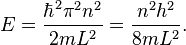
The particle in a one-dimensional potential energy box is the most simple example where restraints lead to the quantization of energy levels. The box is defined as having zero potential energy everywhere inside a certain region, and infinite potential energy everywhere outside' that region. For the one-dimensional case in the  direction, the time-independent Schrödinger equation can be written as:[54]


 as the energy for the state
 , which in this case coincides with the kinetic energy of the particle.
The general solutions of the Schrödinger equation for the particle in a box are:





Finite potential well[edit]
Main article: Finite potential well
This is the generalization of the infinite potential well problem to potential wells of finite depth.Harmonic oscillator[edit]
Main article: Quantum harmonic oscillator




 .
See also[edit]

- Angular momentum diagrams (quantum mechanics)
- EPR paradox
- Fractional quantum mechanics
- Macroscopic quantum phenomena
- Phase space formulation
- Spherical basis
Notes[edit]
- ^ The angular momentum of an unbound electron, in contrast, is not quantized.
- ^ van Hove, Leon (1958). "Von Neumann's contributions to quantum mechanics" (PDF). Bulletin of the American Mathematical Society 64: Part2:95–99.
- ^ Max Born & Emil Wolf, Principles of Optics, 1999, Cambridge University Press
- ^ Mehra, J.; Rechenberg, H. (1982). The historical development of quantum theory. New York: Springer-Verlag. ISBN 0387906428.
- ^ http://www.ias.ac.in/resonance/December2010/p1056-1059.pdf
- ^ Kuhn, T. S. (1978). Black-body theory and the quantum discontinuity 1894-1912. Oxford: Clarendon Press. ISBN 0195023838.
- ^ Einstein, A. (1905). "Über einen die Erzeugung und Verwandlung des Lichtes betreffenden heuristischen Gesichtspunkt" [On a heuristic point of view concerning the production and transformation of light]. Annalen der Physik 17 (6): 132–148. Bibcode:1905AnP...322..132E. doi:10.1002/andp.19053220607. Reprinted in The collected papers of Albert Einstein, John Stachel, editor, Princeton University Press, 1989, Vol. 2, pp. 149-166, in German; see also Einstein's early work on the quantum hypothesis, ibid. pp. 134-148.
- ^ "Quantum interference of large organic molecules". Nature.com. Retrieved April 20, 2013.
- ^ "Quantum - Definition and More from the Free Merriam-Webster Dictionary". Merriam-webster.com. Retrieved 2012-08-18.
- ^ http://mooni.fccj.org/~ethall/quantum/quant.htm
- ^ Compare the list of conferences presented here
- ^ Oocities.com at the Wayback Machine (archived October 26, 2009)[dead link]
- ^ P.A.M. Dirac, The Principles of Quantum Mechanics, Clarendon Press, Oxford, 1930.
- ^ D. Hilbert Lectures on Quantum Theory, 1915-1927
- ^ J. von Neumann, Mathematische Grundlagen der Quantenmechanik, Springer, Berlin, 1932 (English translation: Mathematical Foundations of Quantum Mechanics, Princeton University Press, 1955).
- ^ H.Weyl "The Theory of Groups and Quantum Mechanics", 1931 (original title:"Gruppentheorie una Quantenmechanik").
- ^ Greiner, Walter; Müller, Berndt (1994). Quantum Mechanics Symmetries, Second edition. Springer-Verlag. p. 52. ISBN 3-540-58080-8., Chapter 1, p. 52
- ^ "Heisenberg - Quantum Mechanics, 1925-1927: The Uncertainty Relations". Aip.org. Retrieved 2012-08-18.
- ^ a b Greenstein, George; Zajonc, Arthur (2006). The Quantum Challenge: Modern Research on the Foundations of Quantum Mechanics, Second edition. Jones and Bartlett Publishers, Inc. p. 215. ISBN 0-7637-2470-X., Chapter 8, p. 215
- ^ "[Abstract] Visualization of Uncertain Particle Movement". Actapress.com. Retrieved 2012-08-18.
- ^ Hirshleifer, Jack (2001). The Dark Side of the Force: Economic Foundations of Conflict Theory. Campbridge University Press. p. 265. ISBN 0-521-80412-4., Chapter , p.
- ^ Dict.cc
De.pons.eu - ^ "Topics: Wave-Function Collapse". Phy.olemiss.edu. 2012-07-27. Retrieved 2012-08-18.
- ^ "Collapse of the wave-function". Farside.ph.utexas.edu. Retrieved 2012-08-18.
- ^ "Determinism and Naive Realism : philosophy". Reddit.com. 2009-06-01. Retrieved 2012-08-18.
- ^ Michael Trott. "Time-Evolution of a Wavepacket in a Square Well — Wolfram Demonstrations Project". Demonstrations.wolfram.com. Retrieved 2010-10-15.
- ^ Michael Trott. "Time Evolution of a Wavepacket In a Square Well". Demonstrations.wolfram.com. Retrieved 2010-10-15.
- ^ Mathews, Piravonu Mathews; Venkatesan, K. (1976). A Textbook of Quantum Mechanics. Tata McGraw-Hill. p. 36. ISBN 0-07-096510-2., Chapter 2, p. 36
- ^ "Wave Functions and the Schrödinger Equation" (PDF). Retrieved 2010-10-15.[dead link]
- ^ "Quantum Physics: Werner Heisenberg Uncertainty Principle of Quantum Mechanics. Werner Heisenberg Biography". Spaceandmotion.com. 1976-02-01. Retrieved 2012-08-18.
- ^ http://th-www.if.uj.edu.pl/acta/vol19/pdf/v19p0683.pdf
- ^ Nancy Thorndike Greenspan, "The End of the Certain World: The Life and Science of Max Born" (Basic Books, 2005), pp. 124-8 and 285-6.
- ^ http://ocw.usu.edu/physics/classical-mechanics/pdf_lectures/06.pdf
- ^ "The Nobel Prize in Physics 1979". Nobel Foundation. Retrieved 2010-02-16.
- ^ Carl M. Bender, Daniel W. Hook, Karta Kooner (2009-12-31). "Complex Elliptic Pendulum". arXiv:1001.0131 [hep-th].
- ^ "Quantum mechanics course iwhatisquantummechanics". Scribd.com. 2008-09-14. Retrieved 2012-08-18.
- ^ "Between classical and quantum�" (PDF). Retrieved 2012-08-19.
- ^ "Atomic Properties". Academic.brooklyn.cuny.edu. Retrieved 2012-08-18.
- ^ http://assets.cambridge.org/97805218/29526/excerpt/9780521829526_excerpt.pdf
- ^ "There is as yet no logically consistent and complete relativistic quantum field theory.", p. 4. — V. B. Berestetskii, E. M. Lifshitz, L P Pitaevskii (1971). J. B. Sykes, J. S. Bell (translators). Relativistic Quantum Theory 4, part I. Course of Theoretical Physics (Landau and Lifshitz) ISBN 0-08-016025-5
- ^ Stephen Hawking; Gödel and the end of physics
- ^ "Life on the lattice: The most accurate theory we have". Latticeqcd.blogspot.com. 2005-06-03. Retrieved 2010-10-15.
- ^ Parker, B. (1993). Overcoming some of the problems. pp. 259–279.
- ^ The Character of Physical Law (1965) Ch. 6; also quoted in The New Quantum Universe (2003), by Tony Hey and Patrick Walters
- ^ "Action at a Distance in Quantum Mechanics (Stanford Encyclopedia of Philosophy)". Plato.stanford.edu. 2007-01-26. Retrieved 2012-08-18.
- ^ "Everett's Relative-State Formulation of Quantum Mechanics (Stanford Encyclopedia of Philosophy)". Plato.stanford.edu. Retrieved 2012-08-18.
- ^ The Transactional Interpretation of Quantum Mechanics by John Cramer. Reviews of Modern Physics 58, 647-688, July (1986)
- ^ See, for example, the Feynman Lectures on Physics for some of the technological applications which use quantum mechanics, e.g., transistors (vol III, pp. 14-11 ff), integrated circuits, which are follow-on technology in solid-state physics (vol II, pp. 8-6), and lasers (vol III, pp. 9-13).
- ^ Introduction to Quantum Mechanics with Applications to Chemistry - Linus Pauling, E. Bright Wilson. Books.google.com. 1985-03-01. ISBN 9780486648712. Retrieved 2012-08-18.
- ^ Anderson, Mark (2009-01-13). "Is Quantum Mechanics Controlling Your Thoughts? | Subatomic Particles". DISCOVER Magazine. Retrieved 2012-08-18.
- ^ "Quantum mechanics boosts photosynthesis". physicsworld.com. Retrieved 2010-10-23.
- ^ Davies, P. C. W.; Betts, David S. (1984). Quantum Mechanics, Second edition. Chapman and Hall. p. 79. ISBN 0-7487-4446-0., Chapter 6, p. 79
- ^ Baofu, Peter (2007-12-31). The Future of Complexity: Conceiving a Better Way to Understand Order and Chaos. Books.google.com. ISBN 9789812708991. Retrieved 2012-08-18.
- ^ Derivation of particle in a box, chemistry.tidalswan.com
References[edit]
The following titles, all by working physicists, attempt to communicate quantum theory to lay people, using a minimum of technical apparatus.
- Malin, Shimon (2012). Nature Loves to Hide: Quantum Physics and the Nature of Reality, a Western Perspective (Revised ed.). World Scientific. ISBN 978-981-4324-57-1.
- Chester, Marvin (1987) Primer of Quantum Mechanics. John Wiley. ISBN 0-486-42878-8
- Richard Feynman, 1985. QED: The Strange Theory of Light and Matter, Princeton University Press. ISBN 0-691-08388-6. Four elementary lectures on quantum electrodynamics and quantum field theory, yet containing many insights for the expert.
- Ghirardi, GianCarlo, 2004. Sneaking a Look at God's Cards, Gerald Malsbary, trans. Princeton Univ. Press. The most technical of the works cited here. Passages using algebra, trigonometry, and bra-ket notation can be passed over on a first reading.
- N. David Mermin, 1990, "Spooky actions at a distance: mysteries of the QT" in his Boojums all the way through. Cambridge University Press: 110-76.
- Victor Stenger, 2000. Timeless Reality: Symmetry, Simplicity, and Multiple Universes. Buffalo NY: Prometheus Books. Chpts. 5-8. Includes cosmological and philosophical considerations.
- Bryce DeWitt, R. Neill Graham, eds., 1973. The Many-Worlds Interpretation of Quantum Mechanics, Princeton Series in Physics, Princeton University Press. ISBN 0-691-08131-X
- Dirac, P. A. M. (1930). The Principles of Quantum Mechanics. ISBN 0-19-852011-5. The beginning chapters make up a very clear and comprehensible introduction.
- Hugh Everett, 1957, "Relative State Formulation of Quantum Mechanics," Reviews of Modern Physics 29: 454-62.
- Feynman, Richard P.; Leighton, Robert B.; Sands, Matthew (1965). The Feynman Lectures on Physics 1–3. Addison-Wesley. ISBN 0-7382-0008-5.
- Griffiths, David J. (2004). Introduction to Quantum Mechanics (2nd ed.). Prentice Hall. ISBN 0-13-111892-7. OCLC 40251748. A standard undergraduate text.
- Max Jammer, 1966. The Conceptual Development of Quantum Mechanics. McGraw Hill.
- Hagen Kleinert, 2004. Path Integrals in Quantum Mechanics, Statistics, Polymer Physics, and Financial Markets, 3rd ed. Singapore: World Scientific. Draft of 4th edition.
- Gunther Ludwig, 1968. Wave Mechanics. London: Pergamon Press. ISBN 0-08-203204-1
- George Mackey (2004). The mathematical foundations of quantum mechanics. Dover Publications. ISBN 0-486-43517-2.
- Albert Messiah, 1966. Quantum Mechanics (Vol. I), English translation from French by G. M. Temmer. North Holland, John Wiley & Sons. Cf. chpt. IV, section III.
- Omnès, Roland (1999). Understanding Quantum Mechanics. Princeton University Press. ISBN 0-691-00435-8. OCLC 39849482.
- Scerri, Eric R., 2006. The Periodic Table: Its Story and Its Significance. Oxford University Press. Considers the extent to which chemistry and the periodic system have been reduced to quantum mechanics. ISBN 0-19-530573-6
- Transnational College of Lex (1996). What is Quantum Mechanics? A Physics Adventure. Language Research Foundation, Boston. ISBN 0-9643504-1-6. OCLC 34661512.
- von Neumann, John (1955). Mathematical Foundations of Quantum Mechanics. Princeton University Press. ISBN 0-691-02893-1.
- Hermann Weyl, 1950. The Theory of Groups and Quantum Mechanics, Dover Publications.
- D. Greenberger, K. Hentschel, F. Weinert, eds., 2009. Compendium of quantum physics, Concepts, experiments, history and philosophy, Springer-Verlag, Berlin, Heidelberg.
Further reading[edit]
- Bernstein, Jeremy (2009). Quantum Leaps. Cambridge, Massachusetts: Belknap Press of Harvard University Press. ISBN 978-0-674-03541-6.
- Müller-Kirsten, H. J. W. (2012). Introduction to Quantum Mechanics: Schrödinger Equation and Path Integral (2nd ed.). World Scientific. ISBN 978-981-4397-74-2.
- Bohm, David (1989). Quantum Theory. Dover Publications. ISBN 0-486-65969-0.
- Eisberg, Robert; Resnick, Robert (1985). Quantum Physics of Atoms, Molecules, Solids, Nuclei, and Particles (2nd ed.). Wiley. ISBN 0-471-87373-X.
- Liboff, Richard L. (2002). Introductory Quantum Mechanics. Addison-Wesley. ISBN 0-8053-8714-5.
- Merzbacher, Eugen (1998). Quantum Mechanics. Wiley, John & Sons, Inc. ISBN 0-471-88702-1.
- Sakurai, J. J. (1994). Modern Quantum Mechanics. Addison Wesley. ISBN 0-201-53929-2.
- Shankar, R. (1994). Principles of Quantum Mechanics. Springer. ISBN 0-306-44790-8.
- Cox, Brian; Forshaw, Jeff (2011). The Quantum Universe: Everything That Can Happen Does Happen. Allen Lane. ISBN 1-84614-432-9.
External links[edit]
| Find more about Quantum mechanics at Wikipedia's sister projects | |
 | Definitions and translations from Wiktionary |
 | Media from Commons |
 | Learning resources from Wikiversity |
 | News stories from Wikinews |
 | Quotations from Wikiquote |
 | Source texts from Wikisource |
 | Textbooks from Wikibooks |
- 3D animations, applications and research for basic quantum effects (animations also available in commons.wikimedia.org (Université paris Sud)
- Quantum Cook Book by R. Shankar, Open Yale PHYS 201 material (4pp)
- A foundation approach to quantum Theory that does not rely on wave-particle duality.
- The Modern Revolution in Physics - an online textbook.
- J. O'Connor and E. F. Robertson: A history of quantum mechanics.
- Introduction to Quantum Theory at Quantiki.
- Quantum Physics Made Relatively Simple: three video lectures by Hans Bethe
- H is for h-bar.
- Quantum Mechanics Books Collection: Collection of free books
- Course material
- Doron Cohen: Lecture notes in Quantum Mechanics (comprehensive, with advanced topics).
- MIT OpenCourseWare: Chemistry.
- MIT OpenCourseWare: Physics. See 8.04
- Stanford Continuing Education PHY 25: Quantum Mechanics by Leonard Susskind, see course description Fall 2007
- 5½ Examples in Quantum Mechanics
- Imperial College Quantum Mechanics Course.
- Spark Notes - Quantum Physics.
- Quantum Physics Online : interactive introduction to quantum mechanics (RS applets).
- Experiments to the foundations of quantum physics with single photons.
- AQME : Advancing Quantum Mechanics for Engineers — by T.Barzso, D.Vasileska and G.Klimeck online learning resource with simulation tools on nanohub
- Quantum Mechanics by Martin Plenio
- Quantum Mechanics by Richard Fitzpatrick
- Online course on Quantum Transport
- FAQs
- Media
- PHYS 201: Fundamentals of Physics II by Ramamurti Shankar, Open Yale Course
- Lectures on Quantum Mechanics by Leonard Susskind
- Everything you wanted to know about the quantum world — archive of articles from New Scientist.
- Quantum Physics Research from Science Daily
- Overbye, Dennis (December 27, 2005). "Quantum Trickery: Testing Einstein's Strangest Theory". The New York Times. Retrieved April 12, 2010.
- Audio: Astronomy Cast Quantum Mechanics — June 2009. Fraser Cain interviews Pamela L. Gay.
- Philosophy
- "Quantum Mechanics" entry by Jenann Ismael in the Stanford Encyclopedia of Philosophy
- "Measurement in Quantum Theory" entry by Henry Krips in the Stanford Encyclopedia of Philosophy
Subscribe to:
Posts (Atom)
"Scientific Mysticism" of Michael Whiteman
The previous post gave reference to the book below by an academic. It is similiar but not identical to the ideas of my paradigm known as ...

-
Jeffrey Mishlove, PhD Contents INTRODUCTION Dedication Acknowledgments and Permissions Introducti...
-
From Wikipedia, the free encyclopedia Jump to: navigation , search This article needs additional citations for ve...
-
From Wikipedia, the free encyclopedia Blogger Ref Link http://www.p2pfoundation.net/Multi-Dimensional_Science Jump to: navigation...

