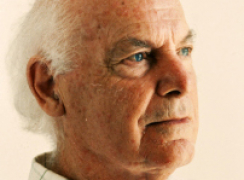
Interview with esteemed Berkeley philosopher and consciousness researcher Dr. John Searle examines the state of academic consciousness research.

Alex Tsakiris: What we’ve been exploring is some of the evidence suggesting that consciousness may not be purely biological. We really started with parapsychology and folks like Rupert Sheldrake from Cambridge and Dean Radin who used to be at Bell Labs and is at IONS. But put all that aside because the real kicker is near-death experience science. Here are these doctors, in hospital, carefully controlled experiments over and over again, and the brain you’re talking about, Dr. Searle, is gone. It’s non-functioning; it isn’t there; and yet some kind of conscious experience that’s able to see and recall what’s going on continues.
That evidence is pretty overwhelming at this point. What do you do with that? How does that fit into your model?
Dr. John Searle: I don’t know. The stuff that I know about this tends to be rather anecdotal. Now maybe there is some really systematic, large-scale study of near-death experience that shows you can have consciousness without a brain but I don’t know of any such study. What I’ve heard is largely anecdotal.
The mistake that people tend to make is they think, look, either these people are lying or there’s a miracle. Of course, both of those are probably wrong. People are perfectly sincere who report near-death experiences but it doesn’t follow that you can have consciousness completely separated from the brain; that this miracle is actually taking place. I’d have to know a whole lot more about it and see more systematic studies, as I said. The accounts that I’ve heard tend to be anecdotal. They tell a story about a guy who has had some unusual experiences.
Alex Tsakiris: There is actually a lot of published work on this. The best compilation is probably The Handbook of Near-Death Experiences edited by Jan Holden at the University of North Texas and Bruce Greyson at the University of Virginia, who is very well-known in this area.
Dr. John Searle: I don’t know enough about this stuff to have an intelligent opinion. Of course, it might turn out that 100 years from now we’ll have this conversation in heaven or in my case more likely the other place. The idea that you have to have a brain in order to be conscious, that’s a kind of silly idea people had back in the 21st Century. It might turn out that way; I don’t think it will.
———-
On today’s episode I have an interview with Dr. John Searle. Now, before we get to the interview I want to tee up a question for you. As you know, I usually do this at the end of the show, but since the question relates to the quote you just heard, and since the question relates to something else I want to talk about I’m going throw it out there now — How do you explain Dr. John Searle’s willful ignorance of near-death experience science? Moreover, why is he so clueless about parapsychology? And most importantly, why does he think it’s ok to summarily dismiss all evidence pointing to any model of consciousness other than his hopelessly obsolete mind=brain clunker.
Let’s consider near-death experience science since it’s the most dramatic example of science that delivers an evidence-based kill-shot to the mind=brain carcass. How can a highly acclaimed, internationally renown expert on consciousness, who gives TED talks and is invited to scholarly symposiums on consciousness, how can that guy be less informed about the published peer-reviewed literature than your average Oprah Winfrey fan? It’s not like he doesn’t understand what’s at stake. As you’ll hear, he agrees the survival of consciousness question is central to all other scientific assumptions about consciousness. So why is Dr. Searle shamelessly, unapologeticly ignorant of this science? Well, that’s the other thing I wanted to talk about before we get to this interview — science bullies.
Back in March of 2013, Robert McLuhan published an article on the organized effort of Skeptics/Atheists to rig Wikipedia (Guerrilla Skeptics). By organizing themselves into a tight-knit team and dedicating themselves to making literally thousands rule-bending Wikipedia changes, these self-described Guerrilla Skeptics have had remarkable success. For example, Parapsychology is a lost cause on Wikipedia. It’s absolutely impossible to get anything close to a “neutral point of view” from Wikipedia on any parapsychology topic. If you don’t know what I mean, and you have a strong stomach, go to Wikipedia see for yourself. If you’re a listener to Skeptiko, and you have a really strong stomach, search “psychic detective.” Now, if you are appropriately outraged, and have a strong masochistic streak, enter Wikipedia as an editor and try and straighten out one of those pages. I mean, you’re supposed to be able to do that, right? Wikipedia is an open-source encyclopedia. Anyone with knowledge of the subject is supposed to be able to edit, right? But before you try and fix things over at Wikipedia read this blog post from Craig Weiler titled, The Wikipedia Battle for Rupert Sheldrake’s Biography. And then take a look at Dr. Rupert Sheldrake’s article on the same topic (Wikipedia Under Attack).
As a listener of this show, none of this is new to you. You know the dogmatic craziness of these fundamentalist Skeptic/Atheist groups can rival any religious cult, but you might be surprised at the zeal with which these group are going after science. Rupert Sheldrake after all isn’t a bible-thumper. He’s not a creationist. He hasn’t taken a stand against, “a woman’s right to choose”, or called for a ban on gay marriage. No, he’s a Cambridge biologist who wrote a book about Dogs that Know When Their Owner’s are Coming Home. And followed it up with a book about how science might want to be a little less dogmatic about defending the materialistic status quo. There are many highly esteemed scientists who think Sheldrake’s ideas are brilliant and admire his willingness stand up to the attacks he’s had to endure, but none of that matters to the science bullies.
The biggest problem is not Guerrilla Skeptics on Wikipedia, or iTunes, or Reddit or any of the places these folks go to try and heal their meaningless-by-definition lives (Atheist dogma, see: ep. 219, ep. 221). The problem is the impact they have on Dr. John Searle. Because you see, Berkley Philosophy professor, Dr. John Searle is not a professional Skeptic. He’s not a fire-breathing, you-are-a-biological-robot Atheist. In fact, within the mainstream science community he’s seen as a progressive because he’s willing to reject the silliness of the “conciseness is an illusion” nonsense that still grips many die-hard materialists. But when it comes to the tough stuff, the stuff that would truly set science free from the materialistic/reductionistic/atheistic dogma that cripples it, Searle is willfully ignorant. Is it an ignorance borne out of a chummy academic life and a long list of accomplishments? Perhaps. But I think this ignorance is also a byproduct of a materialistic science culture that has been traumatized into complacency by Skeptical Bullies who push, shove, and spit insults any free-thinking academic who dares to challenge their status quo. It’s not that Searle is playing to the Skeptics; he’s unwittingly absorbed their eyes-wide-shut worldview into his own without forethought or deliberation… and that’s the greatest threat to science.
So, let’s hear from Dr. John Searle. It’s a short interview, mainly because I ran out of things to say to someone who thinks parapsychology died with J. B. Rhine in 1980 (continued below).
Play It
Listen Now:
Download MP3 (34 min.)
Read It:
Today we welcome esteemed Berkeley philosophy professor, Dr. John Searle to Skeptiko. Dr. Searle has a worldwide reputation for his acclaimed work on the philosophy of mind and language. He’s the author of over a dozen books and hundreds of articles and papers exploring issues of consciousness and mind/body mysteries.
Dr. Searle, welcome to Skeptiko. Thanks so much for joining me.
Dr. John Searle: Thanks for having me.
Alex Tsakiris: First off, Dr. Searle, do you still teach “Philosophy 132, Philosophy of Mind” at Berkeley?
Dr. John Searle: Absolutely. In fact, I’m just starting a new semester. I teach fulltime and after I get through talking with you I’m going to meet my teaching graduate student teaching assistants/instructors. I’ve got a big class so I’m going to have at least 150 people in the class.
Alex Tsakiris: I think it’s fantastic that a kid can still go to a public university in California and walk into a class and there’s a Rhodes Scholar Ph.D. from Oxford teaching the class. I mean, that’s kind of rare these days. That’s really great.
On this show, Skeptiko, we’ve been banging away at this issue of consciousness and the nature of consciousness for quite some time. This is right up your alley. Let me start with a two-part question, if I could. First off, for those folks who don’t know, you were probably one of the first prominent academics to publicly take a stand on this consciousness is an illusion silliness, if you will. So the first question is are we past that? Are we past consciousness is an illusion?
The second part that I want to throw in there before you respond is why the heck did it take so long? It seems pretty obvious to most people that consciousness isn’t an illusion. What’s the answer?
Dr. John Searle: Okay, I don’t think we’re past it. The reason is that there is this tradition that says if consciousness exists it couldn’t be part of the physical world. But the physical world’s the only world there is so consciousness doesn’t exist; it’s an illusion. Now, I think that’s a silly argument but that’s the way that it goes. There’s a history behind this and the history is that the people who talked about consciousness often were people who did it for some religious reason. That is, they thought consciousness was part of God, the soul, and immortality.
If the only world that exists is the world described by physics and other natural sciences, then it looks like consciousness cannot exist. I think those views are silly. Consciousness is a biological phenomenon. It’s as real as any other biological phenomenon. However, it is distinctive in that the way that you show that something is an illusion won’t work for consciousness. We can show that rainbows and sunsets are an illusion because there’s a distinction between how things seem to you and how they really are. It seems like there’s an arch in the sky, the rainbow, but it isn’t really. It’s just an illusion.
But where consciousness is concerned, where the very existence of consciousness is concerned, you can’t make that distinction. You can’t make the distinction between it consciously seeming to you that you are conscious and whether or not you really are conscious because if it consciously seems to you that you’re conscious, then you are conscious.
So really, there are two parts to the answer to this. One is there’s a traditional confusion that suggests that if consciousness really exists it can’t be part of the real, physical world and I’m saying, “Of course it is. It’s a biological phenomenon like digestion or photosynthesis.”
Then there’s another confusion whereby people fail to see that you can’t make the illusion/reality distinction for the very existence of consciousness. I thought I’d wiped out these mistakes 20 or 30 years ago but they keep coming up again. I think it’s going to keep up for quite a while because we don’t yet have a thorough account of how the brain causes consciousness and until we do that, there are always going to be people who think it’s not part of the physical world.
Alex Tsakiris: Okay, but don’t you think that this is partially responsible for the public distrust of science to a certain extent? Let me go with this for a minute. When we hear prominent philosophers, but more importantly prominent scientists, neuroscientists, brain scientists, promoting this idea and then people look back and when they really think about it they go, “Wait a minute. This not only defies common sense but it’s completely at odds with almost every aspect of our society—our legal system, our political system.”
Not to mention science and medicine is built on the idea that you are a conscious being and that your decisions make a difference. You can decide; you have free will. I don’t want to get too far into that whole thing but it’s woven completely into our society. Don’t you think that contributes for this underlying sense of distrust that a lot of people have for science?
Dr. John Searle: Well, I think it does contribute. I think that the leading intellectual problem in philosophy at least, and maybe the leading problem overall is how do we give an account of our human reality of consciousness? We think we have free will, a mental life. We have a society and aesthetics. How do we give an account of that that shows that it’s a part of physical and chemical reality?
So far we haven’t succeeded in doing that and people aren’t willing to give up on the common sense conception of life. So sometimes this gives them an anti-scientific attitude. I don’t think it happens among professional intellectuals. I doubt if there’s much of that in the better universities. But certainly politically there’s a mistrust of science and a feeling that our human reality is being denied by science. I think that’s a terrible mistake.
I think what we’ve got to do, and this is one of the main tasks of philosophy, is to give an account that shows that the human reality is not only consistent with scientific reality; it’s a natural consequence of it. Once you’ve got electrons and protons and neutrons and sub-atomic particles, then it’s just a matter of time and random recombination until evolution gives you life, consciousness, ethics, society, and all the rest of it.
Alex Tsakiris: Now that’s something that you’ve put forward both here a couple of times about consciousness being biological, consciousness being an evolutionary phenomena in the physical world and all that. I’ve also heard quotes from you and I want to clarify on this, that you’re open to the possibility that consciousness is somehow fundamental and that our physical reality is somehow, in some way we can’t fully understand or explain, a phenomena of consciousness. Any thoughts on that?
Dr. John Searle: I think it’s very unlikely. Of course, it might turn out that consciousness is one of the basic features of reality but as far as we know anything about how it actually works, consciousness only exists in human and animal brains. And not even all animals but in human and some animal brains. But other than that there are no known cases of consciousness. Plants aren’t conscious; mountains and rivers and waterfalls and planets are not conscious.
We have to assume that consciousness exists in the universe outside our little Earth because we’re only one. Our little solar system’s only one star of 100 billion stars in our galaxy, and our galaxy is only one of 100 billion galaxies. So we have to assume that we’re not the only place in the universe that has life and consciousness. But we don’t know about the other place. Maybe they’re totally unlike what we have.
Alex Tsakiris: I think even that statement that you just made would draw a lot of controversy from some folks who say, “How do we know plants aren’t conscious? How do we know cells aren’t conscious? How do we know our DNA isn’t conscious?”
Dr. John Searle: If you take an amoeba, why isn’t it conscious? Well, it hasn’t got the right kind of machinery. Of course I don’t know.
Alex Tsakiris: But that presupposes something we don’t know. That is what is the nature of consciousness? How does consciousness arise? When does consciousness begin and when does it end? It’s kind of a loop.
Dr. John Searle: I can’t prove to you that my shoes are not conscious. Maybe they’re thinking, I wish this bastard wouldn’t walk on me all day long. I can’t prove that they’re not conscious. It’s just not a serious hypothesis. We know that consciousness exists in certain rather specific parts of the world and shoes and ships and ceiling wax and mountains and molecules and tectonic plates just don’t have the right kind of machinery to be conscious. Of course, I can’t prove to you that my shoes aren’t conscious but it’s not a serious hypothesis. It’s not something I think, oh boy, we ought to get busy and make sure that we prove that shoes are conscious. It’s just not serious.
Alex Tsakiris: I think the hard part there is where we draw the line in terms of seriousness. Plants, there’s been some interesting research for a long time suggesting that plants react to people and certain situations or there’s some kind of field effect that we don’t understand. But before we even…
Dr. John Searle: Plants have all kinds of sensitivities and reactions but I don’t really think for a moment that the grass under my feet is thinking, gosh, this is terrible the way this guy keeps walking on us. And that awful lawn mower that he runs over us. Of course I can’t prove that the grass isn’t conscious but again, it’s not something that’s worth worrying about.
Alex Tsakiris: Okay. Let’s move on to some topics that are worth worrying about and would violate this notion that consciousness is purely biological and maybe would push us in the other direction that consciousness is somehow fundamental. Let me go through a couple of these and tell me if you think they have any potential to violate or challenge that in any way.
I’ll start with hypnosis. Does hypnosis in any way violate the idea that consciousness is purely biological and the mind is not an active agent that can do anything?
Dr. John Searle: Well, not as far as I know anything about hypnosis. What you do is you get people who are susceptible to certain kinds of suggestions and they tend to be rather cooperative and they’ll go along with what the hypnotist suggests. I’m not sure everybody can be hypnotized. I’m not sure I could be hypnotized. I’m naturally very resistant to anything like that. But hypnosis definitely exists and it exists like all forms of consciousness in human brains. I think we ought to study it more. I think it’s a phenomenon that’s worthy of more curiosity than I have given it.
Alex Tsakiris: So let me just be clear as I go through this little laundry list here. You’re of the opinion that consciousness is ontologically distinct from the brain? Yes or no. Is consciousness different and can act differently? Then I think you could fit hypnosis into that category. Hey, there’s this thing called consciousness we don’t understand. It works differently and it can cause blisters on your hand and do all this stuff that you may not be consciously aware of but it’s doing it.
Dr. John Searle: Consciousness is a feature of the brain. It is a feature of the brain that’s caused by the behavior of lower-level elements, neurons as far as we know. It’s realized in the brain as a higher level feature. An analogy I like to use is water. Liquidity is not an extra juice squirted out by the water. It’s just a condition that the system is in when the molecules are behaving in a certain way. Get the molecules to slow down and it stops being liquid. It becomes ice.
But the solidity and the liquidity are not separate things. They’re features of the whole system in the same way my brain goes from consciousness to unconsciousness when I fall asleep and then it becomes conscious again. But the consciousness and the unconsciousness are not separate entities; they are features of the brain. They are conditions or states that the brain is in. So roughly speaking, consciousness is to the brain as liquidity is to water. The system can go from being liquid to being solid the same way that the conscious brain can go from being conscious to being unconscious.
Alex Tsakiris: Okay. I get that. I hear that. What we’ve been exploring is some of the evidence that suggests that maybe that’s not true. We really started with parapsychology and folks like Rupert Sheldrake from Cambridge or Dean Radin who used to be at Bell Labs and is at INS and all these precognition experiments and telepathy experiments that are highly suggestive that’s going on.
But put all that aside because the real kicker that we run across and keep pounding on because it just won’t go away, is near-death experience science. Here are these doctors in hospital, carefully controlled experiments over and over again. The brain, which you’re talking about, Dr. Searle, is gone. It’s non-functioning; it isn’t there and yet some kind of conscious experience that’s able to be recalled and see what’s going on continues.
That evidence is pretty overwhelming at this point. What do you do with that? How does that fit into it?
Dr. John Searle: I don’t know. The stuff that I know about this tends to be rather anecdotal. Now maybe there is some really systematic, large-scale study of near-death experience that shows you can have consciousness without a brain but I don’t know of any such study. What I’ve heard is largely anecdotal.
The mistake that people tend to make is they think, look, either these people are lying or there’s a miracle. Of course, both of those are probably wrong. People are perfectly sincere who report near-death experiences but it doesn’t follow that you can have consciousness completely separated from the brain; that this miracle is actually taking place. I’d have to know a whole lot more about it and see more systematic studies, as I said. The accounts that I’ve heard tend to be anecdotal. They tell a story about a guy who has had some unusual experiences.
Alex Tsakiris: There is a lot of published work on this. The best compilation is probably The Handbook of Near-Death Experiences edited by Jan Holden at the University of North Texas and Bruce Greyson at the University of Virginia who is very well-known in this area. I’ll just give you a taste for what they’ve done.
I think one of the simplest and most convincing experiments is in hospital, in cardiac arrest ward; they take people who have a cardiac arrest. They die; they’re resuscitated and then they interview these people. They say, “Okay, tell us about your resuscitation.” They have a control group of people that didn’t claim to have a near-death experience. Then they have their study group of people who did have a near-death experience.
They compare and it’s a pretty simple protocol. They compare the amount of hits they get in recounting their resuscitation when they were dead and didn’t have a brain compared to the control group who didn’t report an NDE with the group that did have an NDE. There’s a significant difference. That experiment’s been repeated over and over again and published in peer-reviewed journals…
Dr. John Searle: They didn’t have a brain. What does that mean? My impression is these people are in the hospital and they’re lying there on a hospital bed.
Alex Tsakiris: This is during the resuscitation. They’re asking them to recall their experience during resuscitation. As you know, within 10 to 15 seconds after you have cardiac arrest, your EEG is flat. That’s just the way that it is.
A prominent cardiologist in the Netherlands, Dr. Pim van Lommel, who’s published in The Lancet about this, he will tell anyone that in the modern hospital resuscitation doesn’t begin until at least a minute after that cardiac arrest has happened. There’s no brain function during resuscitation that we know of.
Dr. John Searle: I don’t know enough about this stuff to have an intelligent opinion. Of course, it might turn out that 100 years from now we’ll have this conversation in heaven or in my case more likely the other place. The idea that you have to have a brain in order to be conscious, that’s a kind of silly idea people had back in the 21st Century. It might turn out that way; I don’t think it will.
I think you’ve got to have a brain or some equivalent mechanism. We don’t know how to create consciousness artificially but I don’t see any obstacle theoretically to doing it. If the brain can do it you might be able to do it with some other kind of mechanism. But the idea that it could just so-to-speak float around freely without being realized in anything, that does not seem to be a very serious possibility.
Alex Tsakiris: Yeah. I’m always reluctant to go too far with what it might be or how it might work. I just approach it from the standpoint of can we falsify the existing hypothesis that it is biological? I don’t know. There are a lot of people on that side of the fence.
Dr. John Searle: I think there is an audience for some of this stuff but the stuff that I’ve seen, press accounts and so on, tend to be rather anecdotal and not systematic science.
Incidentally, we keep going through this. You’re not old enough to remember the parapsychology experiments of J.B. Rhine and all those people at Duke. We heard all this over and over that these experiments keep being repeated and they go over and over and it turned out there was really nothing there under a serious examination. Of course, we knew that parapsychology would become resuscitated. I don’t hear much about Rhine anymore and his group but there are other groups.
Alex Tsakiris: Boy, that’s a long tale to pull into this conversation. Why don’t you tell us this to wrap things up? What do you see as the most interesting future research areas that pique your interest in terms of wrestling some of this stuff to the ground?
Dr. John Searle: Okay. To me, the most exciting question in the sciences today, and that’s anywhere in the sciences, is how exactly do brain processes cause consciousness and how exactly is consciousness realized and how does it function in the brain? I woke up this morning and I went from being in a state of unconsciousness to a state of consciousness. What exactly happened in my brain that enabled that to take place?
And then how is it exactly that consciousness, with a specific location, specific biochemical electrical-chemical process in the brain, can then function in such a way as for me to get up, have breakfast, come to the campus, and then engage in this conversation with you? So what exactly is the role of consciousness in our lives and how does it lock into all of these lower-level neurobiological processes that enable it to function?
For example, if I now raise my arm I know I can only raise my arm because the brain is secreting acetylcholine as the templates of the motor neurons and that means that the conscious decision to raise my arm also has a level of description where it’s got neurobiological properties.
What I think is the most fascinating question in the sciences is how the hell does all of that work? How does the brain create consciousness? And then how does the complex system containing a level of description which is conscious and other levels of description which are straightforward chemical and neurobiological and physiological, how does that operate in the behavior of the whole system? Those to me are exciting questions.
Alex Tsakiris: Dr. Searle, you have a number of interesting, well-done videos out there. A TED talk. You have a number of other videos people can find on YouTube. Tell us a little bit about what’s coming for you. Do you have any presentations? I know you’re into the school year so probably not. What’s coming up for you in terms of presentations or books or anything like that?
Dr. John Searle: I’m writing a couple of books. I’m finishing a book on perception and that’s a tough one to do but I’m making progress with that. I think I’ve got some of that figured out. That I should have finished before Christmas.
I’m going to be giving various lectures at various places. I’m giving a lecture in New York at the end of September about the philosophy of language.
Of course, I continue to give lectures on this other question that fascinates me and that is how do we create a reality which exists only because we think it exists? I’m thinking of things like money and property and government and marriage and universities and cocktail parties. How is it that people get together and cooperate and create this very powerful social and institutional reality? Language is crucial. We use language not just to describe reality but language is used to create a social and institutional reality.
So all of those are questions I’m working on.
Alex Tsakiris: Well, it sounds like fascinating and important work. We look forward to seeing it all. It’s been great having you on. Thanks for joining me.
Dr. John Searle: Okay. Great talking to you and I really appreciate it.