Showing posts with label blackmore. Show all posts

Wednesday, 14 May 2025

Illusions of Self and Consciousness Explored With DMT


The strangest, most variable, psychedelic effects.

How are we to use the extraordinary power of psychedelics to help us penetrate the mysteries of consciousness? In our ordinary states of mind, consciousness, self and free will all seem real but in other states they may be revealed as illusions. Then our normal, taken-for-granted, state of consciousness is seen as a state of delusion. Psychedelic experiences can certainly seem profound and meaningful, but do they help us understand the illusion of self and consciousness when we are not in that state?
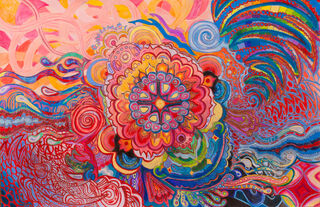
L.Brown - Own work/CC BY-SA 3.0
DMT Idea.
Source: L.Brown - Own work/CC BY-SA 3.0


Do psychedelic experiences provide a way out of delusion into clarity and understanding, or do they just replace one set of delusions with another? We may find ourselves in strange other worlds or discover that we cannot find ourselves at all. We may be transformed into another being: an animal, a plant, a flying spirit, or a disembodied observer. Our body may entirely disappear or the boundaries between self/other and mind/world may dissolve. In this state, the unity of everything seems blatantly obvious, and the hard problem of consciousness appears laughable—no problem at all. Yet, in my experience, this apparent insight into nonduality fades, duality reasserts itself, and I am not left with any kind of theoretical understanding that would sweep the hard problem away.

As an example, think about DMT, dimethyltryptamine. This can be taken in several different ways, on its own or as the main active ingredient in ayahuasca. Its peculiar property is that it is inactivated by the enzyme, monoamine oxidase, MAO, so if you ingest DMT it has almost no effect. Smoking or inhaling its vapour bypasses the enzyme but means a dramatic but very short-lived experience, sometimes said to be like compressing an eight-hour LSD trip into 20 minutes. How then is it possible to drink ayahuasca and have many hours of psychedelic experience? This is because over the centuries in which the peoples of the Amazon developed their shamanic brew, as a teacher and healer, they found many plants, such as psychotria viridis, that combined with the ayahuasca vine, or Banisteriopsis caapi, allow for long-lasting effects. The reason, as we know now, is that these other plants contain MAO inhibitors such as harmine and harmaline.

I have taken DMT using all three different methods of administration—always in very safe and well-prepared circumstances. They produced wildly different consequences. Smoking DMT evoked a brief screaming, colourful world of terror. Drinking ayahuasca produced a multitude of extraordinary, and extraordinarily varied, immersive experiences. Vaporised DMT, with controllable periods of inhalation, produced something different again—a transformation of self with close links to aspects of my 40 years of Zen training.

This one molecule can vary dramatically in its effects, as the art inspired by users beautifully and colourfully reveals. Yet this makes the task of understanding it at the molecular, cellular, or whole brain level especially hard. We know something about changes in EEG, increased disorder, changed connectivity in the default mode network and increased activity in parts of the visual system. There are relationships with dreaming and especially lucid dreaming, but we have hardly begun to work out why the different psychedelics, and the different modes of administration, produce the experiences they do. The recent Tucson conference, "The Science of Consciousness online," included three whole sessions on psychedelics and I spoke about DMT in the ‘Psychedelic Experiences’ plenary.

I like to imagine a future in which psychedelic research, combining experiential accounts with neuroscience, will help us see through our normal illusions and understand the nature of these other worlds of experience.


Wednesday, 31 July 2019

A Series of Short Articles giving a Sceptical Slant on Out-of-Body Experiences and Auras Part 6 / Source Psychology Today

Out-of-Body Experiences: The Psychology of Seeing Auras

Part 6: Kirlian photography, synesthesia, and why some people see auras.

Posted Jul 25, 2019. By Susan Blackmore. Psychology Today (.com) Blog Ref  https://wiki.p2pfoundation.net/Multi-Dimensional_Science


In my previous post, I explored claims that psychics can see a human aura, with experiments showing that the aura is not physically present around people’s bodies.
One final claim worth testing is that auras can be captured with something called Kirlian photography. This method, invented in 1939 by the Russian engineer Semyon Kirlian, involves placing photographic paper or film over a metal plate connected to a high-voltage, high-frequency power supply. With a brief exposure, this method does indeed produce auras surrounding, for example, a finger, a hand or even a coin or a leaf. Superficially the effect does look something like the claimed human aura. 
 
In 1975, before I knew anything about the physics involved, I bought a Kirlian machine and took dozens of pictures, developing them myself in our bathroom ‘darkroom.’ I photographed hands, feet and fingers, insects, leaves and even our cat’s paw but I was gradually disillusioned by what I found. I also learned something about the physics involved. It turns out that the Kirlian effect is produced by the well-understood phenomenon of corona discharge brought on by the ionization of an electrically charged conductor.
The final straw came when I thought to photograph two fingers pointing towards each other. I remembered that when I saw auras after my OBE, I could reach out toward Kevin or Vicki’s hands and their auras would stretch out toward mine. It was a rather nice and friendly feeling and I subsequently discovered that mediums and aura-seers describe a similar effect. But Kirlian photography does not. Place two fingers pointing at each other on the plate and the ‘aura’ of each repels the other – just as would be expected from two negatively charged objects coming together. The corona discharge is not the etheric or astral aura.
 
So what did I see and touch? I am happy to believe that, like all the psychics and mediums tested, I would fail the doorway test. Yet this experience of seeing my own and others’ auras was vivid, as was the sense of feeling it with my hands around Kevin’s body. And I am not alone. In Iceland, 5 percent of the public said they had seen the aura (Haraldsson 1985), and in an American survey, 5 percent of the public and 6 percent of students had (Palmer 1979). In a small study of OBErs, half saw objects as transparent or glowing or with auras around them. So there does seem to be a connection between the OBE and aura-seeing. Again I find I am not alone, but if the aura is not a physically existing emanation around the human body, what is it?
Could it be imagined, even though it appears so realistic? The failure of doorway tests led some researchers to think so (Gissurarson & Gunnarsson ( 1997) and others tried to find out.
Alvarado and Zingrone (1994) at the University of Edinburgh compared 19 aura-seers with a control group who had never seen auras and found they scored higher on both the Vividness of Visual Imagery Questionnaire and the Inventory of Childhood Memories and Imaginings. They more often saw apparitions, had mystical experiences and ‘seeing with eyes closed’ – a strangely interesting experience I shall return to in future posts.
They also had more OBEs. So this confirms a link between OBEs and auras, and gives a clue that imagination is involved but why are auras typically seen as right there in physical space? Tart concluded that an imagined aura with no objective existence was projected beyond the seen body, but how?
One promising idea involves synaesthesia, and some people with synaesthesia do report aura-like experiences (Cytowic 2008). Synaesthesia is a mixing of the senses, in which sounds can become colors or tastes have shapes. Many children experience the world this way but lose the ability with age, leaving some adults with weak synaesthesia and just a few (about 4%) as true synaesthetes. In the most common type of synaesthesia, color-grapheme synaesthesia, one person might see the number 2 as green and 3 as orange, while another sees 2 as blue and 3 as lurid pink. These colors leap out from written text and have been shown to last for decades if not a lifetime (Ramachandran and Hubbard 2001). Could the colors of the aura come about in a similar way? Might the aura-seer look at a person and then intuitively convert their impressions into color?
Some synaesthetes associate colors with human faces and forms but a study of four such people did not find their experiences were like seeing auras (Milán et al 2012). Even so, there are links between auras and synaesthesia.
In their classic study of LSD, a psychedelic drug with a reputation for inducing synaesthesia (Luke & Terhune 2013), Masters and Houston found ‘a fairly common experience where the subject seems to himself to project his consciousness away from his body and then is able to see his body as if he were standing off to one side of it or looking down on it from above.’ Some said they could ‘move about in something like the “astral body” familiar to occultists’ and ‘Some identify this astral body with an “aura” they earlier had perceived as radiating from them, an “energy force field” surrounding the body. The perception of the aura by psychedelic subjects is very common.’ (Masters & Houston 1967 p 86).
Another idea that I have begun exploring is that the bodily shape of the aura is created by a misplaced body schema. In other words, the continuous representation we have of our own body shape is projected onto another person. I shall delve into the nature of the body schema, and the ways in which it can be distorted and exteriorized, when I come back to the science of OBEs. For now, we have at least learned that there really is a link between OBEs and seeing auras, even if we don’t yet understand why.
In my new book, Seeing Myself (Blackmore 2017), I describe auras in more detail and in the next few posts I will delve further into the potential of the human brain.
References
Alvarado, C. S., & Zingrone, N. L. 1994. Individual differences in aura vision: Relationships to visual imagery and imaginative-fantasy experiences. European Journal of Parapsychology, 10, 1-30
Blackmore, S 2017 Seeing Myself: The new science of out-of-body experiences, London, Robinson ISBN-10:1472137361 and 2019, New York
Cytowic, R. E. (2008). The man who tasted shapes. MIT press.
Gissurarson, L.R. and Gunnarsson, A. 1997 An experiment with the alleged human aura. Journal of the American Society for Psychical Research, 91, 33-49
Haraldsson, E. 1985. Representative national surveys of psychic phenomena: Iceland, Great Britain, Sweden, USA and Gallup's multinational survey. Journal of the Society for Psychical Research, 53, 145-158
Luke, D. P., & Terhune, D. B. 2013. The induction of synaesthesia with chemical agents: a systematic review. Frontiers in psychology, 4: 753
Masters, R. E. and Houston, J. 1967 The Varieties of Psychedelic Experience. London, Anthony Blond
Milán, E. G., Iborra, O., Hochel, M., Artacho, M. R., Delgado-Pastor, L. C., Salazar, E., & González-Hernández, A. 2012. Auras in mysticism and synaesthesia: A comparison. Consciousness and cognition, 21(1), 258-268.
Palmer,J. 1979 A community mail survey of psychic experiences Journal of the American Society for Psychical Research 73 221-252
Ramachandran, V. S., & Hubbard, E. M. 2001. Synaesthesia--a window into perception, thought and language. Journal of consciousness studies, 8(12), 3-34.

A Series of Short Articles giving a Sceptical Slant on Out-of-Body Experiences and Auras Part 5/ Source Psychology Today

Out-of-Body Experiences: The Human Aura

Part 5: Do psychics really see an aura around other people?

Posted Jul 18, 2019. Susan Blackmore. Blog Ref  https://wiki.p2pfoundation.net/Multi-Dimensional_Science


I described how my OBE turned into a mystical experience in a previous post and how when I finally got more or less back to normal, I could see or feel auras around myself and my friends. I had heard of the occultist’s aura, the colourful display that psychics claim to see around other people’s bodies, so I assumed this was what I was seeing. But was it?
Psychics claim that the colours they see reveal a person’s personality, their hopes and fears and even their future. The spirit medium, Ursula Roberts, who died (I mean ‘passed over’) in 1996, described auras as like the skins of an onion. The etheric body forms just an outline around the physical, appearing as silvery radiance in the healthy but a dull grey in people who are tired or ill; the astral or psychic aura is larger and colorful; and the even greater spiritual aura is ‘radiated by souls who consciously send out healing, light, and loving thoughts, through...their spiritual will’ (Roberts 1975, 8).
According to Besant (1896) and Leadbeater (1895), clear blues are the colors of spirituality and yellows reveal intellectual development. Pride shows up as bright red while selfishness and depression are various shades of brown.
I recently looked into just one color, yellow, in a variety of books and websites. One site divides yellow into different shades that can mean spiritual inspiration, fear of loss, or latent psychic abilities. Another claims that “Yellow Aura people are analytical, logical and very intelligent.” A Reiki healing site relates yellow to the spleen and ‘life energy’ and, copying some of the previous site word for word, lists so many possible characteristics that any reading becomes meaningless.
Delving more thoroughly into aura colors, psychologist Andrew Neher (2011 p 188-9) found many incompatible claims. For example, the famous psychic Edgar Cayce describes red in the aura as increasing with over-work to the point of nervous breakdown, while Ursula Roberts claims that “the colour of earthly love is red”.
In principle, if auras could reliably be seen, these claims could be tested. For example, aura-seers could record the colors and sizes of the auras of a group of volunteers and then psychologists test the volunteers for personality type, stress, happiness and so on.
IQ is easy to measure, and tests could show whether people with yellow in their auras score higher. If consistencies were found we might be able to tell which psychics were accurate, and even train people to see auras, turning aura-reading into a useful psychological tool.
None of this has happened.
Experimental tests
A different kind of aura test has been damning. This is Charles Tart’s ‘doorway test’ designed to find out whether there is any sense in which auras are actually present in the space around a person’s body.
The idea is very simple. If a psychic can see a person’s aura sticking out around their body then they should be able to see that aura whether or not the body is visible as well. So Tart (1972) suggested the following test, shown in the illustration.
 
First a psychic (let’s call him Jim) is asked whether he can clearly see the aura of a target person (we’ll call her Julie). If he confirms that he can, he stands facing an open doorway while Julie goes through the doorway and stands behind the wall. She then takes up one of two positions: In position (A) she is well away from the edge of the doorway and so neither her physical body nor her aura should be visible to Jim; at position (B) she stands very close to the edge of the doorway, so Jim still cannot see her physical body but he ought to be able to see her aura sticking out past the side of the doorframe.
For a good experiment, Julie should take up each position several times, an experimenter choosing the position randomly so that Jim cannot guess where she is likely to be. All Jim has to do is say whether he sees Julie’s aura or not. Tart and Palmer (1979) tried this test with the well-known psychic healer, Matthew Manning, but in ten trials he was no more accurate than would be expected by chance.
I have also tried this test with no success, as have others. In another test, ten aura-seers were tested along with a control group (Gissurarson & Gunnarsson 1997). Four screens were placed in a row and an experimenter stood behind one of the screens. The aura-seer then came into the room and had to say which screen had someone hidden behind it.
Each group completed 18 sessions of 40 trials each and the results were clear. The aura-seers chose the right screen 185 times and the control group 196 times. Neither total is significantly different from the 180 expected by chance guessing.
TV testing of aura-seers
The same idea has been used on TV, and in 1991, I took part regularly in a TV series called “James Randi: Psychic Investigator”. James ‘The Amazing Randi’, now in his nineties, is an ex-magician and perhaps the most famous skeptic ever, well-known for his offer of a million dollars to anyone who could prove a psychic claim (no one has ever succeeded).
For this show, he would stride onto the glitzy stage in his flowing black cape and put various psychics to the test, including an aura-seer.
First, he asked her to look at a group of people and say whether she could see their auras around and above their heads. She said she could and agreed that the test was fair. This is an important step in testing psychics because there’s no point testing a claim they are not making.
On stage was a row of screens just taller than the people, so that if they stood behind them their auras should still be visible over the top. Some screens had a person behind and some did not. The psychic could not tell which.
In a similar TV show in the USA, the Berkeley Psychic Institute sent their top aura-reader to try the same test and again she failed, claiming to see auras above twenty screens when only six had someone standing behind them (Carroll 2003).
These tests together prove that auras are not physically present in the way that most aura-seers say they are. So what is going on when people, myself included, seem to see an aura around someone else? Another claim involves Kirlian photography, and other experiments explore the psychology behind aura-seeing. I’ll consider these in my next post.
References
Alvarado, C. S., & Zingrone, N. L. 1994. Individual differences in aura vision: Relationships to visual imagery and imaginative-fantasy experiences. European Journal of Parapsychology, 10, 1-30
Besant, A. 1896 Man and his bodies, London, Theosophical Publishing House
Carroll, R.T. 2003 The Skeptic's Dictionary: A Collection of Strange Beliefs, Amusing Deceptions, and Dangerous Delusions, Wiley
Gissurarson, L.R. and Gunnarsson, A. 1997 An experiment with the alleged human aura. Journal of the American Society for Psychical Research, 91, 33-49
Leadbeater, C.W. 1895 The astral plane: Its scenery, inhabitants and phenomena. London, Theosophical Publishing Society
Neher, A. 2011 Paranormal and Transcendental Experience: A Psychological Examination, Dover Publications
Roberts, U. 1975 Look at the Aura - and Learn, Greater World Association
Tart, C. T. 1972. Concerning the scientific study of the human aura. Journal of the Society for Psychical Research.
 

A Series of Short Articles giving a Sceptical Slant on Out-of-Body Experiences and Auras Part 2 / Source Psychology Today

Out-of-Body Experiences: Far Beyond the Body

Part 2: How an OBE became a mystical experience.

Blogger Ref  https://wiki.p2pfoundation.net/Multi-Dimensional_Science


Leaving my body had been easy, or so it seemed when I had a completely unexpected out-of-body experience (OBE) as a 19-year-old student.
In my previous post. I described the first hour or so of this extraordinary experience, up to the point when I tried to return to my body for the second time. It was on this attempt that everything changed again.
 
I found the room I wanted quite easily, and I could still see my friends Vicki and Kevin, but when I looked at my own body I was shocked. It was strangely colored, with a jagged edge around the neck where the head had been. Intrigued, I found myself landing on the edge like a fly, before slipping inside, exploring what seemed to be an empty shell, zooming up and down the legs and into the feet.
I was so noisy in my excitement that Vicki told me to shut up, whereupon I told her to take ‘that body’ away. I’d lost any sense that this weird body was really mine.
Even so, I wanted to get back to normal. So I tried to get bigger, to fill up that empty shell and regain control. But this attempt spectacularly failed. Instead of growing to the right size I grew and grew, and kept on growing. I expanded out through the room and my friends, through the building and the streets, through the underground places of Oxford, all of England, and ultimately the earth.
Afterward, I wrote that I “had the wonderful experience of being able to look at the earth from being all round it”, an ability I can only vaguely imagine now. Then I kept on expanding until there was nowhere further to go—expanding ever faster but going nowhere. I was all, and nothing else existed.
As so many mystics say, describing such experiences is hard; they are ‘ineffable’. But I can try, knowing that I cannot do my memories full justice. Being everything was more like being everywhere and nowhere as an unknowable spaciousness in which everything happens, but nothing happens.
If that sounds odd, I can say that neither time nor space had their ordinary meanings anymore. It was as though everything were just as it should be and complete, and yet still ever changing. I had the sense of knowing things or being taught things which I cannot recount. I had a sense of rightness and peace: nothing to be done; nowhere to go.
By now Kevin was worried and started asking questions. What was I doing? Could I see anything else? What came next? They seemed silly questions. After all, this was ‘it’. Yet somehow, they changed everything.
As I struggled to find any kind of answer, it seemed as though I was swimming up through white mist or cloud to gain the slightest glimpse of another world. Through this veil, there seemed to be a great wide open plain and from all around the sense of some kind of infinite awareness. And that was that.
I was exhausted. All I could do was to try, weakly, to get back to my body again. At first, it seemed easy, but when I opened my eyes I seemed to shoot out to where I was looking. Then I had to try again, fail, and try again. I kept telling myself, ‘Wherever you go you have to take the body with you.’ Or, ‘You can only be in one place at a time’. Then gradually, after about three-quarters of an hour, I was almost back and carefully stood up.
The room, my friends, and my own body still looked strange. I could still see the whitish stuff I had been made of, now more or less coincident with my body but not keeping quite still. Round my friends was a similar pale glow, like a living, body-shaped aura. And further out I could feel, but not see, yet another body. Was this the occultists’ aura that psychics could see, and ordinary people could not? Had my third eye been opened?
When I finally got back to my own room, Kevin said it was too dangerous to go to sleep in case my astral body went flying again and couldn’t return. So he kept me awake all night. Eventually I did sleep, and as far as I know, my astral body did nothing of the kind. But I felt very weird indeed. As I cycled around Oxford, I seemed to be watching myself from one side and almost fell off my bike. For a few days, I could still see the ‘auras’, but these soon disappeared.
So what had happened? Like the OBE that had preceded it, this experience echoes classic descriptions. Mystics and meditators throughout the ages have described these same strange features—becoming nothing but a point of awareness, becoming tiny or vast, being wrapped in light, losing any ordinary senses of time or space, and, above all, merging with everything and losing self.
William James, often called the father of psychology, explored many such experiences in his classic 1902 book The Varieties of Religious Experience. A year earlier, Maurice Bucke had described being wrapped around by a flame-coloured cloud and entering joyful and wonderful states that he termed ‘Cosmic Consciousness’.
In my new book, Seeing Myself, I describe this in more detail and in the next few posts I will delve into some of the theories I considered and where they led me—from astral projection and the etheric aura, to drugs, hallucinations, and the potential of the human brain.
References
Bucke, R.M. (1901) Cosmic consciousness. Philadephia: Innes & Sons and New York: Penguin (1991).
Fontana, D. (2007) Mystical experience. In The Blackwell companion to consciousness, ed. M. Velmans and S. Schneider, 163–172. Oxford: Blackwell.
James, W. 1902 The Varieties of Religious Experience: A study in human nature, London, Longman
Stace, W.T. (1960) The teachings of the mystics. New York: The New American Library.
Underhill, E. (1920) The essentials of mysticism. London: Dent & Sons.

"Scientific Mysticism" of Michael Whiteman

  The previous post gave reference to the book below by an academic. It is similiar but not identical to the ideas of my paradigm known as ...