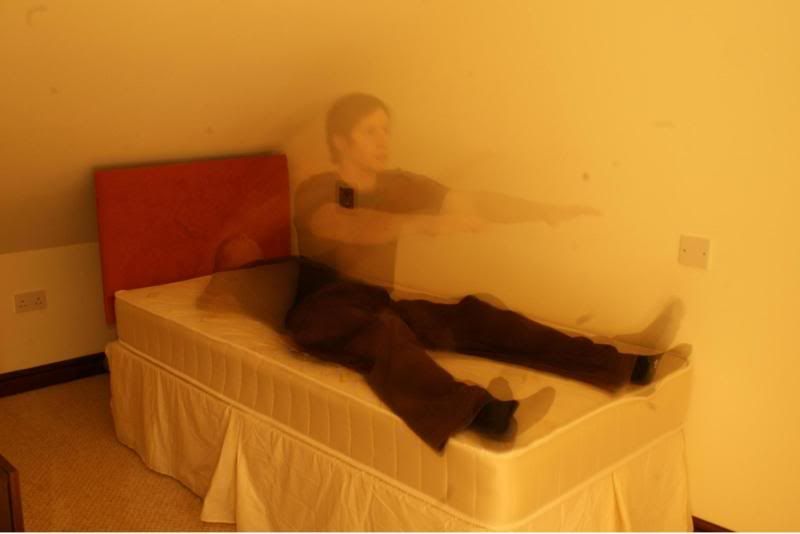
Showing posts with label out-of-body experience. Show all posts

Wednesday, 20 November 2013

Mass Alien Abduction Experiment in Los Angeles


Many were contacted by “aliens” during an experiment conducted by the OOBE Research Center at UCLA. It was the first experiment to ever prove that close encounters with UFOs and extraterrestrials are a product of the human mind.

Alien/UFO abduction experiment in Los Angeles
Alien/UFO Abduction Experiment
We tried to right a common misconception with this experiment - the issue at hand isn't extraterrestrials, but hidden human abilities.
 
                 
Los Angeles, CA (PRWEB) October 26, 2011
Many were contacted by “aliens” during an experiment conducted by the OOBE Research Center at UCLA. It was the first experiment to ever prove that close encounters with UFOs and extraterrestrials are a product of the human mind.
20 volunteers assembled at UCLA on October 7th, 2011. They were instructed to perform a specific procedure upon overnight and early-morning awakenings over the next few days. More than half of the volunteers experienced at least one full or partial out-of-body experience as a result. 7 of them reported making visual contact with UFOs or extraterrestrials. Meanwhile, the sensations they described were identical to those of accounts by “alien abduction survivors”. By some estimates, up to one million Americans experience such encounters every year.
According to the researchers, the term “out-of-body experience” is used to refer to the sensation of having left the body, and not a real exit of some essence from the physical body - although this is just the impression often had by test subjects.
The fact that UFOs and extraterrestrials may be deliberately encountered in a controlled manner and within a few days proves that such experiences are a product of the human brain. Experiment author Michael Raduga explained, "We tried to right a common misconception with this experiment - the issue at hand isn't extraterrestrials, but hidden human abilities. If you've encountered UFOs or aliens after sitting or lying down, it can now be unequivocally stated that you've had a spontaneous out-of-body experience. We have proven this."
It has long been theorized that encounters with extraterrestrials are nearly always the result of spontaneous out-of-body experience. However, scientific proof would have to wait until the discovery of methods for inducing the out-of-body state. In September 2007, the OOBE Research Center started to conduct hundreds of experiments on thousands of people in 5 countries. That work resulted in the development of a procedure allowing anyone to have an out-of-body experience within the first several attempts. This procedure in turn allowed for the OOBE theory of extraterrestrial encounters to be tested and proven correct. The experiment was led by Michael Raduga, founder and head of the OOBE Research Center, as well as the author of 10 published books, the best-known of which is School of Out-of-Body Travel. A Practical Guidebook, freely available online.


Ref Source


Blogger Ref Link http://www.p2pfoundation.net/Multi-Dimensional_Science
 

Wednesday, 31 July 2013

Bibliography of the Out-of-Body Experience


Over 2,000 bibliographic references to the out-of-body experience (OBE),
arranged by subject and author.
Includes references to the near-death experience (NDE).

Copyright © 2009 by Robert Bushman, compiler
Single copies with copyright notice are permitted for non-commercial use.


Contents

Research Interest for OBEers

Links to Internet Sites on OBE

Newsgroups Dealing with OBE


List of the Bibliographies

A Short, Selected Bibliography (about 30 titles)
Titles in Languages Other Than English (Arabic, Danish, French, German, Hungarian, Italian, Japanese, Portuguese, Spanish, Swedish, and Thai)
A Comprehensive Bibliography (all of the above bibliographies in one list, arranged by author.  File size:  958 KB)

Preface

The out-of-body experience is an extraordinary, mystifying, exhilarating, sometimes frightening, and often life-changing experience. It is a window of insight into our nature, our potential, and our place in the universe.  I hope this bibliography will help unfold our understanding of these timeless and fundamental matters.
The strength of the total body of evidence for OBE is overwhelming and impels us to stretch well beyond the comfort of our traditional worldview.  It calls into question the validity of ordinary perception, our belief in form, physicality, time and space, our identity, and indeed, the nature of reality.  Perhaps a more confident understanding of these matters will follow a shift in our current, materialistic worldview. Perhaps a better understanding of OBE will promote that shift. 
OBE awakens us to consciousness as the great frontier.  In that awakening, we stand at a vast horizon of discovery that comprehends virtually all human concern.

Definition

Like a dream, the "out-of-body experience" is a subjective experience in an alternate state of consciousness.  But unlike a dream, an OBE is experienced as real--often as even more real and vivid than normal waking consciousness.  An understanding of OBE is elusive, and depends on one’s metaphysical perspective. The practical definition proposed by parapsychologist, Charles Tart, is that it is simply a state in which one perceives from a point in space apart from one's physical body.
Out-of-body experiences are similar to visual, auditory, and tactile perceptions, but are not mediated by physical senses.  Moreover, the types of OBE perceptions go beyond those we associate with the senses of our physical body.  The experiencer seems to have unlimited mobility and thus may "travel" to any desired spatial location at unlimited speed, or even instantaneously.  Some experience no limits in the time dimension. Direct communication with other life forms seems possible.  Non-ordinary realities may be experienced, including locales associated with the “afterlife.”  Some report access to the thoughts of others.  In general, normal physical limitations do not apply.
Usually, an OBE occurs spontaneously and unexpectedly, though a few have been able to induce the state deliberately.  The most commonly known practitioners of deliberate OBE are shamans and mystics of virtually all cultures worldwide.  Spontaneous OBE is normal and occurs commonly in every population, but because of its extraordinary nature, it is not commonly recognized for what it is.  Experiencers usually believe it is a vivid dream.  Psychiatrists have established that is not a mental disorder, such as depersonalization, autoscopy (or phenomenon of the double or doppelganger), dissociation (multiple personality disorder), psychogenic amnesia, or psychogenic fugue.
Near-death experience (NDE) is a major type of OBE.  NDE is usually induced by serious trauma, and has a distinctive phenomenology (subjective description). Of all that has been published on OBE, the NDE literature contains some of the most personally significant and transformative experience.  Like any perceptions, NDEs are subject to various interpretations, and ordinary OBE provides a broader context for their interpretation.

Nomenclature

"Astral projection" was the earlier common term for OBE. More recently, "out-of-body experience," was suggested by parapsychologist Charles Tart and has become the standard term. Other terms include:
  • altered mind-body perception
  • astral elevation
  • astral excursion
  • astral travel
  • autoscopic hallucination
  • bilocation
  • coat travel
  • consciousness localized in space outside the body
  • depersonalization
  • disembodiment
  • dissociation between body and mind
  • dormiens vigila
  • dream time
  • dream travel
  • dream walking
  • eckstacy
  • ecsomatic experience
  • ecsomaticity
  • ecstasys
  • eidolon
  • ESP projection
  • etheric projection
  • ex-corporeal consciousness
  • exteriorization
  • externalisation
  • extrasensory travel
  • extrasomatic localization
  • false sight
  • flight of the soul
  • interdimensional traveling
  • kosha-state
  • leaving the body
  • little death
  • mental projection
  • mind projection
  • mind traveling
  • mystic death
  • night travel
  • projection of consciousness
  • projection of the etheric body
  • pseudopia
  • psi-projection
  • psychic navigation
  • psychic travel
  • psychological death
  • psychonavigation
  • sacred silence
  • scrying in the spirit vision
  • self-projection
  • separation
  • shamanic journey
  • shamanic ecstasy
  • slipping out
  • soul travel
  • spirit travel
  • statuvolism
  • trance journey
  • traveling clairvoyance
  • traveling ESP
  • traveling telepathy
  • traveling spiritually

Contents of the Bibliographies

This bibliography includes titles of books; booklets; articles from newspapers, magazines, and scholarly journals; self-published works; audio and video tapes; and files from the Internet that deal with OBE.  It includes any material dealing with the phenomenon, from subjective to objective, skeptical to speculative, and scientific to popular.  Included are personal experiences, collections of case histories, phenomenologies (subjective descriptions), induction techniques, anthropological descriptions, psychological descriptions, population surveys, historical surveys, cross-cultural surveys, theoretical explorations, research methodologies, research reports, biography, popularizations, counter-hypotheses, and fiction.  Most of the titles deal exclusively with OBE phenomena while many others are more general in scope and touch only lightly upon OBE. 
There are several other subject areas, such as death survival, lucid dreaming (LD), spiritualism, shamanism, and mediumship, that are related to OBE for which titles are not included except as they touch on OBE.
I have made no attempt to evaluate or restrict titles, and the inclusion of a title does not reflect a position I hold about its content nor its reliability.
Please submit other titles for this bibliography, corrections of errors, and annotations.  You can reach me by sending email to RobertBushman at comcast dot net.  (I have written my address in this way to elude spammers.  To use it, adjust it to the standard format.)

Arrangement of the OBE Bibliographies

Because it may be difficult to find the titles you want from the comprehensive list, which is quite long, I have classified the titles into shorter lists by subject.  I have also included a short, selected list that contains what I hope are the best, frequently cited titles, classic first-hand experiences, and other quality titles offering good overview treatments by the major writers.
The major works have, of course, been reviewed in other publications.  Those reviews are listed along with other titles, and are also listed under the titles reviewed on the comprehensive list.
The subject lists are arranged by publication date.  The Selected and Comprehensive lists are arranged by author.

Notation Convention Used in the OBE Bibliographies

In my format of bibliographic citation, the name of the publisher is followed by the place of publication.  Articles appearing in serial publications are shown with volume, issue number (if any), and page number(s).  For example, “15(3):121-128” means that the article cited appears in volume 15, issue number 3, on pages 121 through 128. When works are published by more than one publisher, the original publisher is usually shown first, as are first edition dates, as many titles have been republished and show later publication dates.

Abbreviations Used in the OBE Bibliographies

bibl       includes a bibliography
ca         approximately
cf         see, in particular
ff          and those related pages which follow
illus       includes illustration(s)
index    includes an index
nd        no date
p          length of work in pages
pp        located at the following page numbers
pseud   pseudonym
refs       includes references to sources

Availability of OBE Titles

Only a few items of this bibliography are now in print.  The classics get reprinted, like those by Monroe, Fox, and Muldoon, but most others fade quickly into the vast ephemera.  It is difficult to find many titles even in large research libraries.  Interlibrary loan is helpful.  The best libraries to search are those that specialize in the paranormal, like the libraries of the Association for Research and Enlightenment (ARE) atVirginia Beach, Virginia; the American Society for Psychical Research (ASPR), and the Parapsychology Foundation in New York City.  Currently, the publishers of the most in-print OBE titles are Hampton Roads in Charlottesville, Virginia and Llewellyn Publications in St. Paul, Minnesota.
Used book dealers can frequently find out-of-print OBE titles, and there are excellent resources for searching for them on the web, such as Abebooks and Bookfinder.

Acknowledgements

Many thanks to those who have contributed items to this bibliography:  Carlos Alvarado of the Parapsychology Foundation, Bruce Greyson of the International Association for Near Death Studies, Melissa Jager, Fowler Jones, Andy Kolovos of the ASPR Library, Joanne McMahon of the Parapsychology Foundation's library, Bob Peterson, Angela Thompson Smith, Rhea White of the Exceptional Human Experience Network, Giulia De Vivo (Italian titles), and Ruth White of the ARE Library. Special thanks to Linda Henkel for her editing. I alone am responsible for the errors, omissions, and mis-classifications.

Research Interest for OBEers

I would like to hear from those who can have OBEs deliberately and who may be interested using that ability in cooperation with others to develop useful information and technologies.  To contact me, send an email to RobertBushman at comcast dot net.  (I have written my address in this way to elude spammers.  To use it, adjust it to the standard format.)

Links to Internet Sites on OBE


Newsgroups Dealing with OBE


Wednesday, 20 February 2013

Out Of Body Experiences (OOBE) Astral Projection


One in ten people have an out-of-body experience at some time in their lives, they are often part of the near-death experience. Those who have experienced OBEs sometimes claim to have observed details which were unknown to them beforehand.
In some cases the phenomenon appears to occur spontaneously; in others it is associated with a physical or mental trauma, use of psychedelic drugs, dissociative drugs, or a dream-like state.
Many techniques aiming to induce the experience deliberately have been developed, for example visualization while in a relaxed, meditative state. Studies from 2007 have shown that experiences somewhat similar to OBEs can be induced by direct brain stimulation. Some of those who experience OBEs claimed to have willed themselves out of their bodies, while others report having found themselves being pulled from their bodies (usually preceded by a feeling of paralysis). In other accounts, the feeling of being outside the body was suddenly realized after the fact the experiencers saw their own bodies almost by accident. The out of body state often occur’s during the borderline stage’s between REM sleep and arousal when sleep paralysis may persist and dream imagery may mingle with sensory input.
Some neurologists have suspected that the event is triggered by a mismatch between visual and tactile signals. They used a virtual reality setup to recreate an OBE. The subject looked through goggles and saw his own body as it would appear to an outside observer standing behind him. The experimenter then touched the subject at the same time as a rod appeared to touch the virtual image. The experiment created an illusion of being behind and outside one's body. However, both critics and the experimenter himself note that the study fell short of replicating "full-blown" OBEs.
Types of OBE
During/near sleep
OBEs are sometimes reported to be preceded by and initiated from a lucid dream state, though other types of immediate and spontaneous experience are also reported. In many cases, people who claimed to have had an OBE reported being asleep, on the verge of sleep, or already asleep shortly before the experience. A large percentage of these cases referred to situations where the sleep was not particularly deep (due to illness, noises in other rooms, emotional stress, exhaustion from overworking, frequent re-awakening, etc.). In most of these cases, the subjects then felt themselves awake; about half of them noted a feeling of sleep paralysis.
Near-death experiences
Another form of spontaneous OBE is the near death experience (NDE). Some subjects report having had an OBE at times of severe physical trauma such as near-drownings or major surgery. In the case of motor vehicle accidents, they are able to recall the accident as if observing it from a location outside the vehicle or seeing themselves go through the window of the car but from their original seated position.

Other
Along the same lines as an near death experiences, extreme physical effort during activities such as high-altitude climbing and marathon running can induce OBEs. A sense of bilocation may be apparent, with both ground and air-based perspectives being experienced simultaneously.
Induced Consciously controlled and pre-meditated OBE methods (examples of which are widely available in many popular books on the subject) are also reported. Some people have attempted to develop techniques to induce OBEs.
Mental induction
Falling asleep physically without losing wakefulness. The "Mind Awake, Body Asleep" state is widely suggested as a cause of OBEs, voluntary and otherwise. Thomas Edison used this state to tackle problems while working on his inventions. He would rest a silver dollar on his head while sitting with a metal bucket in a chair. As he drifted off, the coin would noisily fall into the bucket, restoring some of his alertness. OBE pioneer Sylvan Muldoon more simply used a forearm held perpendicular in bed as the falling object. Salvador Dali was said to use a similar "paranoiac-critical" method to gain odd visions which inspired his paintings. Deliberately teetering between awake and asleep states is known to cause spontaneous trance episodes at the onset of sleep which are ultimately helpful when attempting to induce an OBE. By moving deeper and deeper into relaxation, one eventually encounters a 'slipping' feeling if the mind is still alert. This slipping is reported to feel like leaving the physical body. Some consider progressive relaxation a passive form of sensory deprivation.
Waking up mentally but not physically. This related technique is typically achieved through the practice of lucid dreaming. Once inside a lucid dream, the dreamer either shifts the subject matter of the dream in an OBE direction or banishes the dream imagery completely, in doing so gaining access to the underlying state of sleep paralysis ideal for visualization of separation from the body.
Deep trance, meditation and visualization. The types of visualizations vary; some common imageries used include climbing a rope to "pull out" of one's body, floating out of one's body, getting shot out of a cannon, and other similar approaches. This technique is considered hard to use for people who cannot properly relax. One example of such a technique is the popular Golden Dawn "Body of Light" Technique.
Mechanical induction
Brainwave synchronization via audio/visual stimulation. Binaural beats can be used to induce specific brain wave frequencies, notably those predominant in various mind awake/body asleep states. Binaural induction of the "body asleep" theta brain wave frequencies characteristic of dreaming REM sleep was observed as effective by the Monroe Institute (and corroborated by others). Simultaneous introduction of "mind awake" beta frequencies (detectable in the brains of normal, relaxed awakened individuals) was also observed as constructive. Another popular technology uses sinusoidal wave pulses to achieve similar results, and the drumming accompanying native American religious ceremonies is also believed to have heightened receptivity to "other worlds" through brainwave entrainment mechanisms.
Magnetic stimulation of the brain, as with the God helmet developed by Michael Persinger.
Electrical stimulation of the brain, particularly the temporoparietal junction (See below).
Sensory deprivation. This approach aims to encourage intense disorientation by removal of space and time references. Flotation tanks or pink noise played through headphones are often employed for this purpose. OBEs have been reported by those practicing sense-depriving forms of BDSM such as extreme bondage (mummification).[citation needed]
Sensory overload, the opposite of Sensory deprivation. The subject can for instance be rocked for a long time in a specially designed cradle, or submitted to light forms of torture, to cause the brain to shut itself off from all sensory input. Both conditions tend to cause confusion and this disorientation often permits the subject to experience vivid, ethereal out-of-body experiences. This tends to happen when the subject believes he or she is in a particular position, whereas his or her actual body is either rocking in a cradle actively, or still lying down. Consciousness suddenly transfers to the mental body.
Chemical induction
OBEs induced with drugs are sometimes considered to be hallucinations (i.e., purely subjective), even by those who believe the phenomenon to be objective in general. There are several types of drugs that can initiate an OBE, primarily the dissociative hallucinogens such as ketamine, dextromethorphan (DM or DXM), and phencyclidine (PCP). It has also been reported under the influence of tryptamine psychedelics including dimethyltryptamine (DMT) from ayahuasca. Salvia divinorum has been known to produce symptoms in which the user is said to be able to leave their bodies and travel to many places at once. Many users also claim that they feel as if their "soul" falls out of their body.
Methamphetamine has also been known to cause OBEs, not in itself but through lack of sleep. It has been reported that it felt like the person was talking above and behind them and, being under the influence of the drug, had no idea what was happening.
Galantamine is a Nootropic that can increase the odds of success when using along with Out-of-body experience or Lucid dream induction technique.
Phenomenology
Perceptions of environment
OBEs tend to fall into two types, categorized by Robert Monroe as Locale 1 and Locale 2 experiences.
In Locale 1 experiences the environment is largely consistent with reality; other common labels for this form are etheric, ethereal or RTZ (Real Time Zone) projections. The onset of this type can be frightening as intense physiological sensations may be perceived, such as electrical tingling, full body vibrations and racing heartbeat. Confusion is common in spontaneous Locale 1 experiences; the person can believe he has awakened (or died) physically and panic can be caused by the realization that ones limbs appear to be penetrating other objects.
Locale 2 experiences are less overtly physical in nature and have much subjective overlap with lucid dreaming. The subject is immersed in unrealistic worlds, modified forms of reality exhibiting physically impossible or inconsistent features. Bright and vivid colours are a common feature of this form. Robert Bruce considers this type of OBE to be an Astral Projection.

Progression
Artist's depiction of the separation stage. Though motion is perceived, paralysis is still evident.
An archetypal, classical OBE unfolds through perceptually distinct stages.
Withdrawal stage: Conscious interaction with the physical environment ceases. Attention is elsewhere, with sensory inputs going unnoticed; the body is on auto-pilot. Sleeping is an example of this stage.
Cataleptic stage: Movement is totally impaired. Alternative sensory information may suddenly seem present, such as intense vibrations, noises and sight through closed eyelids.
Separation stage: With effort, the perceptual viewpoint can be pulled away from the physical body location. Still subject to intense sensation, pull back towards the body obstructs progression.
Free movement stage: Beyond a certain radius, movement becomes unimpeded, with control increasing markedly. Visual and mental clarity can vary greatly, from barely functional to exceptional. Re-entry stage: Perceived need to return increases, leading either to voluntary reversal of separation or extremely fast involuntary snap-back. Alternatively, a transition to waking or sleeping may occur. You may feel a pressure as your soul [citation needed] reenters your body.
In practice, the absence of one or more of the classical stages is not unusual. Some (notably Robert Monroe) have claimed these stages become considerably less applicable with extreme familiarity with OBE, eventually finding just a deliberate mental shift to the feeling of the state equivalent. Monroe likened this to tuning a radio away from one station and towards another, and termed the process "phasing".
End-of-OBE perceptions
The OBE may or may not be followed by other experiences which are self-reported as being "as real" as the OBE feeling; alternatively, the subject may fade into a state self-reported as dreaming, or they may awake completely. The OBE is sometimes ended due to a fearful feeling of getting "too far away" from the body. Many end with a feeling of suddenly "popping" or "snapping" and sometimes a "pulling" back into their bodies; some even report being "sucked back" into physical form. A majority describe the end of the experience by saying "then I woke up". However it's worth noting that even those who describe the experience as something fantastic that occurs during sleep, and who describe the end of the experience by saying "and then I woke up", are very specific in describing the experience as one which was clearly not a dream; many described their sense of feeling more awake than they felt when they were normally awake. One compared the experience to that of lucid dreaming, but said that it was "more real".
NDE phenomenology
The phenomenology of an NDE usually includes additional physiological, psychological and transcendental factors beyond those of typical OBEs (Parnia, Waller, Yeates & Fenwick, 2001). Near-death experiences may include subjective impressions of being outside the physical body, visions of deceased relatives and religious figures, and transcendence of ego and spatiotemporal boundaries. Typically the experience includes such factors as: a sense of being dead; a feeling of peace and painlessness; an out-of-body experience; a tunnel experience (the sense of moving up or through a narrow passageway); encountering people of Light; God-like figures or similar forces; being given a "Life review", and a reluctance to return to life.
Studies of OBEs
The first extensive scientific study of OBEs was made by Celia Green (1968). She collected written, first-hand accounts from a total of 400 subjects, recruited by means of appeals in the mainstream media, and followed up by questionnaire. Her purpose was to provide a taxonomy of the different types of OBE, viewed simply as an anomalous perceptual experience or hallucination, while leaving open the question of whether some of the cases might incorporate information derived by extrasensory perception.
Previous collections of cases had been made by Dr Ernesno Bozzano (Italy) and Dr Robert Crookall (UK). Crookall approached the subject from a spiritualistic position, and collected his cases predominantly from spiritualist newspapers such as the Psychic News, which appears to have biased his results in various ways. For example, the majority of his subjects reported seeing a cord connecting the physical body and its observing counterpart; whereas Green found that less than 4% of her subjects noticed anything of this sort, and some 80% reported feeling they were a "disembodied consciousness", with no external body at all.
In 1999, at the 1st International Forum of Consciousness Research in Barcelona, International Academy of Consciousness research-practitioners Wagner Alegretti and Nanci Trivellato presented preliminary findings of an online survey on the out-of-body experience answered by internet users interested in the subject; therefore, not a sample representative of the general population.
1,007 (85%) of the first 1,185 respondents reported having had an OBE. 37% claimed to have had between two and ten OBEs. 5.5% claimed more than 100 such experiences. 45% of those who reported an OBE said they successfully induced at least one OBE by using a specific technique. 62% of participants claiming to have had an OBE also reported having enjoyed nonphysical flight; 40% reported experiencing the phenomenon of self-bilocation (i.e. seeing one's own physical body whilst outside the body); and 38% claimed having experienced self-permeability (passing through physical objects such as walls). The most commonly reported sensations experienced in connection with the OBE were falling, floating, repercussions e.g. myoclonia (the jerking of limbs, jerking awake), sinking, torpidity (numbness), intracranial sounds, tingling, clairvoyance, oscillation and serenity.
Another reported common sensation related to OBE was temporary or projective catalepsy, more commonly known as sleep paralysis. The sleep paralysis and OBE correlation was later corroborated by the Out-of-Body Experience and Arousal study published in Neurology by Kevin Nelson et al. (2007). Also noteworthy, is the Waterloo Unusual Sleep Experiences Questionnaire that further illustrates the correlation.
The University of Manchester has conducted yet another OBE survey. The psychologists at U. of Manchester are investigating the idea that out-of-body experiences, commonly thought of as paranormal phenomena, may in fact have their roots in how people perceive and experience their own bodies.
William Bulham, an author on the subject, has conducted an informal but informative online survey as well.

Neurology and OBE-like experiences there are several possible physiological explanations for parts of the OBE. OBE-like experiences have been induced by stimulation of the brain and by using cameras to fool the mind into thinking that the body is somewhere it is not. OBE-like experience has also been induced through stimulation of the posterior part of the right superior temporal gyrus in a patient. Positron-emission tomography was also used in this study to identify brain regions affected by this stimulation. The term OBE-like is used above because the experiences described in these experiments either lacked some of the clarity or details of normal OBEs, or were described by subjects who had never experienced an OBE before. Such subjects were therefore not qualified to make claims about the authenticity of the experimentally-induced OBE.
English psychologist Susan Blackmore suggests that an OBE begins when a person loses contact with sensory input from the body while remaining conscious.[citation needed] The person retains the illusion of having a body, but that perception is no longer derived from the senses. The perceived world may resemble the world he or she generally inhabits while awake, but this perception does not come from the senses either. The vivid body and world is made by our brain's ability to create fully convincing realms, even in the absence of sensory information. This process is witnessed by each of us every night in our dreams, though OBEs are claimed to be far more vivid than even a lucid dream.
Irwin pointed out that OBEs appear to occur under conditions of either very high or very low arousal. For example, Green found that three quarters of a group of 176 subjects reporting a single OBE were lying down at the time of the experience, and of these 12% considered they had been asleep when it started. By contrast, a substantial minority of her cases occurred under conditions of maximum arousal, such as a rock-climbing fall, a traffic accident, or childbirth. McCreery has suggested that this paradox may be explained by reference to the fact that sleep can supervene as a reaction to extreme stress or hyper-arousal. He proposes that OBEs under both conditions, relaxation and hyper-arousal, represent a form of "waking dream", or the intrusion of Stage 1 sleep processes into waking consciousness.
Van Lommel studies
The first clinical study of near death experiences (NDE's) in cardiac arrest patients was by Pim van Lommel, a cardiologist from the Netherlands, and his team (The Lancet, 2001),Of 344 patients who were successfully resuscitated after suffering cardiac arrest, approximately 18% experienced "classic" NDE's, which included out-of-body experiences. The patients remembered details of their conditions during their cardiac arrest despite being clinically dead with flatlined brain stem activity. Van Lommel concluded that his findings supported the theory that consciousness continued despite lack of neuronal activity in the brain. Van Lommel conjectured that continuity of consciousness may be achievable if the brain acted as a receiver for the information generated by memories and consciousness, which existed independently of the brain, just as radio, television and internet information existed independently of the instruments that received it.
Skeptic Michael Shermer's interpretation of Van Lommel's study, that it demonstrated that the mind was not separate from the brain, has been criticised by Deepak Chopra[45] and also by Jay Ingram of the Canadian Discovery Channel. Ingram commented: "[Shermer's] use of this study to bolster his point is bogus. He could have said, 'The authors think there's a mystery, but I choose to interpret their findings differently'. But he didn't. I find that very disappointing.
Olaf Blanke studies
Research by Olaf Blanke in Switzerland found that it is possible to reliably elicit experiences somewhat similar to the OBE by stimulating regions of the brain called the right temporal-parietal junction (TPJ; a region where the temporal lobe and parietal lobe of the brain come together). Blanke and his collaborators in Switzerland have explored the neural basis of OBEs by showing that they are reliably associated with lesions in the right TPJ region and that they can be reliably elicited with electrical stimulation of this region in a patient with epilepsy. These elicited experiences may include perceptions of transformations of the patient's arm and legs (complex somatosensory responses) and whole-body displacements (vestibular responses).
In neurologically normal subjects, Blanke and colleagues then showed that the conscious experience of the self and body being in the same location depends on multisensory integration in the TPJ. Using event-related potentials, Blanke and colleagues showed the selective activation of the TPJ 330–400 ms after stimulus onset when healthy volunteers imagined themselves in the position and visual perspective that generally are reported by people experiencing spontaneous OBEs. Transcranial magnetic stimulation in the same subjects impaired mental transformation of the participant's own body. No such effects were found with stimulation of another site or for imagined spatial transformations of external objects, suggesting the selective implication of the TPJ in mental imagery of one's own body.
In a follow up study, Arzy et al. showed that the location and timing of brain activation depended on whether mental imagery is performed with mentally embodied or disembodied self location. When subjects performed mental imagery with an embodied location, there was increased activation of a region called the "extrastriate body area" (EBA), but when subjects performed mental imagery with a disembodied location, as reported in OBEs, there was increased activation in the region of the TPJ. This leads Arzy et al. to argue that "these data show that distributed brain activity at the EBA and TPJ as well as their timing are crucial for the coding of the self as embodied and as spatially situated within the human body."
Blanke and colleagues thus propose that the right temporal-parietal junction is important for the sense of spatial location of the self, and that when these normal processes go awry, an OBE arises.
In August 2007 Blanke's lab published research in Science demonstrating that conflicting visual-somatosensory input in virtual reality could disrupt the spatial unity between the self and the body. During multisensory conflict, participants felt as if a virtual body seen in front of them was their own body and mislocalized themselves toward the virtual body, to a position outside their bodily borders. This indicates that spatial unity and bodily self-consciousness can be studied experimentally and is based on multisensory and cognitive processing of bodily information.
Michael Persinger studies
Michael Persinger has undertaken similar research to Olaf Blanke using magnetic stimulation applied to the right temporal lobe of the brain, which is known to be involved in visuo-spatial functions, multi-sensory integration and the construction of the sense of the body in space. Persinger's research also found evidence for objective neural difference between periods of remote viewing in two individuals thought to have psychic abilities. Persinger undertook his research on Sean Harribance and Ingo Swann, a renowned remote viewer who has taken part in numerous studies. Examination of Harribance showed enhanced EEG activity within the alpha band (8–12 Hz) over Harribance's right parieto-occipital region, consistent with neuropsychological evidence of early brain trauma in these regions. In a second study, Ingo Swann was asked to draw images of pictures hidden in envelopes in another room. Individuals with no knowledge of the nature of the study rated Swann's comments and drawings as congruent with the remotely viewed stimulus at better than chance levels. Additionally, on trials in which Swann was correct, the duration of 7 Hz (alpha band) paroxysmal discharges over the right occipital lobe was longer. Subsequent anatomical MRI examination showed anomalous subcortical white matter signals focused in the perieto-occipital interface of the right hemisphere that were not expected for his age or history.
Ehrsson study
In August 2007 Henrik Ehrsson, then at the Institute of Neurology at University College of London (now at the Karolinska Institute in Sweden) published research in Science demonstrating the first experimental method that, according to the scientist's claims in the publication, induced an out-of-body experience in healthy participants.[57] The experiment was conducted in the following way:
The study participant sits in a chair wearing a pair of head-mounted video displays. These have two small screens over each eye, which show a live film recorded by two video cameras placed beside each other two metres behind the participant's head. The image from the left video camera is presented on the left-eye display and the image from the right camera on the right-eye display. The participant sees these as one "stereoscopic" (3D) image, so they see their own back displayed from the perspective of someone sitting behind them. The researcher then stands just beside the participant (in their view) and uses two plastic rods to simultaneously touch the participant's actual chest out-of-view and the chest of the illusory body, moving this second rod towards where the illusory chest would be located, just below the camera's view. The participants confirmed that they had experienced sitting behind their physical body and looking at it from that location.
The experiment fits a three-point definition of the out-of-body experience (OBE). The OBE as reported in spontaneous cases can be phenomenologically more complex as commented in Slate[59] and elsewhere.
Dr. Sam Parnia – University of Southampton study
In the fall of 2008, 25 UK and US hospitals began participation in a 3 year study, co-ordinated by Dr. Sam Parnia and Southampton University. Following on the work of Van Lommel in the Netherlands, the study aims to examine near-death experiences in 1,500 cardiac arrest survivors and so determine whether people without a heartbeat or brain activity can have documentable out-of-body experiences.
OBE Training and Research Facilities
The 9-meter sphere laboratory known as the Projectarium at International Academy of Consciousness (IAC) Campus in Evoramonte, Portugal is the first modern building designed specifically to facilitate out-of-body experience. The Monroe Institute's Nancy Penn Center is another campus specializing on out-of-body experience induction. The Center for Higher Studies of the Consciousness in Brazil is another large OBE training facility.
Olaf Blanke's Laboratory of Cognitive Neuroscience has become a well-known laboratory for OBE research. Lab facilities include a 192-channel EEG platform and a Virtual-Reality EEG platform allowing to record from 256 scalp electrodes during full immersion in virtual reality.
Historically, the first laboratory research on OBE was conducted by The End of Materialism author Dr. Charles Tart at University of California - Davis in the 60's, whose research papers are available online.
Astral projection
Astral projection is a paranormal interpretation of out-of-body experience that assumes the existence of one or more non-physical planes of existence and an associated body beyond the physical. Commonly such planes are called astral, etheric, or spiritual. Astral projection is often experienced as the spirit or astral body leaving the physical body to travel in the spirit world or astral plane.
Evidence for objective reality of projection on to the etheric plane (a near-copy of the physical plane) is sometimes suggested when people, such as patients during surgery, describe OBEs in which they see or hear events or objects outside their sensory range (for instance, Pam Reynolds reported experiencing an OBE during brain surgery and described a surgical instrument she had not seen previously, as well as conversation that occurred while she was under anethesia).[citation needed]
Skeptics such as Susan Blackmore have disputed whether anything leaves the body during an OBE.
Lucid dreaming
Alice in Wonderland syndrome
Dissociation
Depersonalization
Depersonalization disorder
Hallucinations in the sane
Hypnagogia
Macropsia
Nightmare
Galantamine
Bilocation

Reference to Parsonage Side Retreat


Photo Source


Saturday, 22 December 2012

Graham Nicholls, and Out-of-Body Experiences

Why not learn to have out-of-body experiences, or gain more understanding and control, while also supporting research into the area? In this two hour webinar author and OBE specialist Graham Nicholls will guide you through areas including the vibrational state, the void state, the entended mind, OBE nutrition, immersion technology  and his Infra-liminal™ recordings.

About the research

This project is designed to fund research into out-of-body experiences, personal development tools, the nature of consciousness and related areas. Graham Nicholls has been developing immersive technology since 1998. With his many years of experience he now wants to take his research further and explore the therapeutic and health supporting benefits of his technology and approaches. Many of his students have expressed benefits far beyond the original intention behind the design. To allow this work to benefit the maximum number of people Graham Nicholls now wants to purchase new equipment and bring in scientists in a range of fields to support his work. The out-of-body experience or OBE has rarely been studied in detail since the 1960s when technology and scientific protocols were not as advanced as they are today. If OBEs are objective, as they appear to be, they will offer great insight into the nature of consciousness and humanity’s biggest questions.


Infra-liminal™ Technology

Epicene - Immersive Installation

Graham Nicholls’ own sound technology called Infra-liminal™ has been refined since 1998 when Graham built his first OBE inducing structure (see image) the Infra-liminal™ sound is designed to lead to the vibrational state in a consistent way. When combined with Graham’s G-Techniques the results are enhanced still further. Again this approach and technology are unique and not available anywhere else.
This technology is also currently being used to benefit those with various psychological issues, including addiction. By supporting this technology you are also contributing to further development and helping with continuing this work.
Purchase Intra-liminal™ 1.0 below (for individual use only, for a group or practitioner license please contact us)


Research....


This project is designed to fund research into out-of-body experiences, personal development tools, the nature of consciousness and related areas. Graham Nicholls has been developing immersive technology since 1998. With his many years of experience he now wants to take his research further and explore the therapeutic and health supporting benefits of his technology and approaches. Many of his students have expressed benefits far beyond the original intention behind the design. To allow this work to benefit the maximum number of people Graham Nicholls now wants to purchase new equipment and bring in scientists in a range of fields to support his work. The out-of-body experience or OBE has rarely been studied in detail since the 1960s when technology and scientific protocols were not as advanced as they are today. If OBEs are objective, as they appear to be, they will offer great insight into the nature of consciousness and humanity’s biggest questions.

Key areas this research will explore:

• Infra-liminal frequencies - In his work since 1998 Graham Nicholls has indentified various frequency patterns that result in positive changes in our state of being. These can induce the vibrational state, a common early stage of the OBE, and other altered states. The use of this technology for help with addiction, suicide prevention and depression etc., is already being explored as a pilot study.
• Immersive Structures - Graham Nicholls takes a multisensory approach with his work, this is clearest in his immsersive structures that have used, sound, light, virtual reality, floating platforms, hypnosis, and many different elements to create a total or ‘immersive’ experience for the participant. The funds donated here will also go towards new versions of his immersive structures and research into new approaches.
• Out-of-Body Experience Research - The project will also undertake OBE research, looking at the nature of the out-of-body state in terms of brain activity and veridical perception (objective observations beyond the normal senses). This work will be understaken with professional scientists and published in peer reviewed journals.

The Impact

Graham Nicholls’ has used his Infra-liminal and immersive technology with his private students and workshop attendees with excellent results. Virtually everyone who experiences the Infra-liminal state walks away feeling heightened and changed in a positive way. This has obvious potential for helping people suffering from depression, addiction and other issues. With the help of funds from this project he will develop the technology further and work with scientists in various areas to learn more about the processes at work with the technology. The OBE research will also help to explore the nature of consciousness, and broaden our understandings in many areas of parapsychology.

What We Need

The purpose of this project is to raise funds for setting up a research lab with EEG, audio/visual, virtual reality and other equipment. It will also go towards premises, travel and training.
Other Ways You Can Help
If you are passionate about questions like, “Are OBEs real?” “Is there life after death?” or “What is consciousness?” why not support this project and get the word out, blog about it, tell people, link to it…generally show your support. The more people who support this work the more our understanding of spiritual and transformative experiences can grow. You can also donate skills, technology/equipment, and scientific expertise. But above all if you can, donate and be the first to experience the power of these new understandings and technology. Thank you.


For more detail go to the main website from which the above material emanates from.

http://www.grahamnicholls.com/category/articles/

"Scientific Mysticism" of Michael Whiteman

  The previous post gave reference to the book below by an academic. It is similiar but not identical to the ideas of my paradigm known as ...