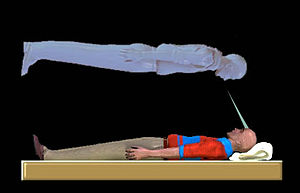
Artist's depiction of the separation stage of an out-of-body experience, which often precedes free movement
An
out-of-body experience (
OBE or sometimes
OOBE) is an experience that typically involves a sensation of floating outside one's body and, in some cases, perceiving one's physical
body from a place outside one's body (
autoscopy).
The term
out-of-body experience was introduced in 1943 by
George N. M. Tyrrell in his book
Apparitions,
[1] and was adopted by researchers such as
Celia Green[2] and
Robert Monroe[3] as an alternative to belief-centric labels such as "
astral projection", "soul travel", or "spirit walking". The researcher
Waldo Vieira described the phenomenon as a projection of consciousness.
[4][5] OBEs can be induced by brain traumas,
sensory deprivation,
near-death experiences,
dissociative and
psychedelic drugs, dehydration, sleep, and electrical stimulation of the brain
[6], among others. It can also be intentionaly induced by some.
[7]
Mainstream science considers the OBE a type of
hallucination that can be caused by various
psychological and
neurological factors.
[8][9][10] Some
parapsychologists and
occult writers treat OBEs as evidence that a
soul,
spirit or
subtle body can detach itself from the body and visit distant locations.
[11][12]
One in ten people has an OBE once, or more commonly, several times
[13] in his or her life,
[14] but scientists still know little about the phenomenon.
[15]
[edit] Types of OBEs
[edit] Spontaneous
[edit] During/near sleep
Those experiencing OBEs sometimes report (among other types of immediate and spontaneous experience) a preceding and initiating
lucid-dream state. In many cases, people who claim to have had an OBE report being on the verge of sleep, or being already asleep shortly before the experience. A large percentage of these cases refer to situations where the sleep was not particularly deep (due to illness, noises in other rooms, emotional stress, exhaustion from overworking, frequent re-awakening, etc.). In most of these cases the subjects then feel themselves awake; about half of them noted a feeling of
sleep paralysis.
[16]
[edit] Near-death experiences
Another form of spontaneous OBE is the near-death experience (NDE). Some subjects report having had an OBE at times of severe physical trauma such as near-drownings or major surgery.
[17]
[edit] Resulting from extreme physical effort
Along the same lines as an NDE, extreme physical effort during activities such as high-altitude climbing and marathon running can induce OBEs. A sense of
bilocation may be apparent, with both ground and air-based perspectives being experienced simultaneously.
[18]
[edit] Induced
Consciously controlled and pre-meditated OBE methods (examples of which are widely available in many popular books on the subject) are also reported.
[19][20][21][22][23] Some people have attempted to develop techniques to induce OBEs.
[edit] Mental induction
- Falling asleep physically without losing wakefulness. The "Mind Awake, Body Asleep" state is widely suggested as a cause of OBEs, voluntary and otherwise.[24] Thomas Edison used this state to tackle problems while working on his inventions. He would rest a silver dollar on his head while sitting with a metal bucket in a chair. As he drifted off, the coin would noisily fall into the bucket, restoring some of his alertness.[25] OBE pioneer Sylvan Muldoon more simply used a forearm held perpendicular in bed as the falling object.[21] Salvador Dalí was said to use a similar "paranoiac-critical" method to gain odd visions which inspired his paintings. Deliberately teetering between awake and asleep states is known to cause spontaneous trance episodes at the onset of sleep which are ultimately helpful when attempting to induce an OBE.[26][27][28] By moving deeper and deeper into relaxation, one eventually encounters a "slipping" feeling if the mind is still alert. This slipping is reported to feel like leaving the physical body. Some consider progressive relaxation a passive form of sensory deprivation.
- Waking up mentally but not physically. This related technique is typically achieved through the practice of lucid dreaming. Once inside a lucid dream, the dreamer either shifts the subject matter of the dream in an OBE direction or banishes the dream imagery completely, in doing so gaining access to the underlying state of sleep paralysis ideal for visualization of separation from the body.
- Deep trance, meditation and visualization. The types of visualizations vary; some common imageries used include climbing a rope to "pull out" of one's body, floating out of one's body, getting shot out of a cannon, and other similar approaches. This technique is considered hard to use for people who cannot properly relax. One example of such a technique is the popular Golden Dawn "Body of Light" Technique.[29]
[edit] Mechanical induction
- Brainwave synchronization via audio/visual stimulation. Binaural beats can be used to induce specific brainwave frequencies,[30] notably those predominant in various mind awake/body asleep states. Binaural induction of a "body asleep" 4 Hertz brainwave frequency was observed as effective by the Monroe Institute,[31] and some authors consider binaural beats to be significantly supportive of OBE initiation when used in conjunction with other techniques.[32][33] Simultaneous introduction of "mind awake" beta frequencies (detectable in the brains of normal, relaxed awakened individuals) was also observed as constructive. Another popular technology uses sinusoidal wave pulses to achieve similar results, and the drumming accompanying native American religious ceremonies is also believed to have heightened receptivity to "other worlds" through brainwave entrainment mechanisms.[34]
- Magnetic stimulation of the brain, as with the God helmet developed by Michael Persinger.[35]
- Direct stimulation of the vestibular cortex.[36]
- Electrical stimulation of the brain, particularly the temporoparietal junction (See Blanke study below).
- Sensory deprivation. This approach aims to encourage intense disorientation by removal of space and time references. Flotation tanks or pink noise played through headphones are often employed for this purpose.[37]
- Sensory overload, the opposite of sensory deprivation. The subject can for instance be rocked for a long time in a specially designed cradle, or submitted to light forms of torture, to cause the brain to shut itself off from all sensory input. Both conditions tend to cause confusion and this disorientation often permits the subject to experience vivid, ethereal out-of-body experiences.[38]
[edit] Chemical induction
- OBEs induced with drugs are sometimes considered to be hallucinations (i.e., purely subjective), even by those who believe the phenomenon to be objective in general. There are several types of drugs that can initiate an OBE, primarily the dissociative hallucinogens such as ketamine, dextromethorphan (DM or DXM), and phencyclidine (PCP). It has also been reported under the influence of tryptamine psychedelics including dimethyltryptamine (DMT) from ayahuasca. Salvia divinorum has been known to produce symptoms in which the user is said to be able to leave his or her body and travel to many places at once. Many users also claim that they feel as if their "soul" falls out of their body.
- Methamphetamine has also been known to cause OBEs, not in itself but through lack of sleep. It has been reported that it felt like the person was talking above and behind them and, being under the influence of the drug, had no idea what was happening.
- Galantamine is a nootropic that can increase the odds of success when using along with out-of-body experience or lucid dream induction techniques.[39][40][41]
[edit] Phenomenology
[edit] Perceptions of environment
OBEs tend to fall into two types, categorized by
Robert Monroe as Locale 1 and Locale 2 experiences.
In Locale 1 experiences the environment is largely consistent with reality; other common labels for this form are etheric, ethereal or RTZ (Real Time Zone) projections. The onset of this type can be frightening as intense physiological sensations may be perceived, such as electrical tingling, full body vibrations and racing heartbeat. Confusion is common in spontaneous Locale 1 experiences; the person can believe he or she has awakened (or died) physically and panic can be caused by the realization that one's limbs appear to be penetrating other objects.
Locale 2 experiences are less overtly physical in nature and have much subjective overlap with lucid dreaming. The subject is immersed in unrealistic worlds, modified forms of reality exhibiting physically impossible or inconsistent features. Bright and vivid colors are a common feature of this form.
Robert Bruce considers this type of OBE to be an
astral projection.
[edit] Progression
In surveys, as many as 85% of respondents tell of hearing loud noises, known as "
exploding head syndrome" (EHS), during the onset of OBEs.
[42][43]
Some who experience OBEs claim to have willed themselves out of their bodies, while others report having found themselves being pulled from their bodies, usually following a feeling of
paralysis).
Those who have experienced OBEs sometimes claim to have observed details which were unknown to them beforehand.
[44]
An archetypal, classical OBE unfolds through perceptually distinct stages.
[45][46]
- Withdrawal stage: Conscious interaction with the physical environment ceases. Attention is elsewhere, with sensory inputs going unnoticed; the body is on auto-pilot. Sleeping is an example of this stage.
- Cataleptic stage: Movement is totally impaired.[47] Alternative sensory information may suddenly seem present, such as intense vibrations, noises and sight through closed eyelids.[48]
- Separation stage: With effort, the perceptual viewpoint can be pulled away from the physical body location. Still subject to intense sensation, pull back towards the body obstructs progression.[49][50]
- Free movement stage: Beyond a certain radius, movement becomes unimpeded,[51] with control increasing markedly. Visual and mental clarity can vary greatly, from barely functional to exceptional.
- Re-entry stage: Perceived need to return increases, leading either to voluntary reversal of separation or extremely fast involuntary snap-back. Alternatively, a transition to waking or sleeping may occur.
In practice, the absence of one or more of the classical stages is not unusual. Some (notably
Robert Monroe) have claimed these stages become considerably less applicable with extreme familiarity with OBE, eventually finding just a deliberate mental shift to the feeling of the state equivalent.
[52] Monroe likened this to tuning a radio away from one station to another into a different
focus level of attention.
[53]
[edit] NDE phenomenology
The
phenomenology of an
NDE usually includes additional physiological, psychological and transcendental factors beyond those of typical OBEs (Parnia, Waller, Yeates & Fenwick, 2001). Near-death experiences may include subjective impressions of being outside the physical body, visions of deceased relatives and religious figures, and transcendence of ego and spatiotemporal boundaries.
[54] Typically the experience includes such factors as: a sense of being dead; a feeling of peace and painlessness; hearing of various non-physical sounds, an out-of-body experience; a tunnel experience (the sense of moving up or through a narrow passageway); encountering people of Light; God-like figures, helpers, spiritual guides, or similar forces; being given a "
Life review", and a reluctance to return to life.
[55]
[edit] Theories of OBEs
[edit] Psychological
The accepted explanation for the OBE in the fields of
cognitive science and
psychology is that the OBE is a
hallucinatory construct that arises from different
psychological factors.
[7][8][9][10] The scientific community consider the OBE to be an experience from a mental state, like a dream or an
altered state of consciousness without recourse to the
paranormal.
[56]
An early researcher
Edmund Gurney (1886) proposed that out-body-body experiences were hallucinations of the
pathological type.
[57] Charles Richet (1887) held that OBEs are created by the subject's
memory and
imagination processes and are no different than
dreams.
[58][59] James Hyslop (1912) wrote that OBEs occur when the activity of the
subconscious mind dramatizes certain images to give the impression the subject is in a different physical location.
[60] Eugèn Osty (1930) considered OBEs to be nothing more than the product of
imagination.
[61] Other early researchers such as (Schmeing, 1938) supported
psychophysiological theories.
[62] G. N. M. Tyrrell interpreted OBEs as hallucinatory constructs relating to subconscious levels of
personality.
[63]
Donovan Rawcliffe (1959) connected the OBE experience with
psychosis and
hysteria.
[64] Other researchers have discussed the phenomena of the OBE in terms of a distortion of the body image (Horowitz, 1970) and
depersonalization (Whitlock, 1978).
[65][66] The psychologists
Nandor Fodor (1959) and Jan Ehrenwald (1974) proposed that an OBE is a defense mechanism designed to deal with the threat of death.
[67][68] According to (Irin and Watt, 2007) Jan Ehrenwald had described the out-of-body experience (OBE) "as an imaginal con- firmation of the question for immortality, a delusory attempt to assure ourselves that we possess a soul that exists independently of the physical body.
[69] The psychologists
Donald Hebb (1960) and
Cyril Burt (1968) wrote on the psychological interpretation of the OBE involving
body image and visual imagery.
[70][71] Graham Reed (1974) suggested that the OBE is a stress reaction to a painful situation, such as the loss of love.
[72] John Palmer (1978) wrote that the OBE is a response to a body image change causing a threat to
personal identity.
[73]
Susan Blackmore (1978) came to the conclusion that the OBE is a hallucinatory fantasy as they have characteristics based around imaginary perceptions, perceptual distortions and fantasy-like perceptions of the self (such as having no body).
[74] Ronald Siegel (1980) also wrote that OBEs are hallucinatory fantasies.
[75] Harvey Irwin (1985) presented a theory of the OBE involving attentional cognitive processes and
somatic sensory activity. His theory involved a cognitive personality construct known as
psychological absorption and gave instances of the classification of an OBE as examples of
autoscopy,
depersonalization and
mental dissociation.
[76] The psychophysiologist
Stephen Laberge (1985) has written that the explanation for OBEs can be found in
lucid dreaming.
[77] David Hufford (1989) linked the OBE experience with a phenomenon he described as a
nightmare waking experience, a type of
sleep paralysis.
[78] Other scientists have also linked OBEs to cases of
hypnagogia and sleep paralysis (
cataplexy).
[79][80]
In case studies
fantasy proneness has been shown to be high among OBEers than those who have not had an OBE.
[81] The data has shown a link between the OBE experience in some cases to
fantasy prone personality (FPP).
[82] In a case study involving 167 participants the findings revealed that those who claimed to have experienced the OBE were "more fantasy prone, higher in their belief in the paranormal and displayed greater somatoform dissociation."
[83] Research from studies has also suggested that OBEs are related to cognitive-perceptual
schizotypy.
[84]
In a study review of
neurological and
neurocognitive data (Bünning and Blanke, 2005) wrote that OBEs are due to "functional disintegration of lower-level
multisensory processing and abnormal higher-level self-processing at the
temporo-parietal junction."
[85] Some scientists suspect that OBEs are the result of a mismatch between visual and tactile signals.
[86][87]
[edit] Paranormal
Writers within the fields of
parapsychology and
occultism have written that OBEs are not psychological and that a
soul,
spirit or
subtle body can detach itself out of the body and visit distant locations.
The Theosophist
Arthur Powell (1927) was an early author to advocate the subtle body theory of OBEs.
[88] Sylvan Muldoon (1936) embraced the concept of an
etheric body to explain the OBE experience.
[11] The psychical researcher Ernesto Bozzano (1938) had also supported a similar view describing the phenomena of the OBE experience in terms of
bilocation in which an "etheric body" can release itself from the physical body in rare circumstances.
[89] The subtle body theory was also supported by occult writers such as Ralph Shirley (1938),
Benjamin Walker (1977) and
Douglas Baker (1979).
[90]
James Baker (1954) wrote that a
mental body enters an "intercosmic region" during the OBE.
[91] Some non-occult writers such as Robert Crookall in many publications supported the subtle body theory of OBEs.
[92][93] Gastone De Boni (1960) and other writers such as Hornell Hart (1967) also speculated on the existence of a subtle body to explain the OBE experience.
[94][95]
The paranormal approach to OBEs has not been supported by all researchers within the study of parapsychology.
Gardner Murphy (1961) wrote OBEs are "not very far from the known terrain of general psychology, which we are beginning to understand more and more without recourse to the paranormal".
[96] Susan Blackmore (1982) criticised the
subtle body intepretation.
[97] The parapsychologist Carlos Alvarado (1989) wrote that the subtle body theory of the OBE is considered obsolete by the
scientific community due to research supporting the psychological approach since the 1970s.
[98]
Robert Bruce (1999) endorsed a theory of subtle bodies entering nonphysical dimensions to explain OBEs.
[99] In 2011, the paranormal author Anthony Peake set forth his intrasomatic model of out of body and near death experience. Peake claimed that consciousness did not leave the body during these experiences, but rather traveled inward into the recesses of the brain's structure.
[100] The clinical researcher Frederick Aardema (2012) has also supported a paranormal interpretation of the OBE claiming that
consciousness is able to transcend the boundaries of time and space.
[101]
[edit] Studies of OBEs
The first extensive scientific study of OBEs was made by
Celia Green (1968).
[102] She collected written, first-hand accounts from a total of 400 subjects, recruited by means of appeals in the mainstream media, and followed up by questionnaires. Her purpose was to provide a
taxonomy of the different types of OBE, viewed simply as an anomalous perceptual experience or
hallucination, while leaving open the question of whether some of the cases might incorporate information derived by
extrasensory perception.
Previous collections of cases had been made by Dr. Ernesto Bozzano (Italy) and Dr. Robert Crookall (UK). Crookall approached the subject from a spiritualistic position, and collected his cases predominantly from spiritualist newspapers such as the
Psychic News, which appears to have biased his results in various ways. For example, the majority of his subjects reported seeing a
cord connecting the physical body and its observing counterpart; whereas Green found that less than 4% of her subjects noticed anything of this sort, and some 80% reported feeling they were a "disembodied consciousness", with no external body at all.
In 1981, Brazilian Physician and
medium Dr.
Waldo Vieira proposed a new field in
parapsychology called
projectiology,
[103] in which researchers study the subjective dynamics of the OBE directly through systematic self-experimentation rather than through verbal reports. He also formed an institution called the CCC -
Center of Continued Consciousness (later IIPC -
International Institute of Conscientiology), to promote discussions about the subject.
[104]
In 1999, at the 1st International Forum of Consciousness Research in Barcelona, International Academy of Consciousness research-practitioners Wagner Alegretti and Nanci Trivellato presented preliminary findings
[105] of an online survey on the out-of-body experience answered by internet users interested in the subject; therefore, not a sample representative of the general population.
1,007 (85%) of the first 1,185 respondents reported having had an OBE. 37% claimed to have had between two and ten OBEs. 5.5% claimed more than 100 such experiences. 45% of those who reported an OBE said they successfully induced at least one OBE by using a specific technique. 62% of participants claiming to have had an OBE also reported having enjoyed nonphysical flight; 40% reported experiencing the phenomenon of self-bilocation (i.e. seeing one's own physical body whilst outside the body); and 38% claimed having experienced self-permeability (passing through physical objects such as walls). The most commonly reported sensations experienced in connection with the OBE were falling, floating, repercussions e.g. myoclonia (the jerking of limbs, jerking awake), sinking, torpidity (numbness), intracranial sounds, tingling, clairvoyance, oscillation and serenity.
Another reported common sensation related to OBE was temporary or projective
catalepsy, a more common feature of sleep paralysis. The sleep paralysis and OBE correlation was later corroborated by the Out-of-Body Experience and Arousal study published in
Neurology [106] by Kevin Nelson et al. (2007). Also noteworthy, is the Waterloo Unusual Sleep Experiences Questionnaire
[107] that further illustrates the correlation.
William Buhlman, an author on the subject, has conducted an informal but informative online survey
[108] as well.
A study in 2007 led by Professor Kevin Nelson from the
University of Kentucky discovered that people who have out-of-body experiences are more likely to suffer from
sleep paralysis.
[109]
[edit] Neurology and OBE-like experiences
There are several possible physiological explanations for parts of the OBE. OBE-like experiences have been induced by stimulation of the brain. OBE-like experience has also been induced through stimulation of the posterior part of the right superior temporal gyrus in a patient.
[110] Positron-emission tomography was also used in this study to identify brain regions affected by this stimulation. The term
OBE-like is used above because the experiences described in these experiments either lacked some of the clarity or details of normal OBEs, or were described by subjects who had never experienced an OBE before. Such subjects were therefore not qualified to make claims about the authenticity of the experimentally-induced OBE.
English psychologist
Susan Blackmore and others suggest that an OBE begins when a person loses contact with sensory input from the body while remaining conscious.
[101][111] The person retains the illusion of having a body, but that perception is no longer derived from the senses. The perceived world may resemble the world he or she generally inhabits while awake, but this perception does not come from the senses either. The vivid body and world is made by our brain's ability to create fully convincing realms, even in the absence of sensory information. This process is witnessed by each of us every night in our dreams, though OBEs are claimed to be far more vivid than even a
lucid dream.
Irwin
[112] pointed out that OBEs appear to occur under conditions of either very high or very low
arousal. For example, Green
[113] found that three quarters of a group of 176 subjects reporting a single OBE were lying down at the time of the experience, and of these 12% considered they had been asleep when it started. By contrast, a substantial minority of her cases occurred under conditions of maximum arousal, such as a rock-climbing fall, a traffic accident, or childbirth. McCreery
[114][115] has suggested that this paradox may be explained by reference to the fact that sleep can supervene as a reaction to extreme stress or hyper-arousal.
[116] He proposes that OBEs under both conditions, relaxation and hyper-arousal, represent a form of "waking dream", or the intrusion of Stage 1
sleep processes into waking consciousness.
[edit] Olaf Blanke studies
Research by Olaf Blanke in Switzerland found that it is possible to reliably elicit experiences somewhat similar to the OBE by stimulating regions of the brain called the right temporal-parietal junction (TPJ; a region where the
temporal lobe and
parietal lobe of the brain come together). Blanke and his collaborators in Switzerland have explored the neural basis of OBEs by showing that they are reliably associated with
lesions in the right TPJ region
[117] and that they can be reliably elicited with electrical stimulation of this region in a patient with epilepsy.
[118] These elicited experiences may include perceptions of transformations of the patient's arms and legs (complex somatosensory responses) and whole-body displacements (vestibular responses).
[119][120]
In neurologically normal subjects, Blanke and colleagues then showed that the conscious experience of the self and body being in the same location depends on
multisensory integration in the TPJ. Using
event-related potentials, Blanke and colleagues showed the selective activation of the TPJ 330–400 ms after stimulus onset when healthy volunteers imagined themselves in the position and visual perspective that generally are reported by people experiencing spontaneous OBEs.
Transcranial magnetic stimulation in the same subjects impaired mental transformation of the participant's own body. No such effects were found with stimulation of another site or for imagined spatial transformations of external objects, suggesting the selective implication of the TPJ in mental imagery of one's own body.
[121]
In a follow up study, Arzy et al. showed that the location and timing of brain activation depended on whether mental imagery is performed with mentally embodied or disembodied self location. When subjects performed mental imagery with an embodied location, there was increased activation of a region called the "extrastriate body area" (EBA), but when subjects performed mental imagery with a disembodied location, as reported in OBEs, there was increased activation in the region of the TPJ. This leads Arzy et al. to argue that "these data show that distributed brain activity at the EBA and TPJ as well as their timing are crucial for the coding of the self as embodied and as spatially situated within the human body."
[122]
Blanke and colleagues thus propose that the right temporal-parietal junction is important for the sense of spatial location of the self, and that when these normal processes go awry, an OBE arises.
[123]
In August 2007 Blanke's lab published research in
Science demonstrating that conflicting visual-somatosensory input in
virtual reality could disrupt the spatial unity between the self and the body. During multisensory conflict, participants felt as if a virtual body seen in front of them was their own body and mislocalized themselves toward the virtual body, to a position outside their bodily borders. This indicates that spatial unity and bodily self-consciousness can be studied experimentally and is based on multisensory and cognitive processing of bodily information.
[124]
[edit] Michael Persinger studies
Michael Persinger has undertaken similar research to Olaf Blanke using magnetic stimulation applied to the right
temporal lobe of the brain, which is known to be involved in visuo-spatial functions, multi-sensory integration and the construction of the sense of the body in space.
[125] Persinger's research also found evidence for objective neural differences between periods of
remote viewing in two individuals thought to have psychic abilities. Persinger undertook his research on Sean Harribance and
Ingo Swann, a renowned remote viewer who has taken part in numerous studies.
[126] Examination of Harribance showed enhanced
EEG activity within the alpha band (8–12 Hz) over Harribance's right parieto-occipital region, consistent with neuropsychological evidence of early brain trauma in these regions. In a second study, Ingo Swann was asked to draw images of pictures hidden in envelopes in another room. Individuals with no knowledge of the nature of the study rated Swann's comments and drawings as congruent with the remotely viewed stimulus at better than chance levels. Additionally, on trials in which Swann was correct, the duration of 7 Hz (alpha band)
paroxysmal discharges over the right
occipital lobe was longer. Subsequent anatomical
MRI examination showed anomalous subcortical
white matter signals focused in the perieto-occipital interface of the right hemisphere that were not expected for his age or history.
In August 2007,
Henrik Ehrsson, then at the
Institute of Neurology at
University College of London (now at the
Karolinska Institute in Sweden), published research in
Science demonstrating the first experimental method that, according to the scientist's claims in the publication,
induced an out-of-body experience in healthy participants. The experiment was conducted in the following way:
The study participant sits in a chair wearing a pair of head-mounted video displays. These have two small screens over each eye, which show a live film recorded by two video cameras placed beside each other two metres behind the participant's head. The image from the left video camera is presented on the left-eye display and the image from the right camera on the right-eye display. The participant sees these as one "
stereoscopic" (3D) image, so they see their own back displayed from the perspective of someone sitting behind them.
The researcher then stands just beside the participant (in their view) and uses two plastic rods to simultaneously touch the participant's actual chest out-of-view and the chest of the illusory body, moving this second rod towards where the illusory chest would be located, just below the camera's view.
The participants confirmed that they had experienced sitting behind their physical body and looking at it from that location.
[86][128]
Both critics and the experimenter himself note that the study fell short of replicating "full-blown" OBEs. As with previous experiments which induced sensations of floating outside of the body, Ehrsson's work does not explain how a brain malfunction might cause an OBE. Essentially, Ehrsson created an illusion that fits a definition of an OBE in which "a person who is awake sees his or her body from a location outside the physical body."
[129]
[edit] University of Southampton study
In the autumn of 2008, 25 UK and US hospitals began participation in a 3 year study, coordinated by
Dr. Sam Parnia and
Southampton University. Following on from the work of
Pim van Lommel in the Netherlands, the study aims to examine
near-death experiences in 1,500
cardiac arrest survivors and so determine whether people without a heartbeat or brain activity can have documentable out-of-body experiences.
[130]
[edit] OBE training and research facilities
The Monroe Institute's Nancy Penn Center is the oldest and most established facility specializing in out-of-body experience induction.
[citation needed] The Center for Higher Studies of the Consciousness in Brazil is another large OBE training facility. The International Academy of Consciousness in southern Portugal features the Projectarium,
[131] a spherical structure dedicated exclusively for practice and research on out-of-body experience.
Olaf Blanke's Laboratory of Cognitive Neuroscience has become a well-known laboratory for OBE research.
[132]
[edit] Astral projection
Astral projection is a
paranormal interpretation of out-of-body experiences that assumes the existence of one or more non-physical planes of existence and an associated body beyond the physical. Commonly such planes are called
astral,
etheric, or
spiritual. Astral projection is often experienced as the
spirit or
astral body leaving the
physical body to travel in the spirit world or
astral plane.
[133]
Evidence for objective reality of projection on to the etheric plane (a near-copy of the physical plane) is sometimes suggested when people, such as patients during surgery, describe OBEs in which they see or hear events or objects outside their sensory range (for instance,
Pam Reynolds reported experiencing an OBE during brain surgery and described a surgical instrument she had not seen previously, as well as conversation that occurred while she was under anesthesia).
[134]
[edit] See also
- ^ G.N.M. Tyrrell, Apparitions, Gerald Duckworth and Co. Ltd, London, 1943, pp. 149. ISBN 978-1169831537
- ^ C.E. Green, Out-of-the-body Experiences, Hamish Hamilton, London, 1968. ISBN 978-0345248435
- ^ Robert Monroe Journeys Out of the Body, 1971. ISBN 0-385-00861-9
- ^ Vieira, Waldo (December 17, 2007) [1979] (in English). Projections of the Consciousness (Paperback) (3 ed.). International Academy of Consciousness. pp. 286. ISBN 1934079502, 978-1934079508. http://iacworld.org/english/publications/projections-consciousness. Retrieved 13-12-2012
- ^ Vieira, Waldo (May 31, 2002) [1986] (in Eenglish). Projectiology: A Panorama Of Experiences Of The Consciousness Outside The Human Body (Hardcover). translated by Kevin De La Tour and Simone De La Tour (1 ed.). International Academy of Consciousness. pp. 1248. ISBN 8586019585, 978-8586019586
- ^ Aspell, Jane; Blanke, Olaf. (2009). Understanding the out-of-body experience from a neuroscientific perspective in Psychological Scientific Perspectives on Out of Body and Near Death Experiences Psychology Research Progress. New York: Nova Science Publishers. ISBN 978-1607417057
- ^ a b Brent, S. B. ( 1979). Deliberately induced, premortem, out-of-body experiences: An experimental and theoretical approach. In B. Kastenbaum (Ed.), Between life and death (pp. 89- 123). New York: Springer. ISBN 978-0826125408
- ^ a b Capel, M. ( 1978). Las experiencias extracorporales: Revision de la casuistica y algunas aportaciones explicativas. Psi Comunicacion, 49-7 1.
- ^ a b Gabbard, G. O., & Twemlow, A. W. (1984). With the eyes of the mind: An empirical analysis of out-of-body states. New York: Praeger Scientific. ISBN 978-0030689260
- ^ a b Zusne, L., & Jones, W. H. (1982). Anomalistic Psychology. Hillsdale, NJ: Lawrence Erlbaum. ISBN 978-0805805086
- ^ a b Muldoon, S. (1936). The case for astral projection. Chicago: Ariel Press. ISBN 978-1162738680
- ^ Bruce, Robert (1999) Astral Dynamics: A NEW Approach to Out-of-Body Experiences ISBN 1-57174-143-7, Chapters 15–22
- ^ Susan Blackmore A Postal Survey of OBEs and Other Experiences
- ^ "(Aug. 24, 2007) First Out-of-body Experience Induced In Laboratory Setting". ScienceDaily. 2007-08-24. http://www.sciencedaily.com/releases/2007/08/070823141057.htm. Retrieved 2011-10-06.
- ^ "Out-of-body or all in the mind?". BBC News. September 22, 2005. http://news.bbc.co.uk/2/hi/uk_news/magazine/4271018.stm. Retrieved May 20, 2010.
- ^ "SOBEs". Oberf.org. http://www.oberf.org/sobe_stories.htm. Retrieved 2011-10-06.
- ^ Atwater, Phyllis. (2007). The Big Book of Near Death Experiences: The Ultimate Guide to What Happens When We Die Hampton Roads Pub Co. ISBN 978-1571745477
- ^ Metziner (citing Alvarado), "Out-of-Body Experiences as the Origin of the Concept of a 'Soul'", Mind & Matter Vol. 3(1), 2005, p. 65.
- ^ Mastering Astral Projection: 90-Day Guide To Out-Of-Body Experience, Robert Bruce & Brian Mercer, ISBN 0-7387-0467-9
- ^ Out-of-Body Experiences: How to Have Them and What to Expect, Robert Peterson and Charles Tart, ISBN 1-57174-057-0
- ^ a b The Projection Of The Astral Body, Sylvan Muldoon and Hereward Carrington, ISBN 978-0-87728-069-9
- ^ Adventures Beyond the Body: How to Experience Out-of-Body Travel, William Buhlman, ISBN 978-0-06-251371-7
- ^ Out-of-Body Exploring: A Beginner's Approach, Preston Dennett, ISBN 1-57174-409-6
- ^ Focus 10: Mind Awake/Body Asleep. Frederick Aardema (2012). Retrieved June 18, 2012
- ^ Pre-Grams of Tomorrow dreams as pathway to a New World Perspective: Forrer, Kurt
- ^ "Journeys out of the Body", 1972, Robert Monroe, p. 207-210, ISBN 0-285-62753-8
- ^ "Astral Dynamics: The Complete Book of Out-of-Body Experiences", 2009, Robert Bruce, p. 208-9, ISBN 978-1-57174-616-0
- ^ The Vigil Method. Frederick Aardema (2012). Retrieved June 27, 2012.
- ^ "The Art and Practice of Astral Projection", 1974, Ophiel, ISBN 978-0-87728-246-4
- ^ "[1]". The Effects of Hemi-Sync on Electrocortical Activity, Sadigh and Kozicky
- ^ Campbell, Thomas, 2007, "My Big TOE", p75,79. ISBN 978-0-9725094-6-6
- ^ Buhlman, William, 2001, "The Secret of the Soul", p198. ISBN 978-0-06-251671-8
- ^ Bruce, Robert, 2009, "Astral Dynamics: The Complete Book of Out-of-Body Experiences", p164. ISBN 978-1-57174-616-0
- ^ Haven, Janine. (2006). At a Glance' Religious and Spiritual Competency for Psychotherapists. AuthorHouse. ISBN 978-1425906849
- ^ "Spirituality & The Brain". Shakti Technology. http://www.shaktitechnology.com/. Retrieved 2011-10-06.
- ^ Cheyne, J. A. & Girard, T. A. (2009). The body unbound: vestibular-motor hallucinations and out-of-body experiences. Cortex, 45, 201-215.
- ^ Nicholls, Graham. (2012). Navigating the Out-of-Body Experience: Radical New Techniques. Llewellyn Publications. ISBN 978-0738727615
- ^ Irwin, Harvey. (1985). Flight of Mind: A Psychological Study of the Out-Of-Body Experience. Metuchen, NJ: Scarecrow Press. ISBN 978-0810817371
- ^ Thomas Yuschak (2006). Advanced Lucid Dreaming (1st ed.). Lulu Enterprises. ISBN 978-1-4303-0542-2.
- ^ Thomas Yuschak (2007). Pharmacological Induction of Lucid dreams. http://www.advancedld.com/f/Pharmacological_Induction_of_Lucid_Dreams.pdf.
- ^ "Substances that enhance recall and lucidity during dreaming". Stephen LaBerge - US Patent. http://www.freepatentsonline.com/20040266659.html. Retrieved 2007-10-29.
- ^ Buhlman, William. "Results of OBE Survey". The Out of Body Experience. http://www.astralinfo.org/obesurvey.htm. Retrieved 2011-03-18.
- ^ Twemlow SW, Gabbard GO, Jones FC, April (1982). "The out-of-body experience: a phenomenological typology based on questionnaire responses". American Journal of Psychiatry 139 (4): 450–455. PMID 7039367.
- ^ "''People Have NDEs While Brain Dead'' Retrieved Sept 21, 2007". Near-death.com. http://www.near-death.com/experiences/evidence01.html. Retrieved 2011-10-06.
- ^ "The Projection of the Astral Body", 1968, Sylvan Muldoon and Hereward Carrington: chapter II, "Sensation and emotion at different stages of exteriorization" subsection
- ^ "Mastering Astral Projection", 2004, Robert Bruce & Brian Mercer, "Anatomy of an OBE" chapter, pp. 222–5
- ^ "Astral Dynamics", 1999, Robert Bruce, chapter 6: "Waking Paralysis"
- ^ "Astral Dynamics", 1999, Robert Bruce, chapter 5: "Astral Sight"
- ^ "Mastering Astral Projection", 2004, Robert Bruce & Brian Mercer: "Body Gravity" subsection, p. 377
- ^ "The Projection of the Astral Body", 1968, Sylvan Muldoon and Hereward Carrington, chapter III, "Cord-activity range" section
- ^ "The Projection of the Astral Body", 1968, Sylvan Muldoon and Hereward Carrington, chapter VI, "When outside cord-activity range the phantom is free" section, p. 69
- ^ Manual for "Gateway Experience Wave VI - Odyssey (Journey to Focus 21)", 2004, The Monroe Institute, pp. 10–11
- ^ The Monroe Institute: Overview of Focus Levels. Retrieved July 6, 2012.
- ^ Greyson, Bruce. Near-Death Experiences in a Psychiatric Outpatient Clinic Population. Psychiatr Serv 54:1649–1651, December 2003
- ^ Mauro, James. Bright lights, big Mystery. Psychology Today, Jul '92
- ^ Blackmore, Susan. (2002) Out-of-Body Experiences. pp. 164-169 in Shermer, Michael. The Skeptic Encyclopedia of Pseudoscience. ABC-CLIO. ISBN 978-1576076538
- ^ Gurney, E., Myers, F. W. H., & Podmore, F. (1886). Phantasms of the Living (2 vols.). London:
- ^ Richet, C. (1887). L 'homme et l'intelligence: Fragments de physiologie et de psychologie (2nd ed.). Paris: Felix Alcan.
- ^ Richet, C. (1922). Traith de metapsychique. Paris: Felix Alcan.
- ^ Hyslop, J. H. (1912). A review, a record and a discussion. Journal of the American Society for Psychical Research, 6, 490-5 16.
- ^ Osty, E. (1930). La vision de soi. Revue metapsychique. No. 3, 185-197.
- ^ Schmeing, K. (1938). Flugtraiume und "Exkursion des Ich. Archiv fur die Gesamte Psychologie,
- ^ Tyrrell, G. N. M. (1953). Apparitions. London: Gerald Duckworth. (Originally published, 1942.)
- ^ Rawcliffe, D.H. (1959). Illusions and Delusions of the Supernatural and the Occult. New York, NY: Dover. (Original work published 1952).
- ^ Horowitz, M. J. (1970). Image formation and cognition. New York: Appleton-Century-Crofts.
- ^ Whitlock, F. A. (1978). The psychiatry and psychopathology of paranormal phenomena. Australian and New Zealand Journal of Psychiatry, 12, 1 1-1 9.
- ^ Fodor, N. (1959). The Haunted Mind. New York: Helix Press.
- ^ Ehrenwald, J. (1974). Out-of-the-body experiences and the denial of death. Journal of Nervous and Mental Disease, 159, 227-233.
- ^ Harvey J. Irwin, Caroline Watt An Introduction to Parapsychology 2007, p. 188
- ^ Hebb, D. O. (1960). The American Revolution. American Psychologist, 15, 735-745.
- ^ Burt, C. (1968). Psychology and Psychical Research. London: Society for Psychical Research.
- ^ Reed, Graham. (1974). The Psychology of Anomalous Experience. Boston: Houghton Mifflin.
- ^ Palmer, J. (1978). The out-of-body experience: A psychological theory. Parapsychology Review, 9(5), 19-22.
- ^ Blackmore, S. (1978). Parapsychology and out-of-the-body experiences. London: Transpersonal Books/Society for Psychical Research.
- ^ Siegel, R. K. (1980). The psychology of life after death. American Psychologist, 35, 911-931.
- ^ Irwin, Harvey. (1985). Flight of Mind: A Psychological Study of the Out-Of-Body Experience. Metuchen, NJ: Scarecrow Press. ISBN 978-0810817371
- ^ LaBerge, S. (1985). Lucid Dreaming. Los Angeles: Jeremy P. Tarcher.
- ^ Hufford, David. (1989) The Terror That Comes in the Night: An Experience-Centered Study of Supernatural Assault Traditions (Publications of the American Folklore Society). University of Pennsylvania Press. ISBN 978-0812213058
- ^ Adler, Shelley. (2010) Sleep Paralysis: Night-mares, Nocebos, and the Mind-Body Connection (Studies in Medical Anthropology). Rutgers University Press. ISBN 978-0813548869.
- ^ Mavromatis, Andreas. (2010). Hypnagogia: The Unique State of Consciousness Between Wakefulness and Sleep. Thyrsos Press. ISBN 978-0955305214
- ^ Myers. S. A., Austrin, H. R., Grisso, J. T., & Nickeson, R. C. (1983). Personaility Characteristics as related to the out-of-body experience. Journal of Parapsychology, 47. 131-144.
- ^ Wilson, S. C., & Barber T. X. (1982). The fantasy-prone personality: Implications for understanding imagery, hypnosis, and parapsychological phenomena. In A. A. Sheikh (Ed.) Imagery: Current theory, Research and Application. New York: John Wiley.
- ^ Gow, K., Lang, T. and Chant, D. (2004). Fantasy proneness, paranormal beliefs and personality features in out-of-body experiences. Contemp. Hypnosis, 21: 107–125.
- ^ Parra, Alejandro. (2009). Out-of-Body Experiences and Hallucinatory Experiences: A Psychological Approach. Journal: Imagination, Cognition and Personality , vol. 29, no. 3, pp. 211-223
- ^ S. Bünning and O. Blanke. The out-of body experience: precipitating factors and neural correlates. Progress in Brain Research, vol. 150, p. 331-50, 2005
- ^ a b "Out-of-body experience recreated". BBC News. August 24, 2007. http://news.bbc.co.uk/2/hi/health/6960612.stm. Retrieved May 20, 2010.
- ^ Blakeslee, Sandra (2006-10-03). "Out-of-Body Experience? Your Brain Is to Blame". Nytimes.com. http://www.nytimes.com/2006/10/03/health/psychology/03shad.html?pagewanted=1&_r=1. Retrieved 2011-10-06.
- ^ Powell, Arthur. (1927). Astral Body and Other Astral Phenomena. Kessinger Publishing. ISBN 978-1162570952 Online
- ^ Bozzano, E. (1938). Discarnate Influences in Human Life. London: John M. Watkins.
- ^ Shirley, Ralph. (1938). The Mystery of the Human Double: The Case for Astral Projection. Kessinger Publishing. ISBN 978-0548056035 Walker. Benjamin. (1977). Beyond the Body: Human Double and the Astral Planes. Routledge. ISBN 978-0710085818. Baker, Douglas. (1979). Practical Techniques of Astral Projection. Red Wheel/Weiser. ISBN 978-0850301410
- ^ Baker, James. (1954). The exteriorization of the mental body : a scientific interpretation of the out-of-the-body experience known as pneumakinesis. William-Frederick Press. Online
- ^ Crookall, R. (1961). The study and practice of astral projection. London: Aquarian Press.
- ^ Crookall, R. (1965). Intimations of immortality. Cambridge: James Clarke.
- ^ Hart, H. (1967). Scientific survival research. International Journal of Parapsychology, 9, 43-52.
- ^ De Boni, G. (1960). L' Uomo alla conquista dell' Anima Verona: Luce e Ombra.
- ^ Murphy, G., with Dale, L. (1961). Challenge of Psychical Research. New York: Harper & Row.
- ^ Blackmore, S. J. (1982). Beyond the body: An investigation of out-of-the-body experiences. London: Heinemann.
- ^ Alvarado, Carlos. (1989). Trends in the study of out-of-body-experiences: An overview of developments since the nineteenth century. Journal of Scientific Exploration 3: 21-42
- ^ Bruce, Robert. (1999). Astral Dynamics: A New Approach to Out-Of-Body Experiences. Hampton Roads Publishing. ISBN 978-1571741431
- ^ Peake, Anthony. (2011). The Out of Body Experience: The History and Science of Astral Travel. Watkins Publishing, London. ISBN 978-1780280219
- ^ a b Aardema, F. (2012). Explorations in consciousness: A New Approach to Out-of-Body Experiences. Montreal: Mount Royal Publishing. ISBN 978-0987911902
- ^ Green, C.E. (1968). Out-of-the-Body Experiences. London: Hamish Hamilton.
- ^ IAC - Projectiology
- ^ Gustus S. (2011), Less Incomplete: A Guide To Experiencing The Human Condition Beyond The Physical Body, O Books, p10. 978-1846943515.
- ^ "preliminary findings". Out-of-body-experience.org. http://out-of-body-experience.org/articles/surveyhtml.htm. Retrieved 2011-10-06.
- ^ "study published in ''Neurology''". Neurology.org. 2007-03-06. http://www.neurology.org/cgi/content/citation/68/10/794. Retrieved 2011-10-06.
- ^ "Waterloo Unusual Sleep Experiences Questionnaire". Watarts.uwaterloo.ca. 1940-06-25. http://watarts.uwaterloo.ca/~acheyne/spquest01.html. Retrieved 2011-10-06.
- ^ "online survey". Astralinfo.org. http://www.astralinfo.org/obesurvey.htm. Retrieved 2011-10-06.
- ^ Highfield, Roger. (2007). What really happens in out of body experiences. The Telegraph.
- ^ De Ridder D, Van Laere K, Dupont P, Menovsky T, Van de Heyning P. Visualizing out-of-body experience in the brain. N Engl J Med. 2007 Nov 1;357(18):1829–33.
- ^ Blackmore, S. (1992). Beyond the body: An investigation of out of body experiences. Chicago: Academy Chicago Publishers.
- ^ Irwin, H.J. (1985). Flight of Mind: a psychological study of the out-of-body experience. Metuchen, New Jersey: The Scarecrow Press.
- ^ Green C.E. (1968). Out-of-the-Body Experiences. London: Hamish Hamilton.
- ^ McCreery, C. (1997). Hallucinations and arousability: pointers to a theory of psychosis. In Claridge, G. (ed.): Schizotypy, Implications for Illness and Health. Oxford: Oxford University Press.
- ^ McCreery, C. (2008). Dreams and psychosis: a new look at an old hypothesis. Psychological Paper No. 2008–1. Oxford: Oxford Forum. Online PDF
- ^ Oswald, I. (1962). Sleeping and Waking: Physiology and Psychology. Amsterdam: Elsevier.
- ^ Blanke, O., Landis, T., Spinelli, L., & Seeck, M. (2004). Out-of-body experience and autoscopy of neurological origin. Brain, 127(Pt 2), 243–258.
- ^ Blanke, O.; Ortigue, S.; Landis, T.; Seeck, M. (2002). "Stimulating illusory own-body perceptions". Nature 419 (6904): 269–270. doi:10.1038/419269a. PMID 12239558.
- ^ Laboratory of Cognitive Neuroscience at Ecole Polytechnique Federeale de Lausanne: http://lnco.epfl.ch/
- ^ Out-of-Body Experiences: All in the Brain? By Jan Holden, EdD, Jeff Long, MD, and Jason MacLurg, MD Vital Signs Volume 21, Number 3
- ^ Blanke, O., Mohr, C., Michel, C. M., Pascual-Leone, A., Brugger, P., Seeck, M., et al. (2005). Linking out-of-body experience and self processing to mental own-body imagery at the temporoparietal junction. Journal of Neuroscience, 25(3); doi:10.1523/JNEUROSCI.2612-04.2005. [2]
- ^ Arzy, S.; Thut, G.; Mohr, C.; Michel, C.M.; Blanke, O. (2006). "Neural basis of embodiment: Distinct contributions of temporoparietal junction and extrastriate body area". Journal of Neuroscience 26 (31): 8074–8081. doi:10.1523/JNEUROSCI.0745-06.2006. PMID 16885221.
- ^ Blanke, O.; Arzy, S. (2005). "The out-of-body experience: Disturbed self-processing at the temporo-parietal junction". Neuroscientist 11 (1): 16–24. doi:10.1177/1073858404270885. PMID 15632275.
- ^ Lenggenhager et al. 2007. Video Ergo Sum: Manipulating Bodily Self-Consciousness. Science 317:1096–1099 doi:10.1126/science.1143439
- ^ Michael Persinger's research on YouTube presented by Michael Shermer
- ^ Persinger, Michael M. (2001). "The neuropsychiatry of paranormal experiences". Neuropsychiatric Practice and Opinion 13 (4): 521–522.
- ^ First out-of-body experience induced in laboratory setting, August 23, 2007, EurekAlert!
- ^ ""Out of Body. Be Back Soon.", EnlightenmentNext, Feb–April 2008". Enlightennext.org. http://www.enlightennext.org/magazine/j39/out-of-body.asp. Retrieved 2011-10-06.
- ^ Dreaper, Jane (2008-09-18). "news.bbc.co.uk, Study into near-death experiences". BBC News. http://news.bbc.co.uk/2/hi/health/7621608.stm. Retrieved 2011-10-06.
- ^ IAC. "Projectarium". Iacworld.org. http://www.iacworld.org/english/research/research-campus-projectarium. Retrieved 2011-10-06.
- ^ Laureys, Steven. (2005). The Boundaries of Consciousness: Neurobiology and Neuropathology, Volume 150 (Progress in Brain Research). Elsevier Science. ISBN 978-0444518514
- ^ "entry on ''Astral body'' in the Historical Terms Glossary from the website of the Parapsychological Association, retrieved August 26, 2007". Parapsych.org. http://parapsych.org/historical_terms.html. Retrieved 2011-10-06.
- ^ Michael B. Sabom. Light & death: one doctor's fascinating account of near-death experiences, Grand Rapids, MI: Zondervan, 1998. ISBN 0-310-21992-2. This account is summarized in People Have NDEs While Brain Dead. Accessed 2008-06-03.
[edit] References
- Aardema, Frederick (2012). Explorations in Consciousness: A New Approach to Out-of-Body Experiences. Town of Mount Royal, Mount Royal Publishing. ISBN 978-0987911902
- Blackmore, Susan. (1984). A psychological theory of the out-of-body experience. Journal of Parapsychology. 48, 201-218.
- Buhlman, William. (1996). Adventures Beyond the Body: How to Experience Out-of-Body Travel. HarperOne. ISBN 0-06-251371-0
- Gabbard, G. O., & Twemlow, A. W. (1984). With the eyes of the mind: An empirical analysis of out-of-body states. New York: Praeger Scientific. ISBN 978-0030689260
- Irwin, Harvey. (1985). Flight of Mind: A Psychological Study of the Out-Of-Body Experience. Metuchen, NJ: Scarecrow Press. ISBN 978-0810817371
- Jones, Zakary et al. (2009). Filters and Reflections: Perspectives on Reality. "Out-of-Body Experiences: An Exploration of Non-Local Filters" (Contributed chapter by Nelson Abreu, International Academy of Consciousness). ICRL Press.
- Leland, Kurt. (2001). Otherwhere: A Field Guide to Nonphysical Reality for the Out-of-Body Traveler. Hampton Roads Publishing. ISBN 978-1-57174-241-4
- Leland, Kurt. (2002). The Unanswered Question: Death, Near-Death, and the Afterlife. Hampton Roads Publishing. ISBN 978-1-57174-299-5
- Monroe, Robert. (1971). Journeys Out of the Body. Doubleday. reprinted (1989) Souvenir Press Ltd. ISBN 978-0-285-62753-6
- Monroe, Robert. (1985). Far Journeys. Doubleday. reprinted (1992) Main Street Books. ISBN 978-0-385-23182-4
- Monroe, Robert. (1994). Ultimate Journey. Doubleday. reprinted (1996) Main Street Books. ISBN 978-0-385-47208-1
- Pritchard, Mark H (2004). "A Course in Astral Travel and Dreams". Absolute Publishing Press. ISBN 0-9740560-1-4
- Raduga, Michael. (2009). School of Out-of-Body Travel. A Practical Guidebook. ISBN 978-1-4457-6671-3
- Raduga, Michael. (2009). Ultimate Yoga 2012
- Schwabe, L., & Blanke, O. (2008). The Vestibular Component in Out-Of-Body Experiences: A Computational Approach. Frontiers in human neuroscience. 2:17.
- Tart, Charles (1997). "Six Studies of Out-of-the-Body Experiences" Journal of Near Death Studies. DOI 10.1023/A:1022932505993
- Vieira, Waldo (2002). Projectiology: A Panorama of Experiences of the Consciousness Outside the Human Body. ISBN 978-85-86019-58-6
- Vieira, Waldo (2007). Projections of the Consciousness: A Diary of Out-of-Body Experiences. International Academy of Consciousness.
[edit] Further reading
[edit] External links