Psychokinesis (from the
Greek ψυχή, "psyche", meaning
mind, soul, spirit, heart, or breath; and κίνησις, "kinesis", meaning
motion, movement; literally "mind-movement"),
[1][2] also referred to as
telekinesis[3] (
Greek τῆλε +
κίνησις, literally "distant-movement") with respect to strictly describing mental movement or motion of solid matter, abbreviated as PK and TK respectively, is a term coined by publisher
Henry Holt[4] to refer to the direct influence of mind on a
physical system that cannot be entirely accounted for by the mediation of any known
physical energy.
[5] Examples of psychokinesis could include distorting or moving an object,
[6] and influencing the output of a
random number generator.
[5][7][8]
The study of phenomena said to be psychokinetic is part of
parapsychology. Some psychokinesis researchers claim psychokinesis exists and deserves further study, although the focus of research has shifted away from large-scale phenomena to attempts to influence dice and then to random number generators.
[9][10][11][12]
Most scientists believe that the existence of psychokinesis has not been convincingly demonstrated.
[13] A
meta-analysis of 380 studies in 2006 found a "very small" effect which could possibly be explained by
publication bias.
[11] PK experiments have historically been criticised for lack of proper controls and
repeatability.
[14][15][16] However, some experiments have created illusions of PK where none exists, and these illusions depend to an extent on the subject's prior belief in PK.
[17][18]
[edit] Terminology
[edit] Early history

Spirit photography hoaxer Édouard Isidore Buguet
[19] (1840-1901) of France fakes telekinesis in this 1875
cabinet card photograph titled
Fluidic Effect.
The term "Telekinesis" was coined in 1890 by Russian psychical researcher
Alexander N. Aksakof (also spelled Aksakov).
[20][21] The term "Psychokinesis" was coined in 1914
[22] by American author-publisher Henry Holt in his book
On the Cosmic Relations[23][24] and adopted by his friend, American parapsychologist
J. B. Rhine in 1934 in connection with experiments to determine if a person could influence the outcome of falling dice.
[25][26] Both concepts have been described by other terms, such as "remote influencing", "distant influencing"
[27] "remote mental influence", "distant mental influence",
[28] "directed conscious intention", " anomalous perturbation",
[29] and "
mind over matter."
[30] Originally telekinesis was coined to refer to the movement of objects thought to be caused by
ghosts of deceased persons, mischievous
spirits,
angels,
demons, or other
supernatural forces.
[30] Later, when speculation increased that humans might be the source of the witnessed phenomena not caused by fraudulent mediums
[31] and could possibly cause movement without any connection to a
spiritualistic setting, such as in a darkened
séance room, psychokinesis was added to the lexicon.
[30] Eventually, psychokinesis became the term preferred by the parapsychological community.
[25] Popular usage favours the word "telekinesis" to describe the paranormal movement of objects, perhaps due to the word's resemblance to other terms, such as telepathy and teleportation. Some early researchers who studied psychokinesis speculated that within the human body an unidentified
fluid termed the "psychode", "psychic force" or "
ecteneic force" existed and was capable of being released to influence matter.
[32] This view was held by
Camille Flammarion[33] and
William Crookes, however a later psychical researcher
Hereward Carrington pointed out that the fluid was hypothetical and has never been discovered.
[34]
[edit] Modern usage
As research entered the modern era, it became clear that many different, but related, abilities could be attributed to the wider description of psychokinesis and these, along with telekinesis, are now regarded as the specialties of PK. In the 2004 U.S. Air Force-sponsored research report
Teleportation Physics Study, the physicist-author Eric Davis, Ph.D., described the distinction between PK and TK as "telekinesis is a form of PK."
[35] The
Oxford Dictionary of Psychology, 2009 edition, also defines psychokinesis in a wider sense as involving the "movement or change of physical objects," while its definition for telekinesis only describes "movement."
[36] Psychokinesis, then, is the general term that can be used to describe a variety of complex mental force phenomena (including object movement) and telekinesis is used to refer only to the movement of objects, however tiny (a grain of salt, or air molecules to create wind)
[37] or large (an automobile, building, or bridge).
[edit] Measurement and observation

A spontaneous PK case featured on the cover of the French magazine
La Vie Mysterieuse in 1911.
Parapsychology researchers describe two basic types of measurable and observable psychokinetic and telekinetic effects in experimental laboratory research and in case reports occurring outside of the
laboratory.
[28][30][38] Micro-PK (also micro-TK) is a very small effect, such as the manipulation of molecules, atoms,
[28] subatomic particles,
[28] etc., that can only be observed with scientific equipment. The words are abbreviations for micro-psychokinesis, micropsychokinesis
[37] and micro-telekinesis, microtelekinesis. Macro-PK (also macro-TK) is a large-scale effect that can be seen with the unaided eye. The adjective phrases "microscopic-scale," "macroscopic- scale," "small-scale," and "large-scale" may also be used; for example, "a small-scale PK effect."
[edit] Spontaneous effects
Spontaneous movements of objects and other unexplained effects have been reported, and many parapsychologists believe these are possibly forms of psychokinesis/telekinesis.
[25][30] Parapsychologist
William G. Roll coined the term "recurrent spontaneous psychokinesis" (RSPK) in 1958.
[39][40] The sudden movement of objects without deliberate intention in the presence or vicinity of one or more witnesses is thought by some to be related to as-yet-unknown PK/TK processes of the subconscious mind.
[37] Researchers use the term "PK agent," especially in spontaneous cases, to describe someone who is suspected of being the source of the PK action.
[37][41] Outbreaks of spontaneous movements or other effects, such as in a private home, and especially those involving violent or physiological effects, such as objects hitting people or scratches or other marks on the body, are sometimes investigated as
poltergeist cases.
[42]
[edit] Umbrella term
Psychokinesis is the
umbrella term for various related specialty abilities, which may include:
- Telekinesis: movement of matter at the micro or macro (visible objects, life forms, etc.) levels; move, lift, agitate, vibrate, spin, bend, break, or impact.
-
- Influencing events (sports, gambling, election, prolongation of life, etc.).[45]
- Biological healing.[46]
- Teleportation (disappearing and reappearing elsewhere).[37][45][47]
- Phasing through matter.[43][45]
- Transmutation of matter.[45][48]
- Metamorphosis Shape-shifting.[49]
- Energy shield (force field).[50]
- Control of magnetism.[45]
- Control of photons (light waves/particles).[51]
- Thoughtform projection aka telepathic projection (a physically perceived person, animal, creature, object, ghostly entity, etc., created in the mind and projected into three-dimensional space and observable by others; for thought images allegedly placed on film, see Thoughtography).[52][53]
[edit] Belief
In September 2006, a survey about belief in various religious and paranormal topics conducted by phone and mail-in questionnaire
polled Americans on their belief in telekinesis. Of these participants, 28% of male participants and 31% of female participants selected "agree" or "strongly agree" with the statement "
It is possible to influence the world through the mind alone". There were 1,721 participants, and the poll had a margin of error of plus or minus 4%.
[54]
In April 2008, British psychologist and skeptic
Richard Wiseman published the results of an online survey he conducted entitled "Magicians and the Paranormal: A Survey," in which 400 magicians worldwide participated. For the question
Do you believe that psychokinesis exists (i.e., that some people can, by paranormal means, apply a noticeable force to an object or alter its physical characteristics)?, the results were as follows: No 83.5%, Yes 9%, Uncertain 7.5%.
[55]
[edit] Notable claimants of psychokinetic ability
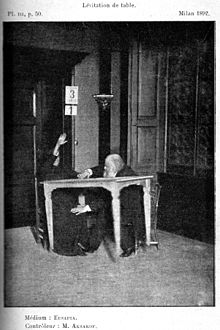
Eusapia Palladino "levitates" a table while researcher
Alexander Aksakof (right) monitors for fraud, Milan, 1892.
- Martin Caidin (1927–1997), the author whose 1972 novel Cyborg was used as the basis for the television series The Six Million Dollar Man and The Bionic Woman, claimed to be able to cause movement by means of telekinesis in one or multiple small tabletop "energy wheels," also known as psi wheels beginning in the mid 1980s.[56][57][58] Parapsychologist Loyd Auerbach, a friend of Caidin's who sometimes accompanied him in demonstrations and workshops, reiterated a strong endorsement of him in his June 2004 Fate magazine column: "Martin Caidin was capable of moving things with his mind."[59] James Randi offered to test Caidin's claimed abilities in 1994.[60] In September 2004, Randi wrote: "He frantically avoided accepting my challenge by refusing even the simplest of proposed control protocols, but he never tired of running on about how I would not test him."[60]
- Uri Geller (1946 – ), the Israeli famous for his spoon bending demonstrations, allegedly by PK.[30] Geller has been caught many times using sleight of hand[61] and according to author Terence Hines, all his effects have been recreated using conjuring tricks.[62]
- Many of India's "godmen" have claimed macro-PK abilities and demonstrated apparently miraculous phenomena in public, although as more controls are put in place to prevent trickery, fewer phenomena are produced.[63] Perhaps the most notable is the spectacular allegation of Mahaavatar Babaji's materialization of an entire palace, mentioned in Paramahamsa Yogananda's classic Autobiography of a Yogi.
- Nina Kulagina (1926–1990), who came to wide public attention following the publication of Sheila Ostrander and Lynn Schroeder's best seller, Psychic Discoveries Behind The Iron Curtain. The alleged Soviet psychic of the late 1960s and early 1970s was filmed apparently performing telekinesis while seated in numerous black-and-white short films,[30][64][65] mentioned in the U.S. Defence Intelligence Agency report from 1978.[66]
- Matthew Manning (1955 – ) of the United Kingdom was the subject of laboratory research in the United States and England involving PK in the late 1970s and today claims healing powers.[30][31]
- Eusapia Palladino (1854–1918; alternate spelling: Eusapia Paladino) was an Italian medium who allegedly could cause objects to move during seances and was endorsed by world famous magician Howard Thurston (1869–1936), who said he witnessed her levitation of a table.[67]
- Swami Rama (1925–1996), a yogi skilled in controlling his heart functions who was studied at the Menninger Foundation in the spring and fall of 1970, and was alleged by some observers at the foundation to have telekinetically moved a knitting needle twice from a distance of five feet.[68] Although Swami Rama wore a facemask and gown to prevent allegations that he moved the needle with his breath or body movements, and air vents in the room had been covered, at least one physician observer who was present at the time was not convinced and expressed the opinion that air movement was somehow the cause.[69]
[edit] Notable witnesses to PK events
Alleged psychokinetic events have been witnessed by psychologists in the United States,
[70][71][72] and elsewhere in the world by professionals with medical degrees,
[72][73] physicists,
[74] electrical engineers,
[71] military personnel,
[75] police officers,
[76] and other professionals and ordinary citizens.
Robert M. Schoch Ph.D., professor at Boston University, has written "I do believe that some psychokinesis is real" referring to the evidence for micro-psychokinesis obtained by the Princeton PEAR laboratory experiments and similar studies and some reports of macro-RSPK observed in poltergeist cases. He reports once seeing a book "jumping off a shelf" while in a room where a female psychokinesis agent was also present.
[77] Best-selling author and medical doctor
Michael Crichton described what he termed a "successful experience" with psychokinesis at a "spoon bending party" in his 1988 book
Travels.
[73] Senior Scientist at the
Institute of Noetic Sciences, author
Dean Radin has reported that he, like Michael Crichton, was able to bend the bowl of a spoon over with unexplained ease of force with witnesses present at a different informal PK experiment gathering. He described his experience in his 2006 book
Entangled Minds: Extrasensory Experiences in a Quantum Reality and online (with photos).
[71] Author
Michael Talbot (1953–1992) described a variety of spontaneous psychokinetic events he experienced and were witnessed by family and friends in two of his books,
Beyond the Quantum and
The Holographic Universe.
French biologist
Remy Chauvin carried out a number of experiments to test psychokinesis. Because of the results of one of the experiments, Chauvin came to believe that mind can influence matter.
[78] Chauvin's experiment involved using a uranium isotope, a
Geiger counter and several assistants. Some parapsychologists have written that ordinary people may be able to influence
biological organisms from distance such as the growth rates of
fungi and
bacteria.
[79] Carroll Nash (1984) reported that human subjects could use their psychokinetic ability to influence the rate at which bacterial genes mutate.
[80]
Anecdotes such as these - stories by eyewitnesses outside of controlled conditions - are considered insufficient evidence by the majority of scientists to establish the scientific validity of psychokinesis.
[28][81]
[edit] PK Parties
"PK Parties" were a cultural fad in the 1980s, where groups of people were guided through rituals and chants to awaken metal-bending powers. They were encouraged to shout at the items of cutlery they had brought and to jump and scream to create an atmosphere of pandemonium (or what scientific investigators called heightened
suggestibility). Critics were excluded and participants were told to avoid looking at their hands. Thousands of people attended these emotionally charged parties, and many became convinced that they had bent silverware by paranormal means.
[82]
[edit] Scientific view
If PK were to exist as claimed by some experimenters, it would violate some well-established laws of physics, including the
inverse square law, the
second law of thermodynamics, and the
conservation of momentum, according to
Martin Gardner and
Thomas Gilovich.
[83][84] Hence scientists have demanded a high standard of evidence for PK, in line with
Marcello Truzzi's dictum "Extraordinary claims require extraordinary proof".
[15][85] When apparent PK can be produced in ordinary ways—by trickery, special effects or by poor experimental design—scientists accept that explanation as more
parsimonious than to accept that the
laws of physics should be rewritten.
[28]
The late
Carl Sagan included telekinesis in a long list of "offerings of pseudoscience and superstition" which "it would be foolish to accept (...) without solid scientific data" though even highly improbable claims may possibly be eventually verified. He placed the
burden of proof on the proponents, but cautioned readers to "await—or, much better, to seek—supporting or disconfirming evidence" for claims that have not been resolved either way.
[86] Nobel Prize laureate
Richard Feynman advocated a similar position.
[87]

Nobel laureate
Brian Josephson coauthored a 1991 scientific paper that agreed with the theories of earlier published researchers that consciousness and the creative mind could have a role in affecting the statistical outcomes of quantum phenomena.
[88]
In their 1991 research paper
Biological Utilization of Quantum Nonlocality, Nobel Prize laureate
Brian Josephson and coauthor Fotini Pallikara-Viras proposed that explanations for both psychokinesis and telepathy might be found in quantum physics.
[88][89] Gerald Feinberg's concept of a
tachyon, a theoretical particle that travels faster than the speed of light has been advocated by some parapsychologists who claim that it could explain psychokinesis.
[90] Haakon Forwald (1897-1978) a Swedish electrical engineer suggested that psychokinesis of objects could occur due to gravitational fields produced by mental influence acting on
neutrons in the
atoms inside the objects, however his hypothesis has never been proven and critics have pointed out his hypothesis is faulted by
general relativity.
[91][92]
There is a broad consensus, including several proponents of parapsychology, that PK research, and parapsychology more generally, has not produced a reliable, repeatable demonstration.
[13][15][93][94]
In 1984, the
United States National Academy of Sciences, at the request of the US Army Research Institute, formed a scientific panel to assess the best evidence from 130 years of parapsychology. Part of its purpose was to investigate military applications of PK, for example to remotely jam or disrupt enemy weaponry. The panel heard from a variety of military staff who believed in PK and made visits to the
PEAR laboratory and two other laboratories that had claimed positive results from micro-PK experiments.
The panel criticised macro-PK experiments for being open to deception by conjurors, and said that virtually all micro-PK experiments "depart from good scientific practice in a variety of ways". Their conclusion, published in a 1987 report, was that there was no scientific evidence for the existence of psychokinesis. Parapsychology advocates responded by accusing the panel of bias.
[95]
Research with random number generators has been influenced by
signal detection theory, viewing the effect of PK as weak but real "signal" hidden in the "noise" of experimental results. An effect too weak to be demonstrated in a replicable experiment would still show up as a statistically significant effect in a large set of data. To test this, parapsychologists have carried out
meta-analyses of large data sets, with apparently impressive positive results.
[96] This has in turn been criticized as an invalid use of meta-analysis, since the original studies are too dissimilar for the resulting statistics to be meaningful.
[12] A 2006 meta-analysis of 380 studies found a small positive effect within the margin that could be explained by
publication bias.
[11]
Physicist
Robert L. Park finds it suspicious that a phenomenon should only ever appear at the limits of detectability of questionable statistical techniques. He cites this feature as one of
Irving Langmuir's indicators of
pathological science. Park argues that if PK really existed it would be easily and unambiguously detectable, for example using modern
microbalances which can detect tiny amounts of force.
[94]
PK hypotheses are also tested implicitly in a number of contexts outside parapsychological experiments. Gardner considers a dice game played in casinos, where gamblers have a large incentive to affect the numbers that come up. This is in effect a large sample-size test of the same hypothesis as the J. B. Rhine dice experiments, but year after year the house takings are exactly those predicted by chance.
[97] Psychologist
Nicholas Humphrey argues that many experiments in
psychology,
biology or
physics assume that the intentions of the subjects or experimenter do
not physically distort the apparatus. Humphrey counts them as replications of PK experiments (but implicitly so) in which PK fails to appear.
[15]
In the book
Parapsychology: The Controversial Science (1991), British parapsychologist Richard S. Broughton, Ph.D, wrote of the differences of opinion among top scientists encountered by
Robert G. Jahn, director of the (now-closed)
PEAR laboratory, regarding the psychokinesis research that the lab was engaged in at the time.
[28]
[edit] Explanations in terms of bias
Cognitive bias research has been interpreted to argue that people are susceptible to illusions of PK. These include both the illusion that they themselves have the power, and that events they witness are real demonstrations of PK.
[98] For example,
Illusion of control is an
illusory correlation between intention and external events, and believers in the paranormal have been shown to be more susceptible to this illusion than skeptics.
[17][99] Psychologist
Thomas Gilovich explains this as a biased interpretation of personal experience. For example, to someone in a dice game willing for a high score, high numbers can be interpreted as "success" and low numbers as "not enough concentration."
[84] Bias towards belief in PK may be an example of the
human tendency to see patterns where none exist, which believers are also more susceptible to.
[98]
A 1952 study tested for
experimenter's bias in a PK context. Richard Kaufman of
Yale University gave subjects the task of trying to influence eight dice and allowed them to record their own scores. They were secretly filmed, so their records could be checked for errors. The results in each case were random and provided no evidence for PK, but believers made errors that favoured the PK hypothesis, while disbelievers made opposite errors. A similar pattern of errors was found in
J. B. Rhine's dice experiments which at that time were the strongest evidence for PK.
[100]
Wiseman and Morris (1995) showed subjects an unedited videotape of a magician's performance in which a fork bent and eventually broke. Believers in the paranormal were significantly more likely to misinterpret the tape as a demonstration of PK, and were more likely to misremember crucial details of the presentation. This suggests that
confirmation bias affects people's interpretation of PK demonstrations.
[18] Psychologist
Robert Sternberg cites confirmation bias as an explanation of why belief in psi phenomena persists, despite the lack of evidence: "[P]eople want to believe, and so they find ways to believe."
[101]
Psychologist
Daniel Wegner has argued that an
introspection illusion contributes to belief in psychokinesis.
[102] He observes that in everyday experience, intention (such as wanting to turn on a light) is followed by action (such as flicking a light switch) in a reliable way, but the underlying neural mechanisms are outside awareness. Hence though subjects may feel that they directly introspect their own
free will, the experience of control is actually inferred from relations between the thought and the action. This theory of
apparent mental causation acknowledges the influence of
David Hume's view of the mind.
[102] This process for detecting when one is responsible for an action is not totally reliable, and when it goes wrong there can be an
illusion of control. This could happen when an external event follows, and is congruent with, a thought in someone's mind, without an actual causal link.
[102]
As evidence, Wegner cites a series of experiments on
magical thinking in which subjects were induced to think they had influenced external events. In one experiment, subjects watched a
basketball player taking a series of
free throws. When they were instructed to visualise him making his shots, they felt that they had contributed to his success.
[103]
[edit] Magic and special effects
Magicians, sleight-of-hand-artists, etc., have successfully simulated some of the specialized abilities of PK (object movement,
spoon bending, levitation, teleportation), but not all of the feats of claimed spontaneous and intentional psychokinesis have been reproduced under the same observed conditions as the original.
[28] According to philosopher
Robert Todd Carroll, there are many impressive magic tricks available to amateurs and professionals to simulate psychokinetic powers.
[104] These can be purchased on the Internet from magic supply companies. Metal objects such as keys or cutlery can be bent by a number of different techniques, even if the performer has not had access to them beforehand.
[105] Amateur-made videos alleging to show feats of psychokinesis, particularly spoon bending and the telekinetic movement of objects, can be found on video-sharing websites such as YouTube. Critics point out that it is now easier than ever for the average person to fake psychokinetic events and that without more concrete proof, the topic, apart from its enjoyment in fiction, will continue to remain controversial.
[44]
The need for PK researchers to be aware of conjuring techniques was illustrated by events in the early 1980s. The McDonnell Laboratory for Psychical Research at Washington University reported a series of experiments in which two subjects had demonstrated PK phenomena (including metal-bending and causing images to appear on film) and other psychic powers under laboratory conditions. Magician
James Randi revealed that the subjects were two of his associates, amateur conjurers Steve Shaw and Michael Edwards. The pair had created the effects by standard trickery, but the researchers, being unfamiliar with magic techniques, interpreted them as proof of PK. The laboratory closed not long after.
[106]
[edit] Prize money for proof of psychokinesis
Internationally, there are several individual skeptics of the paranormal and
skeptics' organizations who offer cash prize money for demonstration of the existence of an extraordinary psychic power, such as psychokinesis. Experimental design must be agreed upon prior to execution, and additional conditions, such as a minimum level of fame, may be imposed. Prizes have been offered specifically for PK demonstrations, for example businessman Gerald Fleming's offer of
£250,000 to Uri Geller if he can bend a spoon under controlled conditions.
[107] These prizes remain uncollected by people claiming to possess paranormal abilities.
The
James Randi Educational Foundation offers
US$1,000,000 to anyone who has a demonstrated media profile as well as the support from some member of the academic community, and who can produce a paranormal event, such as psychokinesis, in a controlled, mutually agreed upon experiment.
[edit] In religion, mythology and popular culture
There are written accounts and oral legends of events fitting the description of psychokinesis dating back to early history, most notably in the stories found in various religions and mythology. In the Bible, for example, Jesus is described as transmuting water into wine, an act some have described as an example of psychokinesis,
[108] healing the sick, and multiplying food.
[109]
Mythological beings, such as witches, have been described as levitating people, animals, and objects.
[110] The court wizard and prophet
Merlin in the
King Arthur legend, is said to have used his power to transport
Stonehenge across the sea to England from Ireland.
[111]
Psychokinesis has been an aspect in movies, television, computer games, literature, and other forms of popular culture, often presented as a
superpower. An early example is the 1952 novella
Telek by
Jack Vance. Notable portrayals of psychokinetic characters include
Sissy Spacek as a troubled high school student in the 1976 film
Carrie, based on the
Stephen King novel of the same name,
[112] Ellen Burstyn in the healer-themed film
Resurrection (1980),
[113] and by high school seniors Andrew Detmer, Steve Montgomery, and Matt Garetty from the 2012 film
Chronicle. Psychokinesis is also commonly used as a power in a large number of
videogames and
role playing games.
[edit] See also
[edit] References
- ^ Random House (2005-07-12). Random House Webster's Unabridged Dictionary. Boston, Massachusetts: Random House Reference. p. 1560. ISBN 978-0-375-42599-8. OCLC 48010385. http://books.google.com/?id=y6aOPgAACAAJ. "psycho-, a combining form representing psyche in compound words. ... (Gk, comb. form of psyche breath, spirit, soul, mind; akin to psycheim to blow)."
- ^ Erin McKean, [principal editor]. (2005-04-08). The New Oxford American Dictionary. New York City: Oxford University Press. p. 1367. ISBN 978-0-19-517077-1. OCLC 123434455. http://books.google.com/?id=opNWcgAACAAJ. "psycho. comb. form relating to the mind or psychology: ...from Greek psukhe breath, soul, mind."
- ^ "Encyclopædia Britannica online: psychokinesis". http://www.britannica.com/eb/article-9061720. Retrieved July 16, 2006.
- ^ Holt, Henry, On the Cosmic Relation - Book II- Part III, Psychokinesis, pp.216-217
- ^ a b "Parapsychological Association, glossary of key words frequently used in parapsychology". http://parapsych.org/glossary_l_r.html#p. Retrieved December 20, 2006.
- ^ Search+OMD "On-Line Medical Dictionary: psychokinesis". http://cancerweb.ncl.ac.uk/cgi-bin/omd?query=psychokinesis&action= Search+OMD. Retrieved July 16, 2006.
- ^ Jeffers, Stanley (May/June 2007, Vol. 31, Issue 3). "PEAR Lab Closes, Ending Decades of Psychic Research," Skeptical Inquirer. Amherst, New York, USA: Committee for Skeptical Inquiry. p. 16. "Much of the work of the PEAR group has employed 'random event generators' (REGs), which are essentially electronic random number generators whose ' operators' are invited by dint [force, power] of their own intentionality, to bias in such a way, that the mean of the random number distribution would be either much higher or lower than it would be in the absence of their intentional efforts..."
- ^ "Parapsychological Association FAQ". Parapsychological Association. 1995. Archived from the original on 2011-08-21. http://www.parapsych.org/faq_file1.html. Retrieved 2007-07-02.
- ^ "The Princeton Engineering Anomalies Research". http://www.princeton.edu/~pear/.
- ^ "Parapsychological Association FAQs - discussion of random number generator experiments.". http://parapsych.org/faq_file2.html#12. Retrieved August 13, 2007.
- ^ a b c Bösch, Holger; Fiona Steinkamp, Emil Boller (July 2006). "Examining psychokinesis: The interaction of human intention with random number generators--A meta-analysis". Psychological Bulletin 132 (4): 497–523. doi:10.1037/0033-2909.132.4.497. PMID 16822162.
- ^ a b Hyman, Ray; Henry L. Roediger, Diane F. Halpern (2007). "Evaluating Parapsychological Claims". In Robert J. Sternberg, Henry L. Roediger, Diane F. Halpern. Critical Thinking in Psychology. Cambridge University Press. p. 218. ISBN 978-0-521-60834-3. http://books.google.com/?id=3mA9NPAgWR0C.
- ^ a b Vyse, Stuart A. (2000-03-01). Believing in Magic: The Psychology of Superstition. Oxford University Press US. p. 129. ISBN 978-0-19-513634-0. http://books.google.com/?id=QGysXzdTxo0C. "[M]ost scientists, both psychologists and physicists, agree that it has yet to be convincingly demonstrated."
- ^ Girden, Edward (September 1962). "A review of psychokinesis (PK)". Psychological Bulletin 59 (5): 353–388. doi:10.1037/h0048209.
- ^ a b c d Humphrey, Nicholas K. (1995). Soul Searching: Human nature and supernatural belief. Chatto & Windus. ISBN 978-0-7011-5963-4.
- ^ Carroll, Robert Todd (2005). "psychokinesis (PK)". Skepdic.com. The Skeptics Dictionary. http://skepdic.com/kinesis.html. Retrieved 2007-10-05.
- ^ a b Benassi, Victor A.; Paul D. Sweeney, and Gregg E. Drevno (1979). "Mind over matter: Perceived success at psychokinesis". Journal of Personality and Social Psychology 37 (8): 1377–1386. doi:10.1037/0022-3514.37.8.1377. http://psycnet.apa.org/journals/psp/37/8/1377/. Retrieved 2008-11-16.
- ^ a b Wiseman, Richard; Robert Morris (1995). "Recalling pseudo-psychic demonstrations". British Journal of Psychology 86 (1): 113–125. doi:10.1111/j.2044-8295.1995.tb02549.x. http://search.ebscohost.com/login.aspx?direct=true&db=bth&AN=9507101503&site=ehost-live. Retrieved 2008-11-29.
- ^ Hajela, Deepti (October 3, 2005). "New exhibit looks at occult photography". Associated Press story. http://www.azcentral.com/ent/arts/articles/1003occult.html. Retrieved January 19, 2008.
- ^ Myers, Frederic William Henry (December 1890). Proceedings. London, England: Journal of the Society for Psychical Research. "For the alleged movements without contact... M. Aksakof's new word 'telekinetic' seems to me the best attainable." Note: this quote as a cited reference can also be seen on page 722 in the multivolume "The Oxford English Dictionary, Second Edition", 1989, Clarendon Press, Oxford, England, ISBN 978-0-19-861229-2." The "M. Aksakof" is actually "A. Aksakof," as indicated in this 1896 quarterly journal Borderland
- ^ "Online Etymology Dictionary". Archived from the original on 2011-08-27. http://www.etymonline.com/index.php?term=telekinesis. Retrieved January 20, 2007. "Telekinesis. 1890, said to have been coined by Alexander N. Aksakof (1832-1903) Imperial Councilor to the Czar... Translates Ger. 'Fernwirkung.'"
- ^ ed. in chief Frederick C. Mish (2005). Merriam-Webster's Collegiate Dictionary, Eleventh Edition. Springfield, Massachusetts, USA: Merriam-Webster, Incorporated. p. 1004. ISBN 978-0-87779-809-5. OCLC 146761465. http://books.google.com/?id=TAnheeIPcAEC. "Psychokinesis (1914)...."
- ^ "Parapsychology Foundation "Basic terms in Parapsychology"". Archived from the original on 2011-08-27. http://www.parapsychology.org/dynamic/060100.html. Retrieved December 22, 2006.
- ^ Holt, Henry (1914) (PDF). On the Cosmic Relations. Cambridge: Houghton Mifflin. http://books.google.com/?id=Kts0AAAAMAAJ. Retrieved 2007-12-13.
- ^ a b c Spence, Lewis (2003-02-01). Encyclopedia of Occultism and Parapsychology. Kessinger Publishing (reprint publisher). pp. 752–753, 879, 912, 933. ISBN 978-0-7661-2817-0. http://books.google.com/?id=gq1LhcH48GQC.
- ^ "Parapsychological Association - Glossary: PK/Psychokinesis". http://parapsych.org/glossary_l_r.html#p. Retrieved July 19, 2006.
- ^ "Overview of Current Parapsychology Research in the Former Soviet Union, Introduction" (PDF). Subtle Energies Volume 3, Number 3. 1992. p. 1. http://www.lfr.org/LFR/csl/library/Fsu1.pdf. Retrieved July 3, 2007. "AMP research programs in the Soviet Union have primarily focused on experimental studies in 'distant influence' on animate an inanimate systems; i.e., psychokinesis (PK) and bio-PK."
- ^ a b c d e f g h Broughton, Richard S. (1991-07-30). Parapsychology: The Controversial Science. New York: Ballantine Books. pp. 35, 75–79, 149, 161–162, 329–330. ISBN 978-0-345-35638-3. http://books.google.com/?id=4GlRAAAAYAAJ.
- ^ "Overview of Current Parapsychology Research in the Former Soviet Union, Abstract" (PDF). Subtle Energies Volume 3, Number 3. 1992. p. 1. http://www.lfr.org/LFR/csl/library/Fsu1.pdf. Retrieved July 3, 2007. "The authors primarily discuss experiments in anomalous perturbation (often referred to as psychokinesis—PK and bio- which have been the main focus of AMP research programs in the Soviet Union."
- ^ a b c d e f g h Berger, Arthur S.; Berger, Joyce (1991-02). The Encyclopedia of Parapsychological and Psychical Research. New York: Paragon House. pp. 326, 341, 430. ISBN 978-1-55778-043-0. http://books.google.com/?id=SmzGQgAACAAJ.
- ^ a b editor in chief, Richard Cavendish ; editorial board, C.A. Burland ... [et al.] ; new edition edited and compiled by Richard Cavendish and Brian Innes.; Brian Innes (1995) [1970]. Man, Myth & Magic: The Illustrated Encyclopedia of Mythology, Religion, and the Unknown. New York: Marshall Cavendish Corporation. p. 2442. ISBN 978-1-85435-731-1. OCLC 228665658. http://books.google.com/?id=H-QaAQAAMAAJ. "Spiritualism aroused violent antagonism and criticism concentrating particularly on the physical phenomena occurring at seances, which opponents claimed were faked." Page 1626, v. 12: entry on Matthew Manning.
- ^ Hamlin Garland Forty years of psychic research: a plain narrative of fact 1936, pp. 127-128
- ^ H. F. Prevost Battersby Psychic Certainties Kessinger Reprint Edition, 1988, pp. 125-126
- ^ Hereward Carrington Eusapia Palladino and Her Phenomena Kessinger Reprint Edition, 2003, p. 267
- ^ Davis, Eric; physicist, Ph.D, U.S. Air Force Research Laboratory, 2004. "Teleportation Physics Study" (PDF). p. 55. http://www.fas.org/sgp/eprint/teleport.pdf. Retrieved July 19, 2006. "Telekinesis is a form of PK, which describes the movement of stationary objects without the use of any known physical force."
- ^ Colman, Andrew M. (2009). A Dictionary of Psychology. New York City: Oxford University Press, Inc.. ISBN 9780199534067.
- ^ a b c d e Guiley, Rosemary Ellen (2001-07-17). Encyclopedia of the Strange, Mystical & Unexplained. New York: Gramercy Books. pp. 454, 456, 478, 609. ISBN 978-0-517-16278-1.
- ^ "Library.ThinkQuest.org - Glossary: Macro PK and Micro PK". http://library.thinkquest.org/C0120993/glossaryfull.html. Retrieved October 14, 2006.
- ^ Roll, William G.; Pratt, J. G. (1958). The Seaford Disturbances. Journal of Parapsychology, Vol. 2,. pp. 79–124.
- ^ "Parapsychological Association - Glossary: "RSPK"". http://parapsych.org/glossary_l_r.html#r. Retrieved January 5, 2007.
- ^ Pratt, J. G.; Stevenson, Ian (Vol. 70, January 1976). An Instance of Possible Metal-Bending Indirectly Related to Uri Geller. The Journal of the American Society for Psychical Research. "As far as I can say, no one in the apartment that night would take credit for being the responsible PK agent."
- ^ Reader's digest ; [chief contributing writer, Richard Marshall ; contributing writers, Monte Davis, Valerie Moolman, Georg Zappler]. (1990). Mysteries of the Unexplained. Readers Digest Association. p. 181. ISBN 978-0-89577-146-9. OCLC 10605367. http://books.google.com/?id=MjqcKUX9x74C. "Attempting to understand the forces at work, researchers in parapsychology have hypothesized that the poltergeist's feats in moving objects (which are seen to fly in violation of the laws of gravity, gliding, rising, and turning corners) are examples of psychokinesis, or PK—the ability to influence inanimate objects by mind power."
- ^ a b c Kakalios, James (2005-10-04). The Physics of Superheores. New York: Gotham Books/Penguin Group, Inc.. ISBN 978-1-59240-146-8. http://books.google.com/?id=4Ne3QgAACAAJ. The author, James Kakalios, is a physics professr. Page 133: 'Knowing that all matter is composed of atoms, we now recognize that when an object is 'hot,' the kinetic energy of the constituent atoms is large, while when an object is 'cold,' the kinetic energy of the atoms is lower." Pages 254-255: "With our improved understanding of physics, we can now more accurately describe Kitty Pryde's mutant power as being able to alter her macroscopic quantum wave function, increasing her tunneling probability to near 100 percent at will." Page 255: "How, when she's is 'phasing' and immaterial, can she walk?"
- ^ a b Genzmer, Herbert; Hellenbrand, Ulrich (2007-03). "Psychokinesis". Mysteries of the World: Unexplained Wonders and Mysterious Phenomena. Bath, United Kingdom: Parragon Books Ltd. p. 194. ISBN 978-1-4054-9022-1. http://books.google.com/?id=uHgAGQAACAAJ. Republished in 2012 as Myths and Mysteries of the World, same publisher and cited page number, new ISBN 978-1-4454-9026-7.
- ^ a b c d e f the editors of Time-Life Books. (1988-11). Mind Over Matter (volume of Mysteries of the Unknown encyclopedia series). New York: Time-Life Books. pp. 7–8, 27, 82, 85. ISBN 978-0-8094-6336-7. OCLC 17877875. http://books.google.com/?id=WIZ53Ea82GQC.
- ^ Hathaway, Michael R. (2003-09-01). "Glossary". The Everything Psychic Book. Avon, Massachusetts, USA: Adams Media / F+W Publications Company. pp. 139, 271. ISBN 978-1-58062-969-0. http://books.google.com/?id=8_262Olw3RUC. "Psychokinesis. The ability to levitate, move objects, heal, and manipulate psychic energy...Psychokinesis is the ability to...create healing."
- ^ ed. in chief Frederick C. Mish (2004). Merriam-Webster's Collegiate Dictionary, Eleventh Edition. Springfield, Massachusetts, USA: Merriam-Webster, Incorporated. p. 1284. ISBN 978-0-87779-809-5. OCLC 146761465. http://books.google.com/?id=TAnheeIPcAEC. "Teleportation. The act or process of moving an object or person by psychokinesis."
- ^ Colman, Andrew M. (2001). Dictionary of Psychology. Oxford, England, UK: Oxford University Press. p. 599. ISBN 978-0-19-866211-2. http://books.google.com/?id=2tenQgAACAAJ. "Psychokinesis. The movement or change of physical objects by mental processes"
- ^ editor in chief, Richard Cavendish ; editorial board, C.A. Burland ... [et al.] ; new edition edited and compiled by Richard Cavendish and Brian Innes.; Brian Innes (1995). Man, Myth & Magic: The Illustrated Encyclopedia of Mythology, Religion, and the Unknown. New York: Marshall Cavendish Corporation. p. 2354. ISBN 978-1-85435-731-1. OCLC 228665658. http://books.google.com/?id=H-QaAQAAMAAJ. "Shape-shifting. The idea that it is possible, in certain circumstances, for men to change their natural bodily form... Sorcerers also, and some great heroes, were believed to have the same power, by virtue of magical knowledge or some innate quality; and so, though more rarely, were a few otherwise ordinary people who acquired the gift through possession of a charm or the performance of a ritual act."
- ^ "Mass Media Funk". The Skeptic's Dictionary. http://skepdic.com/refuge/funk3.html. Retrieved February 27, 2007. "Those who practice TT [Therapeutic Touch] believe they are able to move 'energy,' some sort of psychic force field or chi which they believe permeates the body and surrounding aura."
- ^ Bersani, F.; Martelli, A. (1983). Psychoenergetics: The Journal of Psychophysical Systems. United Kingdom: Gordon and Breach Science Publishers. pp. 99–128. "The effects observed range from the typical bending of metal objects, such as spoons, keys, bars, etc., to strange effects like light flashes and teleportation."
- ^ McCoy, Edain (1999-03-01). Astral Projection for beginners. Woodbury, Minnesota: Llewllyn Publications. p. 207. ISBN 978-1-56718-625-3. http://books.google.com/?id=ak1__e0HmgYC. "Creative visualization is the practice of mentally envisioning a desired outcome, infusing it with personal energy, and then releasing it to the cosmos so that it can grow to manifest in the physical. While all that sounds unduly complicated, what it boils down to is that it creates a thoughtform on the astral plane that, with proper effort, can be brought into the physical world."
- ^ editor in chief, Richard Cavendish ; editorial board, C.A. Burland ... [et al.] ; new edition edited and compiled by Richard Cavendish and Brian Innes.; Brian Innes (1995). Man, Myth & Magic: The Illustrated Encyclopedia of Mythology, Religion, and the Unknown. New York: Marshall Cavendish Corporation. p. 2679. ISBN 978-1-85435-731-1. OCLC 228665658. http://books.google.com/?id=H-QaAQAAMAAJ. "The evocation of a tulpa, an entity created entirely by an act of the imagination, was described by Alexandra David-Néel in her book Magic and"
- ^ Study conducted by the Gallup Organization between October 8, 2005 and December 12, 2005 on behalf of the Baylor Institute for Studies of Religion, Baylor University, of Waco, Texas, in the United States.
- ^ "Magicians and the Paranormal: A Survey". http://richardwiseman.com/magicsurvey. Retrieved May 7, 2008. Published April 23, 2008.
- ^ Caidin, Martin (January 1994). "Telekinesis". Fate (Lakeville, USA: Llewellyn Publications/Galde Press, Inc.). http://www.fatemag.com/fatemagold/issues/1990s/1994-01.html.
- ^ Auerbach, Loyd (1996-05-01). Mind Over Matter. Kensington Publishing Corporation. ISBN 978-1-57566-047-9. http://books.google.com/?id=77xnPQAACAAJ.
- ^ Heath, Pamela Rae (2011-02-24). Mind-Matter Interaction: A Review of Historical Reports, Theory and Research. Jefferson, North Carolina USA: McFarland. ISBN 978-0-7864-4971-2. http://books.google.com/?id=OwVgHlx4KQEC.
- ^ Auerbach, Loyd (June 2004). "The Psychokinetic Zone". Fate (Lakeville, USA: Galde Press, Inc.). Monthly column "Psychic Frontiers"
- ^ a b "Swift, September 24, 2004". http://www.randi.org/jr/092404from.html. Retrieved February 1, 2011. Online newsletter of the JREF.
- ^ Hines, Terence (2003). Pseudoscience and the Paranormal (2nd ed.). Prometheus. p. 126. ISBN 978-1-57392-979-0. http://books.google.com/?id=Px0RAQAAIAAJ.
- ^ Hines, Terence (2003). Pseudoscience and the Paranormal (2nd ed.). Prometheus. p. 130. ISBN 978-1-57392-979-0. http://books.google.com/?id=Px0RAQAAIAAJ.
- ^ Wiseman, Richard (1997). Deception & Self-deception: Investigating Psychics. Prometheus Books. ISBN 978-1-57392-121-3. http://books.google.com/?id=pDMNAQAAMAAJ. chapters 6-8
- ^ J. Gaither Pratt, H. H. Jürgen Keil (1973). First Hand Observations of Nina S. Kulagina Suggestive of PK on Static Objects. 67. Journal of the American Society for Psychical Research. pp. 381–390.
- ^ Jürgen Keil (1984) (in German). Parapsychologie in der Sowjetunion. 26. Zeitschrift für Parapsychologie und Grenzgebiete der Psychologie. pp. 191–210.
- ^ Paraphysics R&D - Warsaw Pact (U). Prepared by U.S. Air Force, Air Force Systems Command Foreign Technology Division. DST-1810S-202-78, Nr. DIA TASK NO. PT-1810-18-76. Defense Intelligence Agency. 30. March 1978. pp. 7–8. http://www.dia.mil/publicaffairs/Foia/pa_warsaw.pdf. "G.A. Sergevev is known to have studied Nina Kulagina, a well-known psychic from Leningrad. Although no detailed results are available, Sergevev's inferences are that she was successful in repeating psychokinetic phenomena under controlled conditions. G.A. Sergevev is a well-respected researcher and has been active in paraphysics research since the early 1960s."
- ^ Muldoon, Sylvan (1947). Psychic Experiences of Famous People. Chicago: Aries Press. pp. 55–56. See endorsement quote by Thurston at Eusapia Palladino article. Text of entire book also available at google.books.com
- ^ Green, Elmer; Alyce Green (1977). Beyond Biofeedback. Knoll Publishing Co. pp. 197–218. ISBN 978-0-440-00583-4. http://books.google.com/?id=f3aN8vnf3YIC.
- ^ "http://www.swamij.com/pdf/swami-rama-beyond-biofeedback.pdf" (PDF). pp. 12–16. http://www.swamij.com/pdf/swami-rama-beyond-biofeedback.pdf. Retrieved July 24, 2007.Elmer Green's description of Swami Rama's alleged psychokinetic demonstration (with illustrations).
- ^ Roll, William G.; Storey, Valerie (2004-05-18). Unleashed — Of Poltergeists and Murder: The Curious Story of Tina Resch. New York: Paraview Pocket Books/Simon and Schuster. ISBN 978-0-7434-8294-3. OCLC 55117933. http://books.google.com/?id=y-X8haq31KAC. William G. Roll, Ph.D., and Jeannie Lagle (Masters degree) both state that they witnessed psychokinesis involving Tina Resch. Roll additionally reports numerous other cases he investigated.
- ^ a b c "Official website of Dean Radin". http://www.deanradin.com/NewWeb/bio.html. Retrieved June 9, 2007. see also Dean
- ^ a b "Official website of Pamela Heath". http://pamelaheath.com/about.htm. Retrieved June 9, 2007.
- ^ a b "Official website of Michael Crichton". http://www.crichton-official.com/aboutmichaelcrichton-biography.html. Retrieved March 27, 2012. See also, same site: Spoonbending.
- ^ Hasted, John B. (1981-03-05). The Metal Benders. London: Routledge and Kegan Paul. ISBN 978-0-7100-0597-7. OCLC 7923491. http://books.google.com/?id=PLc9AAAAIAAJ.John B. Hasted (1921-2002), Ph.D., Physics professor, University of London. In his book The Metal- Benders, he describes his research of psychokinesis claimants and psychokinesis events he personally witnessed.
- ^ Ronson, Jon (2006-04-04). The Men Who Stare at Goats. New York: Simon & Schuster. pp. 63, (Back cover). ISBN 978-0-7432-7060-1. http://books.google.com/?id=KrwdbEHBd6AC."In 1979, a secret unit was established by the most gifted minds within the US Army. Defying all known accepted military practice—and indeed, the laws of physics—they believed that a soldier could adopt a cloak of invisibility, pass cleanly through walls, and, perhaps most chillingly, kill goats just by staring at them."; "Lenny from Special Forces disappeared into the room where the goat was. He came back and answered, with surprise and solemnity, "The goat is down.'"
- ^ Roll, William G.; Storey, Valerie (2004-05-18). Unleashed — Of Poltergeists and Murder: The Curious Story of Tina Resch. New York: Paraview Pocket Books/Simon and Schuster. ISBN 978-0-7434-8294-3. OCLC 55117933. http://books.google.com/?id=y-X8haq31KAC. Two police officers witnessed alleged psychokinetic activity in the Resch home in the 1984 Columbus poltergeist case.
- ^ Schoch, Robert M. (January/February 2008). "Psychokinesis: A Scientist Searches for the Reality Behind PK's Representations". Atlantis Rising (Livingston, Montana USA): 42–43, 70–71.
- ^ Znanie-Sila magazine, No 9, 1967 U.S.S.R.
- ^ Barry, J. (1968). General and comparative study of the psychokinetic effect on fungus culture. Journal of Parapsychology, 32, 237–243 also see Barry, J. (1968). PK on fungus growth. Journal of Parapsychology, 32, 55. (Abstract.)
- ^ Nash, C. B. (1984). Test of psychokinetic control of bacterial mutation. Journal of the American Society for Psychical Research, 78, 145–152.
- ^ Hennacy Powell, M.D., Diane (2009-01-13). The ESP Enigma: The Scientific Case for Psychic Phenomena. New York: Walker & Company. p. 5. ISBN 978-0-8027-1606-4. http://books.google.com/?id=pvlv2efnFY0C.
- ^ Frazier, Kendrick (1990-12-31). "Improving Human Performance: What About Parapsychology?". In Kendrick Frazier. The Hundredth Monkey and Other Paradigms of the Paranormal. Prometheus Books. pp. 156–157. ISBN 978-0-87975-655-0. http://books.google.com/?id=AzQNAQAAMAAJ.
- ^ Gardner, Martin (1981-09). "Einstein and ESP". In Kendrick Frazier. Paranormal Borderlands of Science. Prometheus. pp. 60–65. ISBN 978-0-87975-148-7. http://books.google.com/?id=XjENAQAAMAAJ.
- ^ a b Gilovich, Thomas (1993). How We Know What Isn't So: The fallibility of human reason in everyday life. Simon & Schuster. pp. 174–175. ISBN 978-0-02-911706-4. http://books.google.com/?id=LURGkHCPAJEC.
- ^ Sutherland, Stuart (1994). Irrationality: the enemy within. Penguin books. p. 309. ISBN 978-0-14-016726-9. http://books.google.com/?id=HAVjQgAACAAJ. "[T]he movement of objects without the application of physical force would, if proven, require a complete revision of the laws of physics. (...) [T]he more improbable something is, the better the evidence needed to accept it"
- ^ Sagan, Carl (1995). The Demon-Haunted World: Science as a candle in the dark. Headline. pp. 208–212. ISBN 978-0-7472-7745-3. http://books.google.com/?id=CYo7PgAACAAJ.
- ^ Feynman, Richard P. (1999-02-01). The Meaning of It All. Penguin. pp. 68–71. ISBN 978-0-14-027635-0. http://books.google.com/?id=AdGBQwAACAAJ.
- ^ a b Josephson, Brian D.; Pallikari-Viras, Fotini. "Biological Utilization of Quantum Nonlocality". http://www.tcm.phy.cam.ac.uk/~bdj10/papers/bell.html. Retrieved December 18, 2008. Foundations in Physics, Vol. 21, pp. 197-207, 1991, Plenum Press, New York.
- ^ Michael Hanlon (2007-05-29). 10 Questions Science Can't Answer (Yet). New York: Macmillan. pp. 165–166. ISBN 978-0-230-51758-5. http://books.google.com/?id=5y-NgsrQn8MC.
- ^ Marc Seifer, Stanley Krippner Transcending the Speed of Light 2008, p. 52
- ^ Haakon Forwald Mind, matter, and gravitation: a theoretical and experimental study Parapsychology Foundation, 1969
- ^ The Journal of parapsychology, Volume 48, Duke University Press, 1984, p. 302
- ^ Gilovich, Thomas (1993). How We Know What Isn't So: The fallibility of human reason in everyday life. Simon & Schuster. pp. 160, 169. ISBN 978-0-02-911706-4. http://books.google.com/?id=LURGkHCPAJEC.
- ^ a b Park, Robert L. (2002-07). Voodoo Science: The road from foolishness to fraud. Oxford University Press. pp. 198–200. ISBN 978-0-19-860443-3. http://books.google.com/?id=xzCK6-Kqs6QC.
- ^ Frazier, Kendrick (1990-12-31). "Improving Human Performance: What About Parapsychology?". In Kendrick Frazier. The Hundredth Monkey and Other Paradigms of the Paranormal. Prometheus Books. pp. 149–161. ISBN 978-0-87975-655-0. http://books.google.com/?id=AzQNAQAAMAAJ.
- ^ Radin, Dean (1997). The Conscious Universe: The Scientific Truth of Psychic Phenomena. HarperEdge.
- ^ Gardner, Martin (1957). Fads & Fallacies in the Name of Science. Dover. p. 307. ISBN 978-0-486-20394-2. http://books.google.com/?id=TwP3SGAUsnkC.
- ^ a b Blackmore, Susan J. (1992). "Psychic Experiences: Psychic Illusions". Skeptical Inquirer 16: 367–376.
- ^ Blackmore, Susan J.; Tom Trościanko (1985). "Belief in the paranormal Probability judgements, illusory control, and the "chance baseline shift."". British Journal of Psychology 76 (4): 459–468. doi:10.1111/j.2044-8295.1985.tb01969.x. http://search.ebscohost.com/login.aspx?direct=true&db=bth&AN=5701336&site=ehost-live. Retrieved 2008-11-16.
- ^ Gardner, Martin (1957). Fads & Fallacies in the Name of Science. Dover. p. 306. ISBN 978-0-486-20394-2. http://books.google.com/?id=TwP3SGAUsnkC.
- ^ Sternberg, Robert J.; Henry L. Roediger, Diane F. Halpern (2007). "Critical Thinking in Psychology: It really is critical". In Robert J. Sternberg, Henry L. Roediger, Diane F. Halpern. Critical Thinking in Psychology. Cambridge University Press. p. 292. ISBN 978-0-521-60834-3. http://books.google.com/?id=3mA9NPAgWR0C. "Some of the worst examples of confirmation bias are in research on parapsychology (...) Arguably, there is a whole field here with no powerful confirming data at all. But people want to believe, and so they find ways to believe."
- ^ a b c Wegner, Daniel M.; James C. Kaufman, Roy F. Baumeister (2008). "Self is Magic". In John Baer, James C. Kaufman, Roy F. Baumeister. Are we free?: psychology and free will. New York: Oxford University Press. ISBN 978-0-19-518963-6. http://isites.harvard.edu/fs/docs/icb.topic67047.files/2_13_07_Wegner.pdf. Retrieved 2008-07-02.
- ^ Pronin, Emily; Daniel M. Wegner, Kimberly McCarthy, Sylvia Rodriguez (2006). "Everyday Magical Powers: The Role of Apparent Mental Causation in the Overestimation of Personal Influence". Journal of Personality and Social Psychology (American Psychological Association) 91 (2): 218–231. doi:10.1037/0022-3514.91.2.218. ISSN 0022-3514. PMID 16881760. http://www.wjh.harvard.edu/~wegner/pdfs/Pronin,%20Wegner,%20McCarthy,%20&%20Rodriguez%20(2006).pdf. Retrieved 2009-07-03.
- ^ Carroll, Robert Todd (2003-07-17). "Psychokinesis". The Skeptic's Dictionary: a collection of strange beliefs, amusing deceptions, and dangerous delusions. Wiley. p. 316. ISBN 978-0-471-27242-7. http://books.google.com/?id=6FPqDFx40vYC.
- ^ Hines, Terence (2003). Pseudoscience and the Paranormal (2nd ed.). Prometheus. pp. 127–131. ISBN 978-1-57392-979-0. http://books.google.com/?id=Px0RAQAAIAAJ.
- ^ Colman, Andrew M. (1987). Facts, Fallacies and Frauds in Psychology. Unwin Hyman. pp. 195–6. ISBN 978-0-09-173041-3.
- ^ Hutchinson, Mike (1988). "A Thorn in Geller's Side". British and Irish Skeptic (July/August): 2–4.
- ^ Brian, Denis (2000-11). The Voice of Genius: Conversations with Nobel Scientists and Other Luminaries. New York: Basic Books, imprint of Perseus Books. p. 288. ISBN 978-0-7382-0447-5. http://books.google.com/?id=x1BYMA-8oq8C. ". . . parapsychologists are studying some of the unusual events recorded in the Bible: changing water into wine could be called psychokinesis; . . . People have spoken of such things from early times and they seem to occur in every civilization."
- ^ Heath, Pamela Rae, M.D., Psy.D. (2003-07). The PK Zone: A Cross-Cultural review of Psychokinesis. Bloomington, Indiana: iUniverse. p. 3. ISBN 978-0-595-27658-5. http://books.google.com/?id=nRfTKWwCTIoC. "Religion has seemed to provide fertile ground for both spontaneous and intentional PK. Every great religious tract of mankind includes stories of people with the ability to heal and to multiply food, such as the Bible says were performed by Jesus Christ."
- ^ Guiley, Rosemary Ellen (1989). The Encyclopedia of Witches and Witchcraft. New York: Facts On File. p. 201. ISBN 0-8160-1793. "In hauntings, witches, poltergeists, and fairies have been blamed for levitating people, animals, and objects."
- ^ Newall, Venetia; Richard Mercer Dorson (1974). The Encyclopedia of Witchcraft & Magic. New York: The Dial Press. p. 121. ISBN 978-0-8037-2343-6. "He performed many feats of magic, sailing through the ocean in a house of glass and transporting Stonehenge across the sea from Ireland."
- ^ 1 "http://movies.msn.com/movies/movie-awards-and-nominations/carrie.3 1". http://movies.msn.com/movies/movie-awards-and-nominations/carrie.3 1. Retrieved September 30, 2011.
- ^ 2 "http://movies.msn.com/movies/movie-awards-and-nominations/resurrection.5/?ipp=15 2". http://movies.msn.com/movies/movie-awards-and-nominations/resurrection.5/?ipp=15 2. Retrieved September 30, 2011.
[edit] Further reading
- Minds and motion: the riddle of psychokinesis, D. Scott Rogo, Taplinger Pub. Co., 1978.
- To stretch a plank: a survey of psychokinesis, Diana Robinson, Nelson-Hall, 1981.
- The Conscious Universe: The Scientific Truth of Psychic Phenomena, Dean Radin, HarperEdge, 1997.
- William Braud (2003-12). Distant mental influence: its contributions to science, healing, and human interactions. Hampton Roads Pub Co Inc. ISBN 978-1-57174-354-1. http://books.google.com/?id=WEUHAAAACAAJ.
- Richard John Wiseman (1997). Deception & self-deception: investigating psychics. ISBN 978-1-57392-121-3. http://books.google.com/?id=pDMNAQAAMAAJ.
- Charles T. Tart; Huston Smith, Kendra Smith (2009-03-15). The end of materialism: how evidence of the paranormal is bringing science and spirit together. Ions / Nhp. ISBN 978-1-57224-645-4. http://books.google.com/?id=tzZj0FHfMggC.
- Entangled Minds: Extrasensory Experiences in a Quantum Reality, Dean Radin, Pocket Books, 2006.
- Diane Hennacy Powell (2009-01-13). The ESP Enigma: The Scientific Case for Psychic Phenomena. Walker & Company. ISBN 978-0-8027-1606-4. http://books.google.com/?id=pvlv2efnFY0C.
- Lynne McTaggart (2007-12-18). The Field: The Quest for the Secret Force of the Universe. Harper Paperbacks. ISBN 978-0-06-143518-8. http://books.google.com/?id=VtNaz_vSnIIC.
- James Randi (1982-06-01). Flim-flam!: psychics, ESP, unicorns, and other delusions. Pyr Books. ISBN 978-0-87975-198-2. http://books.google.com/?id=UHoQAQAAIAAJ.
- James Houran; Rense Lange (2001-06-30). Hauntings and poltergeists: multidisciplinary perspectives. McFarland & Company. ISBN 978-0-7864-0984-6. http://books.google.com/?id=BwTP31-3JRcC.
- Thomas Gilovich (1993). How we know what isn't so: the fallibility of human reason in everyday life. Free Press. ISBN 978-0-02-911706-4. http://books.google.com/?id=LURGkHCPAJEC.
[edit] Published Papers on PK / TK
- The Journal of Non-Locality and Remote Mental Interactions A journal of PK-related research papers published by EmergentMind.org.
- Examining Psychokinesis: The Interaction of Human Intention With Random Number Generators – A Meta-Analysis by Holger Bösch, Fiona Steinkamp, and Emil Boller, Psychological Bulletin, 132, 497-523, 2006.
- Solar-periodic full moon effect in the Fourmilab RetroPsychoKinesis Project experiment data: an exploratory study by Eckhard Etzold Journal of Parapsychology, Fall 2005.
- Does Psi Exist and Can We prove It: Belief and Disbelief in Psychokinesis Research by Eckhard Etzold, presented at the Parapsychological Association Convention 2004.
- Material Deformation by Intention by Jack Houck, presented at the Science of Whole Person Healing Conference, March 28, 2003.
- "Can Our Intentions Interact Directly with the Physical World?" by William G. Braud, European Journal of Parapsychology, Vol. 10, 1994.
- "A review of psychokinesis (PK)" by Edward Girden (1962). Psychological Bulletin 59 (5) pages 353-388 doi:10.1037/h0048209
- The Persistent Paradox of Psychic Phenomena: An Engineering Perspective[dead link] by Robert G. Jahn, (1982) Proceedings IEEE, 70, No.2, pp. 136–170.
- "Mind over matter: Perceived success at psychokinesis" by Victor A. Benassi, Paul D. Sweeney, and Gregg E. Drevno (1979). Journal of Personality and Social Psychology 37 (8) pp. 1377–1386. doi:10.1037/0022-3514.37.8.1377
[edit] Military Papers on PK / TK
- Psychokinesis and Its Possible Implication to Warfare Strategy A 1985 study on potential military applications of psychokinesis by the U.S. Army Command and General Staff College, Fort Leavenworth, Kansas USA. Listed at the U.S. Defense Technical Information Center's website and available to the public through the U.S. National Technical Information Service.
- Teleportation Physics Study A study published in 2004 that reviews the current state research of real and hypothetical methods of teleportation. Includes a section titled PK phenomenon. Conducted by Eric Davis of Warp Drive Metrics, Nevada and sponsored by the U.S. Air Force Research Laboratory at Edwards AFB, California. Available publicly on the Federation of American Scientists website.
- New Correlation Between a Human Subject and a Quantum Mechanical Random Number Generator A 1967 study by Helmut Schmidt conducted at the Boeing Scientific Research Laboratory in Seattle, Washington USA that concluded: "From the results, it is tentatively concluded that there exists a weak but significant correlation between the statistical processes operative in these experiments and the experimenter who initiates the processes." Listed at the U.S. Defense Technical Information Center's website and available to the public through the U.S. National Technical Information Service.
[edit] External links
[show]
|
|---|
|
| Topics |
|
|---|
|
| Organizations |
|
|---|
|
| People |
|
|---|
|
| Publications |
|
|---|
|
|
|
|


 Added by
 You can find discussions about everything related to this wiki on