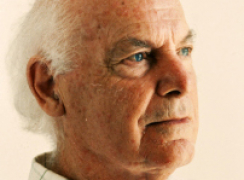
Timothy Francis Leary (October 22, 1920 – May 31, 1996) was an American
psychologist and writer, known for his advocacy of
psychedelic drugs. During a time when drugs such as
LSD and
psilocybin were legal, Leary conducted experiments at
Harvard University under the
Harvard Psilocybin Project, resulting in the
Concord Prison Experiment and the
Marsh Chapel Experiment. Both studies produced useful data, but Leary and his associate
Richard Alpert were fired from the university.
Leary believed LSD showed therapeutic potential for use in
psychiatry. He popularized
catchphrases that promoted his philosophy, such as "
turn on, tune in, drop out", "
set and setting", and "
think for yourself and question authority". He also wrote and spoke frequently about
transhumanist concepts involving space migration, intelligence increase and
life extension (SMI²LE), and he developed the
eight-circuit model of consciousness in his book
Exo-Psychology (1977).
During the 1960s and 1970s, Leary was arrested regularly and was held captive in 29 different prisons throughout the world. President
Richard Nixon once described Leary as "the most dangerous man in America".
[1]
[edit] Early life and education
Leary was born in
Springfield, Massachusetts, the
only child[1] of an
Irish American dentist who abandoned his wife Abigail Ferris when Leary was 13.
[citation needed] Leary graduated from Springfield's Classical High School.
Timothy Leary attended the
College of the Holy Cross in
Worcester, Massachusetts from September 1938 to June 1940. Under pressure from his father, Leary enrolled as a cadet in the
United States Military Academy at
West Point. In his first months he acquired numerous demerits for rule infractions and then got into serious trouble for failing to report infractions by other cadets when on supervisory duty. He was alleged to have engaged in a bout of drinking and then failed to be forthright about it. For violating the Academy's
honor code, he was asked by the Honor Committee to resign. When he refused, he was "silenced"; that is, shunned and ignored by his fellow cadets as a tactic to pressure him to resign. Though he was acquitted by a court-martial, the silencing measure continued in force, as well as an onslaught of demerits for minuscule infractions of the rules. When the treatment continued in his second year, his mother appealed to a family friend, United States Senator
David I. Walsh, head of the Senate Naval Affairs Committee, who conducted a personal investigation. Behind the scenes, the Honor Committee revised its position and announced that it would abide by the court-martial verdict. Leary then resigned and received an honorable discharge.
[2] Almost 50 years later, Leary said that it was "the only fair trial I've had in a court of law".
[3]
Leary transferred to
University of Alabama where he received a
B.A. degree in
psychology in 1943 through a program that allowed for external study at
Georgetown University and
Ohio State University. His obituary in the
New York Times said he "finally earned his bachelor's degree in the
United States Army during World War II,"
[1] when he was a
sergeant in the Medical Corps. He received an
M.S. degree in psychology at
Washington State University in 1946, and his
Ph.D. degree in psychology at the
University of California, Berkeley in 1950.
[4] The title of Leary's Ph.D. dissertation was "The Social Dimensions of Personality: Group Structure and Process."
In 1945 Leary married Marianne Busch, who gave birth in 1947 to their first child, Susan, while he was working on his doctorate at the University of California at Berkeley. Susan was followed two years later by a son, Jack. In 1952 the Leary family spent a year in Spain, subsisting on a research grant awarded to Leary. A Berkeley colleague, Marv Freedman, later recounted that "Something had been stirred in him in terms of breaking out of being another cog in society...".
[5]
Following his PhD, Leary became an assistant professor at Berkeley (1950–1955). In 1955, Leary's wife committed suicide, leaving him to raise their son and daughter alone.
[1] He described himself during this period as "an anonymous institutional employee who drove to work each morning in a long line of commuter cars and drove home each night and drank
martinis ... like several million middle-class, liberal, intellectual robots."
[6][7]
From 1955 to 1958, Leary was director of psychiatric research at the
Kaiser Family Foundation (1955–1958), and then a lecturer in psychology at
Harvard University (1959–1963). He was fired from Harvard for failing to conduct his scheduled class lectures,
[8] though he claimed that he had fulfilled all of his teaching obligations. The decision to dismiss him was allegedly influenced by his role in the popularity of then-legal psychedelic substances among Harvard students and faculty members.
[9]
Leary's early work in psychology expanded on the research of
Harry Stack Sullivan and
Karen Horney regarding the importance of interpersonal forces in mental health. Leary focused on how the interpersonal process might be used to diagnose
disorders and patterns found in human personalities. He developed a complex and respected
interpersonal circumplex model, published in
The Interpersonal Diagnosis of Personality,
[10] which offered a means by which psychologists could use
Minnesota Multiphasic Personality Inventory (MMPI) scores to determine a respondent's characteristic interpersonal modes of reaction.
[edit] Psychedelic experiments and experiences
On May 13, 1957,
Life magazine published an article by
R. Gordon Wasson that documented the use of
psilocybin mushrooms in the religious ceremony of the indigenous
Mazatec people of Mexico.
[11] Anthony Russo, a colleague of Leary's, experienced
psychedelic (or
entheogenic)
Psilocybe mexicana mushrooms during a trip to Mexico, and related the experience to Leary. In August 1960,
[12] Leary traveled to
Cuernavaca, Mexico with Russo and ate
psilocybin mushrooms for the first time, an experience that drastically altered the course of his life.
[13] In 1965, Leary commented that he "learned more about... (his) brain and its possibilities... (and) more about psychology in the five hours after taking these mushrooms than... (he) had in the preceding 15 years of studying and doing research in psychology."
[13]
Upon his return from Mexico to Harvard in 1960, Leary and his associates, notably Richard Alpert (later known as
Ram Dass), began a research program known as the
Harvard Psilocybin Project. The goal was to analyze the effects of
psilocybin on human subjects (in this case, prisoners, and later, students of the
Andover Newton Theological Seminary) using a synthesized version of the then-legal drug — one of two active compounds found in a wide variety of hallucinogenic mushrooms including
Psilocybe mexicana. The compound was produced according to a process developed by
Albert Hofmann of
Sandoz Pharmaceuticals, famous for synthesizing LSD.
Beat poet
Allen Ginsberg, after hearing about the Harvard research project, asked to join the experiments. Leary was inspired by Ginsberg's enthusiasm and the two shared an optimism in the benefit of psychedelic substances to help people "turn on" (discover a higher level of consciousness). Together they began a campaign of introducing other intellectuals and artists to psychedelics.
[14]
Leary argued that
psychedelic substances, used at proper doses, in a stable
set and setting could, under the guidance of psychologists, alter behavior in beneficial ways not easily attainable through regular therapy. Leary's research focused on treating
alcoholism and reforming
criminals. Many of Leary's research participants reported profound
mystical and spiritual experiences, which they claimed permanently altered their lives in a very positive manner. According to Leary's autobiography,
Flashbacks, LSD was given to 300 professors, graduate students, writers and philosophers and 75 percent of the test subjects reported the experience as one of the most educational and revealing experiences of their lives.
The
Concord Prison Experiment was designed to evaluate the effects of psilocybin combined with
psychotherapy on rehabilitation of released prisoners. After being guided through the psychedelic experience, or "trips," by Leary and his associates, 36 prisoners allegedly repented and swore to give up future criminal activity. For United States prisoners, the average
recidivism rate is 60 percent, while the recidivism rate of the subjects involved in Leary's project was claimed to have dropped to 20 percent. The Concord Prison experimenters concluded that long-term reduction in overall criminal recidivism rates could be achieved with a combination of psilocybin-assisted group psychotherapy (inside the prison) along with a comprehensive post-release follow-up support program modeled on
Alcoholics Anonymous. The conclusions of this experiment were later contested on the basis of a followup study, with several problems cited including time differences monitoring the study group versus the control group and other methodology factors including the difference between subjects reincarcerated for parole violations versus those imprisoned for new crimes. The researchers concluded that statistically only a slight improvement from the use of psilocybin could be shown, in contrast to the significant improvement Leary reported.
[15]
Leary and Alpert founded the
International Foundation for Internal Freedom in 1962 in
Cambridge, Massachusetts. This was run by Lisa Bieberman (now known as Licia Kuenning),
[16] a disciple of Leary
[17] and one of his many lovers.
[18][19] Their research attracted much public attention, and many people wanted to participate in the experiments but were unable to do so because of the high demand. In order to satisfy the curiosity of those who were turned away, a black market for psychedelics developed near the Harvard University Campus.
[20]
According to
Andrew Weil, Leary was fired for not attending his lecture classes, while Alpert was fired for allegedly giving
psilocybin to an undergraduate in an off-campus apartment.
[20][21] This version is supported by the words of Harvard President Nathan M. Pusey, who released the following statement on May 27, 1963:
On May 6, 1963, the Harvard Corporation voted, because Timothy F. Leary, lecturer on clinical psychology, has failed to keep his classroom appointments and has absented himself from Cambridge without permission, to relieve him from further teaching duty and to terminate his salary as of April 30, 1963.[8]
In 1967 he had a
televised debate with
Jerry Lettvin of MIT.
[22]
Leary's activities interested siblings Peggy, Billy, and Tommy Hitchcock, heirs to the
Mellon fortune, who in 1963 helped Leary and his associates acquire the use of a rambling mansion on an estate in the town of
Millbrook (near
Poughkeepsie, New York), where they continued their experiments. Leary later wrote:
We saw ourselves as anthropologists from the 21st century inhabiting a time module set somewhere in the dark ages of the 1960s. On this space colony we were attempting to create a new paganism and a new dedication to life as art.[23]
Later, the Millbrook estate was described by Luc Sante of
The New York Times as:
the headquarters of Leary and gang for the better part of five years, a period filled with endless parties, epiphanies and breakdowns, emotional dramas of all sizes, and numerous raids and arrests, many of them on flimsy charges concocted by the local assistant district attorney, G. Gordon Liddy.[24]
Others contest this characterization of the Millbrook estate; for instance, in
The Electric Kool-Aid Acid Test,
Tom Wolfe portrays Leary as interested only in research, and not in using psychedelics merely for recreational purposes. According to "The Crypt Trip" chapter of Wolfe's book, when
Ken Kesey's
Merry Pranksters visited the residence, the Pranksters did not even see Leary, who was engaged in a three-day trip. According to Wolfe, Leary's group even refused to give the Pranksters
acid.
In 1964, Leary coauthored a book with Alpert and
Ralph Metzner called
The Psychedelic Experience, based upon the
Tibetan Book of the Dead. In it, they wrote:
A psychedelic experience is a journey to new realms of consciousness. The scope and content of the experience is limitless, but its characteristic features are the transcendence of verbal concepts, of spacetime dimensions, and of the ego or identity. Such experiences of enlarged consciousness can occur in a variety of ways: sensory deprivation, yoga exercises, disciplined meditation, religious or aesthetic ecstasies, or spontaneously. Most recently they have become available to anyone through the ingestion of psychedelic drugs such as LSD, psilocybin, mescaline, DMT, etc. Of course, the drug does not produce the transcendent experience. It merely acts as a chemical key — it opens the mind, frees the nervous system of its ordinary patterns and structures.[citation needed]
Repeated
FBI raids ended the Millbrook era. Regarding a 1966 raid by
G. Gordon Liddy, Leary told author and Prankster
Paul Krassner: "He was a government agent entering our bedroom at midnight. We had every right to shoot him. But I've never owned a weapon in my life. I have never had and never will have a gun around."
On September 19, 1966, Leary founded the
League for Spiritual Discovery, a religion declaring LSD as its holy sacrament, in part as an unsuccessful attempt to maintain legal status for the use of LSD and other psychedelics for the religion's adherents, based on a "freedom of religion" argument. (Although
The Brotherhood of Eternal Love would subsequently consider Leary their spiritual leader, The Brotherhood did not evolve out of IFIF
International Foundation for Internal Freedom.) On October 6, 1966, LSD was made illegal in the United States and controlled so strictly that not only were possession and recreational use criminalized, but all legal scientific research programs on the drug in the US were shut down as well.
In 1966,
Folkways Records recorded Leary reading from his book
The Psychedelic Experience, and released the album,
The Psychedelic Experience: Readings from the Book "The Psychedelic Experience. A Manual Based on the Tibetan...".[25]
During late 1966 and early 1967, Leary toured college campuses presenting a multi-media performance "The Death of the Mind", which attempted to artistically replicate the LSD experience. Leary said the
League for Spiritual Discovery was limited to 360 members and was already at its membership limit, but he encouraged others to form their own
psychedelic religions. He published a pamphlet in 1967 called
Start Your Own Religion, to encourage people to do so (see below under "writings").
Leary was invited to attend the January 14, 1967
Human Be-In by
Michael Bowen the primary organizer of the event.
[26] Leary spoke at the Human Be-In, a gathering of 30,000
hippies in
Golden Gate Park in San Francisco and uttered the famous phrase, "
Turn on, tune in, drop out". In a 1988 interview with
Neil Strauss, Leary stated that slogan was "given to him" by
Marshall McLuhan during a lunch in New York City. Leary added that Marshall, "was very much interested in ideas and marketing, and he started singing something like, 'Psychedelics hit the spot / Five hundred micrograms, that's a lot,' to the tune of a Pepsi commercial. Then he started going, 'Tune in, turn on, and drop out.'"
[27]
At some point in the late 1960s, Leary moved to California, making many friends in Hollywood. "When he married his third wife,
Rosemary Woodruff in 1967, the event was directed by Ted Markland of
Bonanza. All the guests were on acid."
[1]
In the late 1960s and early 1970s, Leary, in collaboration with the writer
Brian Barritt, formulated his eight circuit model of consciousness, in which he claimed that the human mind/nervous system consisted of seven circuits which, when activated, produce seven levels of consciousness. This model was first published as the short essay, "The Seven Tongues of God". The system soon expanded to include an eighth circuit; this version was first unveiled to the world in the rare 1973 pamphlet "Neurologic" — written with Joanna Leary while he was in prison — but was not exhaustively formulated until the publication of
Exo-Psychology (by Leary) and in
Robert Anton Wilson's
Cosmic Trigger in 1977. Wilson contributed to the model after befriending Leary in the early 1970s, and has used it as a framework for further exposition in his book
Prometheus Rising, among other works.
Leary believed that the first four of these circuits ("the Larval Circuits" or "Terrestrial Circuits") are naturally accessed by most people in their lifetimes, triggered at natural transition points in life, such as puberty. The second four circuits ("the Stellar Circuits" or "Extra-Terrestrial Circuits"), Leary claimed, were evolutionary off-shoots of the first four that would be triggered at transition points that we will have when we evolve further, and would equip us to encompass life in space, as well as the expansion of consciousness that would be necessary to make further scientific and social progress. Leary suggested that some people may "shift to the latter four gears",
i.e., trigger these circuits artificially, by utilizing consciousness-altering techniques such as
meditation and spiritual endeavors such as
yoga, or by taking
psychedelic drugs specific to each circuit. An example of the information Leary cited as evidence for the purpose of the "higher" four circuits was the feeling of floating and uninhibited motion experienced by users of
marijuana. In the
eight circuit model of consciousness, a primary theoretical function of the fifth circuit (the first of the four developed for life in outer space) is to allow humans to become accustomed to life in a zero or low gravity environment.
[edit] Legal troubles
Leary's first run-in with the law came on December 20, 1965. Leary decided to take his two children Jack and Susan, and his girlfriend Rosemary Woodruff, to Mexico for an extended stay to write a book. While they were returning from Mexico into the United States, marijuana was found in his daughter Susan's underwear. They had crossed into
Nuevo Laredo, Mexico in the late afternoon and discovered they would have to wait until morning for the appropriate visa for an extended stay. They decided to cross back into
Texas to spend the night and were on the bridge when Rosemary remembered she had a very small amount of marijuana in her possession. It was impossible to throw it out on the bridge, so Susan put it in her underwear.
[28] After taking responsibility for the controlled substance, Leary was convicted of possession under the
Marihuana Tax Act on March 11, 1966, and sentenced to 30 years in jail, given a $30,000 fine, and ordered to undergo psychiatric treatment. Soon after, however, he appealed the case, claiming the Marihuana Tax Act was, in fact, unconstitutional, as it required a degree of
self-incrimination. Leary claimed this was in stark violation of the
Fifth Amendment.
On December 26, 1968, Leary was arrested again, in
Laguna Beach, California, this time for the possession of two
roaches of marijuana, which Leary claimed were planted by the arresting officer. He was later convicted of this offense. On May 19, 1969, The
Supreme Court concurred with Leary in
Leary v. United States. The Marihuana Tax Act was declared unconstitutional, and his 1965 conviction was quashed.
On the day his conviction was overturned, Leary announced his candidacy for
Governor of California, running against
Ronald Reagan. His campaign slogan was "Come together, join the party." On June 1, 1969, Leary joined
John Lennon and
Yoko Ono at their
Montreal Bed-In and Lennon subsequently wrote Leary a campaign song called "
Come Together".
[29]
On January 21, 1970, Leary received a 10-year sentence for his 1968 offense, with a further 10 added later while he was in custody, for a previous arrest in 1965, making 20 years in total to be served consecutively. When Leary arrived in prison, he was given psychological tests that were used to assign inmates to appropriate work details. Having designed some of the tests himself (including the "Leary Interpersonal Behavior Test"), Leary answered them in such a way that he seemed to be a very conforming, conventional person with a great interest in forestry and gardening.
[30] As a result, Leary was assigned to work as a gardener in a lower security prison, and in September 1970 he escaped. Leary claimed his non-violent escape was a humorous prank, and left a challenging note for the authorities to find after he was gone.
For a fee of $25,000, paid by
The Brotherhood of Eternal Love, the
Weathermen smuggled Leary and his wife,
Rosemary Woodruff Leary, out of the United States and into
Algeria after collecting him in a pickup truck driven by
Clayton Van Lydegraf.
[31][32] He sought the patronage of
Eldridge Cleaver and the remnants of the
Black Panther Party's "government in exile." After staying with them for a short time, Leary claimed that Cleaver attempted to hold him and his wife hostage.
In 1971, the couple fled to
Switzerland, "where they were sheltered and effectively imprisoned by a large-living arms dealer,
Michel Hauchard, who claimed he had an 'obligation as a gentleman to protect philosophers,' but mostly had a film deal in mind."
[24] In 1972, President
Richard Nixon's attorney general,
John Mitchell, persuaded the Swiss government to imprison Leary, which it did for a month, but the Swiss refused to extradite him back to the United States. In that same year, Leary and Rosemary separated. Leary became involved with Swiss-born British socialite Joanna Harcourt-Smith, a stepdaughter of financier
Árpád Plesch. Leary "married" Harcourt-Smith at a hotel two weeks after they were first introduced; she used his surname until their breakup in early 1977. They traveled to
Vienna, then
Beirut, and finally went to
Kabul,
Afghanistan in 1973. "Afghanistan had no extradition treaty with the United States, but this stricture did not apply to American airliners", Luc Sante wrote in a review of a biography of Leary.
[24] That interpretation of the law was used by United States authorities to capture the fugitive. "Before Leary could deplane, he was arrested by an agent of the federal
Bureau of Narcotics and Dangerous Drugs."
[24]
At a layover in the United Kingdom, as Leary was being flown back to the United States, he requested
political asylum from Her Majesty's Government, but to no avail. He was then held on five million dollars bail ($21.5 mil. in 2006). President
Richard Nixon had earlier labeled him "the most dangerous man in America."
[1] The judge at his remand hearing remarked, "If he is allowed to travel freely, he will speak publicly and spread his ideas."
[33] Facing a total of 95 years in prison, Leary hired criminal defense attorney
Bruce Margolin and was put into solitary confinement in
Folsom Prison, California.
[34]
Leary made a pretense of cooperating with the FBI's investigation of the
Weathermen and radical attorneys, by giving them information that they already had or that was of little consequence; in response, the FBI gave him the code name "Charlie Thrush".
[35] Leary would later claim, and members of the Weathermen would later support, that no one was ever prosecuted based on any information he gave to the FBI.
The Weather Underground, the radical left organization responsible for his escape, was not impacted by his testimony. Histories written about the Weather Underground usually mention the Leary chapter in terms of the escape for which they proudly took credit. Leary sent information to the Weather Underground through a sympathetic prisoner that he was considering making a deal with the FBI and waited for their approval. The return message was "we understand".[36]
While imprisoned, Leary remained a productive writer, sowing the seeds for his incarnation as a futurist lecturer with the StarSeed Series. In
Starseed (1973),
neurologic (1973), &
Terra II: A Way Out (1974), Leary transitioned from Eastern philosophy and
Aleister Crowley to a belief that outer space was a medium for spiritual transcendence as his principal frame of reference.
Neurologic also added the idea of "time dilation/contraction" available to the activated brain through the cellular, DNA, or atomic level of reality.
Terra II is his first detailed proposal for
space colonization. Leary's muse peaked with
Exo-Psychology,
Neuropolitics, and
Intelligence Agents.
[edit] Last two decades
Leary was released from prison on April 21, 1976, by Governor
Jerry Brown. After briefly relocating to
San Diego, Leary established residence in
Laurel Canyon and continued to write books and appear as a lecturer and (by his own terminology) "stand-up philosopher." In 1978, Leary married filmmaker Barbara Blum, also known as Barbara Chase, sister of actress
Tanya Roberts. Leary adopted Blum's son and raised him as his own. Leary and Blum divorced in 1992.
Leary cultivated a friendship with former foe
G. Gordon Liddy, the
Watergate burglar and conservative radio talk-show host. They toured the lecture circuit in 1982 as ex-cons (Liddy having been imprisoned after high-level involvement in the Watergate scandal) debating different social and fiscal issues from
gay rights and
abortion to
welfare and
the environment with Leary generally representing the voice from the left and Liddy representing the voice from the right. The tour generated massive publicity and considerable funds for both. Along with the personal appearances, a successful documentary called
Return Engagement that chronicled the tour, and the concurrent release of the
autobiography Flashbacks, helped to return Leary to the spotlight. In
1988, Leary held a fundraiser for
Libertarian presidential candidate
Ron Paul.
[37][38]
While his stated ambition was eventually to cross over as a mainstream Hollywood personality, reluctant studios and sponsors made certain that it would never occur. Nonetheless, constant touring ensured that he was able to maintain a very comfortable lifestyle by the mid-1980s, while his colorful past made him a desirable guest at
A-list parties throughout the decade. He also attracted a more intellectual crowd, which included
Robert Anton Wilson,
science fiction writer
William Gibson,
Norman Spinrad,
David Byrne and
John Frusciante (Leary appeared in
Johnny Depp's and
Gibby Haynes' 1994 film
Stuff which showed the squalid conditions in which Frusciante was living at the time).
While he continued to use drugs frequently on a private basis, rather than evangelizing and proselytizing the use of psychedelics as he had in the 1960s, the latter day Leary emphasized the importance of space colonization and an ensuing extension of the human lifespan while also providing a detailed explanation of the eight-circuit model of consciousness in books such as
Info-Psychology, among several others. He adopted the acronym "
SMI²LE" as a succinct summary of his pre-
transhumanist agenda:
SM (
Space Migration) +
I² (
intelligence increase) +
LE (
Life extension). Leary credited L5 co-founder
Keith Henson with helping develop his interest in space migration.
Leary's colonization plan varied greatly through the years. Because he believed that he would soon migrate into space, Leary was opposed to the ecology movement. He dismissed many of Earth's problems and labeled the entire field of ecology "a seductive dinosaur science." Leary stated that only the "larval," intellectually and philosophically backward humans, would choose to remain in "the fouled nest." According to his initial plan to leave the planet, 5,000 of Earth's most virile and intelligent individuals would be launched on a vessel (Starseed 1) equipped with luxurious amenities. This idea was inspired by the plotline of
Paul Kantner's
concept album Blows Against The Empire, which in turn was derived from
Robert A. Heinlein's
Lazarus Long series. In the 1980s, he came to embrace
NASA scientist
Gerard O'Neill's more realistic and egalitarian plans to construct giant
Eden-like High Orbital Mini-Earths (documented in the
Robert Anton Wilson lecture
H.O.M.E.s on LaGrange) using existing technology and raw materials from the
Moon, orbital rock and obsolete satellites.
During the 1980s, Leary became fascinated by computers, the Internet, and virtual reality. Leary proclaimed that the "PC is the LSD of the 1990s" and admonished
bohemians to "
turn on, boot up, jack in".
[39][40] He became a promoter of virtual reality systems,
[41] and sometimes demonstrated a prototype of the
Mattel Power Glove as part of his lectures (as in
From Psychedelics to Cybernetics). Around this time he cultivated friendships with a number of notable people in the field, including
Brenda Laurel, a pioneering researcher in virtual environments and human–computer interaction. With the rise of
cyberdelic counter-culture, Leary became a consultant to
Billy Idol in the production of the latter's 1993 album,
Cyberpunk.
[42]
In 1990, Leary's daughter, Susan, committed suicide after years of mental instability. After separating from Barbara Leary in 1992, Leary formed a new entourage of Baby Boomer and Generation X artists and cultural figures that included people as diverse as actors
Johnny Depp,
Susan Sarandon and
Dan Aykroyd, and his granddaughters, Dieadra Martino and Sara Brown; grandson, Ashley Martino; son, Zach Leary; author
Douglas Rushkoff, publisher
Bob Guccione, Jr., and goddaughters: actress
Winona Ryder and artist/music–photographer Hilary Hulteen. In spite of his declining health, Leary maintained a regular schedule of public appearances through 1994.
From 1989 on, Leary had begun to reestablish his connection to unconventional religious movements with an interest in altered states of consciousness. In 1989 he appeared with friend and book collaborator
Robert Anton Wilson in a dialog entitled
The Inner Frontier for the
Association for Consciousness Exploration, a Cleveland-based group that had been responsible for his first
Cleveland, Ohio appearance in 1979. After that, he appeared at the
Starwood Festival, a major
Neo-Pagan event run by ACE, in 1992 and 1993
[43] (though his planned 1994 WinterStar Symposium appearance was cancelled due to his declining health). In front of hundreds of neo-pagans in 1992, he declared, "I have always considered myself, when I learned what the word meant, I've always considered myself a Pagan."
[44] He also collaborated with Eric Gullichsen on
Load and Run High-tech Paganism: Digital Polytheism.
[45] Prior to his death on May 31, 1996, Timothy Leary recorded the "Right to Fly" album with Simon Stokes. It was released in July 1996.

etoy agents with mortal remains of Timothy Leary 1997
In early 1995, Leary was diagnosed with inoperable
prostate cancer. He did not reveal the condition to the press upon diagnosis, but did so after the death of
Jerry Garcia in August.
Leary authored an outline for a book called
Design for Dying, which attempted to show people a new perspective of death and dying. Leary's entourage (as mentioned above) updated his website on a daily basis as a sort of proto-
blog, noting his daily intake of various illicit and legal chemical substances, with a predilection for
nitrous oxide, cigarettes, his trademark "Leary Biscuits" (a snack cracker with cheese and a small marijuana bud, briefly microwaved), and eventually
heroin and
morphine. His sterile house was completely redecorated by the staff, who had more or less moved in, with an array of surreal ornamentation. In his final months, thousands of visitors, well wishers and old friends visited him in his California home. Until the final weeks of his illness, Leary gave many interviews discussing his new philosophy of embracing death.

Movie poster for
Timothy Leary's Dead
For a number of years, Leary was reported to have been excited by the possibility of freezing his body in
cryonic suspension, and Leary publicly announced in September 1988 that he had signed up with
Alcor.
[46] Leary had appeared at Alcor's grand opening a year previously.
[46] He did not believe that he would be resurrected in the future, but he believed that cryonics had important possibilities and stated the chance was "one chance in 1,000".
[46] He called it his "duty as a
futurist", and helped publicize the process and hoped it would work for his children and grandchildren if not for him, although he said he was "light-hearted" about it.
[46] Leary had relationships with two cryonic organizations, originally Alcor and then CryoCare, which delivered a cryonic tank to Leary's house in the months before his death. However, Leary subsequently requested that his body be
cremated, which it was, and distributed among his friends and family.
Leary died on May 31, 1996 at the age of 75. His death was videotaped for posterity at his request, capturing his final words. During his final moments, he said, "Why not?" to his son Zachary. He uttered the phrase repeatedly, in different intonations, and died soon after. His last word, according to Zachary Leary, was "beautiful."
The film
Timothy Leary's Dead (1996) contains a simulated sequence in which Leary allows his bodily functions to be suspended for the purposes of cryonic preservation, and his head is removed and placed on ice. At the end of the film is a sequence showing the creation of the artificial head used in the film.
Seven grams of Leary's ashes were arranged by his friend at
Celestis to be
buried in space aboard a rocket carrying the remains of 24 other people including
Gene Roddenberry (creator of
Star Trek),
Gerard O'Neill (space physicist),
Krafft Ehricke (rocket scientist), and others. A
Pegasus rocket containing their remains was launched on April 21, 1997, and remained in orbit for six years until it burnt up in the atmosphere.
[edit] Influence
Leary is often considered one of the most prominent figures during the
counterculture of the 1960s, and since those times has remained influential on
pop culture, literature, television, film; and especially music.
Leary's ideas influenced the work of
Robert Anton Wilson. This influence went both ways and Leary admittedly took just as much from Wilson. Wilson's book
Prometheus Rising was an in depth, highly detailed and inclusive work documenting Leary's
eight circuit model of consciousness. Although the theory originated in discussions between Leary and a Hindu holy man at Millbrook, Wilson was one of the most ardent proponents of it and introduced the theory to a mainstream audience in 1977's bestselling
Cosmic Trigger. In 1989, they appeared together on stage in a dialog entitled
The Inner Frontier[47] in
Cleveland, Ohio hosted by the
Association for Consciousness Exploration,
[48] (the same group that had hosted Leary's first Cleveland appearance in 1979
[49][50]).
Owsley Stanley, one of the pioneers of the era, would later write of him:
Leary was a fool. Drunk with "celebrity-hood" and his own ego, he became a media clown — and was arguably the single most damaging actor involved in the destruction of the evanescent social movement of the 1960s. Tim, with his very public exhortations to the kids to "tune in, turn on and drop out", is the inspiration for all the current draconian US drug laws against psychedelics. He would not listen to any of us when we asked him to please cool it, he loved the limelight and relished his notoriety... I was not a fan of his.[51]
World religion scholar
Huston Smith was turned on by Leary after the two were introduced to one another by
Aldous Huxley in the early 1960s. The experience was interpreted as deeply religious by Smith, and is captured in detailed religious terms in Smith's later work
Cleansing of the Doors of Perception. Smith asked Leary, to paraphrase, if Leary knew the power and danger of that with which he was conducting research. In
Mother Jones Magazine, 1997, Smith commented:
First, I have to say that during the three years I was involved with that Harvard study, LSD was not only legal but respectable. Before Tim went on his unfortunate careening course, it was a legitimate research project. Though I did find evidence that, when recounted, the experiences of the Harvard group and those of mystics were impossible to tell apart—descriptively indistinguishable—that's not the last word. There is still a question about the truth of the disclosure.[52]
[edit] In popular culture
The Psychedelic Experience was the inspiration for
John Lennon's song "
Tomorrow Never Knows" on
The Beatles' album
Revolver.
[24] Leary once recruited
John Lennon to write a theme song for his
California gubernatorial campaign against Ronald Reagan (which was interrupted by his prison sentence due to cannabis possession), inspiring Lennon to come up with "
Come Together", based on Leary's theme and catchphrase for the campaign.
[53][54] Leary was also present when Lennon and his wife
Yoko Ono recorded
Give Peace a Chance during one of their
bed-ins in Montreal and is mentioned in the lyrics of the song.
[55] The Moody Blues also recorded a track about Leary,
Legend of a Mind, on their 1968 album
In Search of the Lost Chord in which the refrain is "Timothy Leary's dead. No, no, no, no, He's outside looking in".
[54]
While in exile in Switzerland, Leary and British writer Brian Barrett collaborated with the German band
Ash Ra Tempel, and recorded the album
Seven Up. He is credited as a songwriter, and his lyrics and vocals can be heard throughout the album.
[56]
Leary authored and co-authored over 20 books and was featured on more than a dozen audio recordings. He had an acting career that included over a dozen appearances in movies and television shows, over 30 appearances as himself in them, and produced and/or collaborated in both multi-media presentations and computer games.
In June 2011
The New York Times reported that the
New York Public Library had acquired Leary's personal archives, including papers, videotapes, photographs and other archival material from the Leary estate, including correspondence and documents relating to
Allen Ginsberg,
Aldous Huxley,
William Burroughs,
Jack Kerouac,
Ken Kesey,
Arthur Koestler,
G. Gordon Liddy and other prominent cultural figures. The collection will take approximately 18 months to process and should be open to researchers by July 2013.
[57]
[edit] See also
[edit] References
- ^ a b c d e f Mansnerus, Laura (1996-06-01). "Timothy Leary, Pied Piper Of Psychedelic 60s, Dies at 75". The New York Times. http://query.nytimes.com/gst/fullpage.html?res=9500E0DD1E39F932A35755C0A960958260&sec=&spon=&pagewanted=all. Retrieved 2008-07-11.
- ^ Peter O. Whitmer, Aquarius Revisited: Seven Who Created the Sixties Counterculture That Changed America (NY: Citadel Press, 1991), 21-5
- ^ Greenfield, Robert, Timothy Leary: A Biography (Harcourt Books, 2006), 28–55
- ^ John Cashman, The LSD Story, Fawcett Publications, 1966, p. ?
- ^ Greenfield, Robert 2006. Timothy Leary:A Biography. Harcourt Books Pg. 68–77.
- ^ Torgoff, Martin (2004). Can't Find My Way Home: America in the Great Stoned Age. Simon and Schuster. p. 72. ISBN 0-7432-3010-8.
- ^ Leary, Timothy; Allen Ginsberg (1995). High Priest. Ronin Publishing. p. 4. ISBN 0-914171-80-1.
- ^ a b New York Times, 03/12/1966, p. 25
- ^ Jay Stevens, "Storming Heaven", Grove Press, 1987
- ^ Leary, Timothy (1957). Interpersonal diagnosis of personality: a functional theory and methodology.
- ^ LIFE on LSD
- ^ Cashman, John. "The LSD Story". Fawcett Publications, 1966
- ^ a b Ram Dass Fierce Grace, 2001, Zeitgeist Video
- ^ Goffman, K. and Joy, D. 2004. Counterculture Through the Ages: From Abraham to Acid House. New York: Villard. Pg 250–252
- ^ Dr. Leary's Concord Prison Experiment: A 34 Year Follow-Up Study
- ^ http://www.lycaeum.org/drugs.old/hyperreal/millbrook/ch-04.html
- ^ http://www.thecrimson.com/article.aspx?ref=134589
- ^ Timothy Leary's Biography
- ^ Timothy Leary's Biography
- ^ a b Weil, Andrew T. (1963-11-05). "The Strange Case of the Harvard Drug Scandal". Look.
- ^ The Crimson Takes Leary, Alpert to Task by Joseph M. Russin and Andrew T. Weil, January 24, 1973 The Harvard Crimson
- ^ LSD: Lettvin vs Leary, 30 November 1967, http://openvault.wgbh.org/catalog/7df2a7-lsd-lettvin-vs-leary, retrieved 21 December 2011
- ^ Jay Stevens Storming Heaven: LSD and the American Dream, 1998, p. 208
- ^ a b c d e Sante, Luc (2006-06-26). "The Nutty Professor". The New York Times Book Review. http://www.nytimes.com/2006/06/25/books/review/25sante.html?pagewanted=all. Retrieved 2008-07-12.
- ^ The Psychedelic Experience: Readings from the Book "The Psychedelic Experience. A Manual Based on the Tibetan Book of the Dead" Album Details at Smithsonian Folkways
- ^ http://books.google.com/books?id=eFaq_I24teQC&pg=PA641&dq=timothy+leary+%22michael+bowen%22&lr=&as_brr=0&client=firefox-a#PPA299,M1
- ^ Strauss, Neil. Everyone Loves You When You're Dead: Journeys into Fame and Madness. New York: HarperCollins, 2011, p. 337-38
- ^ FLASHBACKS an autobiography by Timothy Leary Chapter 28 page 236
- ^ http://oldies.about.com/od/thebeatlessongs/a/cometogether.htm
- ^ RE/Search Publications – Pranks! – Timothy Leary
- ^ Rudd, Mark (2009). Underground: My Life with SDS and the Weathermen. New York City: William Morrow and Company. pp. 225–7. ISBN 978-0-06-147275-6.
- ^ Brian Flanagan (2002) (mp4). The Weather Underground. The Free History Project. Event occurs at 0:59:00. http://www.youtube.com/watch?v=LV7GSff4fIA. Retrieved March 2, 2012.
- ^ This is also reported as: "He has preached the length and breadth of the land, and I am inclined to the view that he would pose a danger to the community if released." Jesse Walker (2006) "The Acid Guru's Long, Strange Trip" The American Conservative, November 6, 2006.
- ^ Nick Gillespie, "Psychedelic, Man," Washington Post, June 15, 2006
- ^ Martin A. Lee and Bruce Shlain (1985). Acid dreams: the complete social history of LSD: the CIA, the sixties, and beyond. Grove Press. ISBN 0-8021-3062-3.
- ^ "Open Letter from the Friends of Timothy Leary". http://www.konformist.com/1999/leary.htm. Retrieved 2009-07-04.
- ^ Caldwell, Christopher (2007-07-22) The Antiwar, Anti-Abortion, Anti-Drug-Enforcement-Administration, Anti-Medicare Candidacy of Dr. Ron Paul, New York Times
- ^ Gillespie, Nick (2011-12-09) Five myths about Ron Paul, Washington Post
- ^ Leary, Timothy; Horowitz, Michael; Marshall, Vicky (1994). Chaos and Cyber Culture. Ronin Publishing. ISBN 0-914171-77-1.
- ^ Ruthofer, Arno (1997). Think for Yourself; Question Authority. Archived from the original on 2007-11-12. http://web.archive.org/web/20071112225454/http://www.geocities.com/arno_3/menu.html. Retrieved 2007-02-02.
- ^ [www.time.com/time/magazine/article/0,9171,971015-2,00.html]
- ^ Saunders, Michael (1993-05-19). "Billy Idol turns `Cyberpunk' on new CD". The Boston Globe (135 Morrissey Boulevard. Boston, Massachusetts, United States: P. Steven Ainsley). http://www.jaimelevyrussell.com/press/bostonglobe.htm. Retrieved 2008-08-12.[dead link]
- ^ The Cleveland Free Times :: Archives :: Circle Of Ash
- ^ Quote from CD: Timothy Leary Live at Starwood
- ^ http://deoxy.org/l_digpol.htm
- ^ a b c d Darwin, Mike (September 1988). "Dr. Leary Joins Up...". Alcor Life Extension Foundation. http://www.alcor.org/cryonics/cryonics8809.txt. Retrieved 2009-08-24.
- ^ Lesie, Michele (1989) High Priest of LSD To Drop In. The Plain Dealer
- ^ Local Group Hosts Dr. Timothy Leary by Will Allison (The Observer Fri. September 29th, 1989)
- ^ Two 60s Cult Heroes, on the Eve of the 80s by James Neff (Cleveland Plain Dealer Oct. 30th, 1979)
- ^ Timothy Leary: An LSD Cowboy Turns Cosmic Comic by Frank Kuznik (Cleveland Magazine November 1979
- ^ http://forum.lowcarber.org/showpost.php?p=6064486&postcount=1637
- ^ http://www.motherjones.com/news/qa/1997/11/snell.html
- ^ http://www.beatlesbible.com/songs/come-together/
- ^ a b Lattin, Don (2011). The Harvard Psychedelic Club: How Timothy Leary, Ram Dass, Huston Smith, and Andrew Weil Killed the Fifties and Ushered in a New Age for America. HarperCollins. p. 13. ISBN 978-0-06-165594-4.
- ^ Perlstein, Rick (2008). Nixonland: The Rise of a President and the Fracturing of America. Simon and Schuster. p. 386. ISBN 978-0-7432-4302-5.
- ^ Article, "It's Frothy Man", Mojo, issue #113, April 2003
- ^ Cohen, Patricia (15 June 2011). "New York Public Library Buys Timothy Leary's Papers". The New York Times. http://www.nytimes.com/2011/06/16/books/new-york-public-library-buys-timothy-learys-papers.html?ref=arts. Retrieved 06-05-2011.
[edit] External links
[show]
|
|---|
|
| Major recreational drugs |
|
|
|---|
|
| Drug culture |
|
|---|
|
| Drug production and trade |
Drug production
|
|
|---|
|
Drug trade
|
|
|---|
|
|---|
|
| Problems with drug use |
|
|---|
|
| Legality of drug use |
International
|
|
|---|
|
State level
|
|
|---|
|
Drug policy
by country
|
|
|---|
|
Other
|
|
|---|
|
|---|
|
| Lists of countries by... |
|
|---|
|