Monday, 19 November 2012

The Varieties of Religious Experience...

From Wikipedia, the free encyclopedia
Jump to: navigation, search
The Varieties of Religious Experience: A Study in Human Nature
Author(s)William James
Original titleThe Varieties of Religious Experience: A Study in Human Nature, Being the Gifford Lectures on Natural Religion Delivered at Edinburgh in 1901–1902[1]
LanguageEnglish
Subject(s)Philosophy of religion
PublisherLongmans, Green & Co.
Publication date1902
Pages534
LC ClassificationBR110.J3 1902a
Followed byPragmatism: A New Name for Some Old Ways of Thinking (1907)
The Varieties of Religious Experience: A Study in Human Nature is a book by Harvard University psychologist and philosopher William James. It comprises his edited Gifford Lectures on natural theology, which were delivered at the University of Edinburgh in Scotland in 1901 and 1902.
These lectures concerned the nature of religion and the neglect of science, in James' view, in the academic study of religion. Soon after its publication, the book entered the canon of psychology and philosophy and has remained in print for over a century.
James went on to develop his philosophy of pragmatism. There are many overlapping ideas in Varieties and his 1907 book, Pragmatism.[citation needed]

Contents

 [hide] 

[edit] Topics

[edit] Proposition of value versus existential judgment

James believed that the study of the origin of an object or an idea does not play a role in the study of its value. He asserted that existential judgment, or the scientific examination of an object's origin, is a separate matter from that object's value. As an example, he alluded to the Quaker religion and its founder, George Fox. Many of the scientists in James' audience immediately reject all aspects of the Quaker religion because evidence suggests that Fox was schizophrenic. Calling this rejection medical materialism, James insisted that the origin of Fox's notions about religion should not come into account when propositioning the value of the Quaker religion. As an aside, many believe El Greco to have suffered from astigmatism, yet no one would dismiss his art based on this medical detail. James proposed, somewhat sarcastically, that his audience's atheism was perhaps a dysfunction of the liver. Some believe science to be superior to religion because of religion's seemingly vain, unfounded, or perhaps insane origin. In his lectures, James asserted that these claims, while perhaps historically or epistemologically interesting, play no role in the separate question of religion's value.

[edit] Reality versus symbols of reality

The lectures discussed the distinction between symbolism and reality. Symbols, such as the word "steak" on a menu, do not embody the actuality of the objects they represent. The word "steak" on a menu merely points to some slab of meat in the back of the restaurant. In a similar way, James posits that all of science is fundamentally detached from reality since the tools of science are merely pointers to some actual objective realm. He criticized his audience for the scientific tendency to ignore the unseen aspects of life and the universe. As an example, he discussed the way the notion of a lemon causes salivation in the mouth of an individual; while there is no lemon, there is clearly a process occurring worthy of academic inquiry.

[edit] Reception

The August 1902 New York Times review of the first edition ends with the following:[1]
Everywhere there is a frolic welcome to the eccentricities and extravagances of the religious life. Many will question whether its more sober exhibitions would not have been more fruitful of results, but the interest and fascination of the treatment are beyond dispute, and so, too, is the sympathy to which nothing human is indifferent.
A July 1963 Time review of an expanded edition published that year, ends with quotes about the book from Peirce and Santayana:[2]
In making little allowance for the fact that people can also be converted to vicious creeds, he acquired admirers he would have deplored. Mussolini, for instance, hailed James as a preceptor who had showed him that "an action should be judged by its result rather than by its doctrinary basis." James...had no intention of giving comfort to latter-day totalitarians. He was simply impatient with his fellow academicians and their endless hairsplitting over matters that had no relation to life. A vibrant, generous person, he hoped to show that religious emotions, even those of the deranged, were crucial to human life. The great virtue of The Varieties, noted pragmatist philosopher Charles Peirce, is its "penetration into the hearts of people." Its great weakness, retorted George Santayana, is its "tendency to disintegrate the idea of truth, to recommend belief without reason and to encourage superstition."

[edit] Editions

also contained in:

[edit] References

[edit] External links

An Experiment with Time

From Wikipedia, the free encyclopedia
Jump to: navigation, search
An Experiment with Time
An Experiment with Time book cover.jpg
Author(s)J. W. Dunne
CountryUnited Kingdom
LanguageEnglish
PublisherA. & C. Black
Faber & Faber
Publication date1927
Pages208pp
ISBN1-57174-234-4
OCLC Number46396413
LC ClassificationMLCM 2004/02936 (B)
An Experiment with Time is a long essay by the Irish aeronautical engineer J. W. Dunne (1875 — 1949) on the subjects of precognition and the human experience of time. First published in March 1927, it was very widely read, and his ideas promoted by several other authors, in particular by J. B. Priestley. Other books by J. W. Dunne are The Serial Universe, The New Immortality, and Nothing Dies.

Contents

 [hide] 

[edit] Contents

  • I. Definitions
  • II. The Puzzle
  • III. The Experiment
  • IV. Temporal Endurance and Temporal Flow
  • V. Serial Time
  • VI. Replies to Critics
Appendix to the third edition:
Index

[edit] Basic concepts

Dunne's theory is, simply put, that all moments in time are taking place at once, at the same time. For example, if a cat were to spend its whole entire life living in a box, anyone looking into the box could see the cat's birth, life and death in the same instant - were it not for the human consciousness, which means that we perceive at a fixed rate.
According to Dunne, whilst human consciousness prevents us from seeing outside of the part of time we are "meant" to look at, whilst we are dreaming we have the ability to traverse all of time without the restriction of consciousness, leading to pre-cognitive dreams, resulting in the phenomena known as Deja vu. Henceforth, Dunne believes that we are existing in two parallel states, which requires a complete rethink of the way that we understand time.

[edit] Dunne's experiment

In An Experiment with Time, Dunne discusses how a theoretical ability to perceive events outside the normal observer's stream of consciousness might be proved to exist. He also discusses some of the possible other explanations of this effect, such as déjà vu.
He proposes that observers should place themselves in environments where consciousness might best be freed and then, immediately upon their waking, note down the memories of what had been dreamed, together with the date. Later, these notes should be scanned, with possible connections drawn between them and real life events that occurred after the notes had been written.
While the first half of the book is an explanation of the theory, the latter part comprises examples of notes and later interpretations of them as possible predictions. Statistical analysis was at that time in its infancy, and no calculation of the significance of the events reported was able to be made.

[edit] Parallels with other scientific and metaphysical systems

Dunne's theory of time has parallels in many other scientific and metaphysical theories. The Aboriginal people of Australia, for example, believe that the Dreamtime exists simultaneously in the present, past and future, and that this is the objective truth of time, linear time being a creation of human consciousness and therefore subjective. Kabbalah, Taoism and indeed most mystical traditions have always posited that waking consciousness allows awareness of reality and time in only a limited way and that it is in the sleeping state that the mind can go free into the multi-dimensional reality of time and space (examples: "Dreams are the wandering of the spirit through all nine heavens and nine earths," The Secret of the Golden Flower, trans. Richard Wilhelm). Similarly, all mystery traditions speak of the immortal and temporal selves which exist simultaneously both within time and space and without.
There are also parallels with classical relativity theory, in which time and space are merged into "spacetime", and time is not absolute and independent but is dependent upon the motion of the observer.

[edit] Scientific reception

In 1928, Sir Arthur Eddington wrote a letter to Dunne, a portion of which was reprinted in the 1929 and later editions of An Experiment With Time, in which he said:
“I agree with you about 'serialism'; the 'going on of time' is not in Minkowski's world as it stands. My own feeling is that the 'becoming' is really there in the physical world, but is not formulated in the description of it in classical physics (and is, in fact, useless to a scheme of laws which is fully deterministic).[1]”
Some psychical researchers such as George N. M. Tyrrell and C. D. Broad have pointed out problems with Dunne's theory of time. As Tyrell explained:
“Mr. J. W. Dunne, in his book, An Experiment with Time, introduces a multidimensional scheme in an attempt to explain precognition and he has further developed this scheme in later publications. But, as Professor Broad has shown, these unlimited dimensions are unnecessary, and unless I have misunderstood Mr. Dunne's argument, they resolve themselves into space-dimensions, and the true problem of time — the problem of becoming, or the passage of events from future through present to past, is not explained by them but is still left on the author's hands at the end.[2]”
In an article in the New Scientist in 1983 it was reported that Dunne had written a book just before his death admitting that he was a medium and a believer in spiritualism, the article reports that Dunne had deliberately chosen to leave this out of his An Experiment with Time book as he judged that it would have affected the reception of his theory.[3]
In a review for the New Scientist John Gribbin described An Experiment with Time as a "definitive classic".[4] Paul Davies in his book About Time: Einstein's Unfinished Revolution (2006) wrote that Dunne was an entertaining writer but there is no scientific evidence for more than one time and that Dunne's argument seems ad hoc.[5]
In his book Is There Life After Death? (2006), British writer Anthony Peake wrote that some of Dunne's ideas are valid and attempts to update the ideas of Dunne in the light of the latest theories of quantum physics, neurology and consciousness studies.[6]

[edit] Popular culture

In literature, interest in Dunne's theory may be reflected in T. S. Eliot's Burnt Norton, from Four Quartets, which opens with the lines:
Time present and time past
Are both perhaps present in time future,
And time future contained in time past.[7][8]
J. B. Priestley used Dunne's theory directly in his play Time and the Conways, professing in his introduction that he believed the theory to be true. Other writers contemporaneous to Dunne who expressed enthusiasm for his ideas included Aldous Huxley, who was also interested in the expansion of human consciousness to experience time, and Adolfo Bioy Casares, who mentioned this book in the introduction to his novel The Dream of Heroes (1954).
Charles Chilton used Dunne's analogy of time as a book to explain time travel in his radio play Journey Into Space. Philippa Pearce's childhood fantasy Tom's Midnight Garden also makes use of Dunne's ideas.
The idea that time might be experienced differently in enfolded space is one posited by quantum physicist David Bohm, who also believed that consciousness defined how we perceived the world. Bohm, who called for a revolution in human consciousness to free us from the old, Newtonian, mechanistic understanding of the universe, even posited that through a transformation of consciousness Time could possibly cease to exist in the way we perceive it now (cf., "The Ending Of Time" by Jiddu Krishnamurti and Dr David Bohm).
The book is instrumental in Dr Philip Raven's production of his future history as 'edited' by H G Wells in his 1933 work The Shape of Things to Come.
The 1964 novel Froomb! by British writer John Lymington refers to and is inspired by some of Dunne's concepts.[9] The protagonist, intended to be scientifically "killed" and revived to bring back an account of Heaven, is instead physically transported into the future, a parallel "time-band." He attempts to communicate with the controller of the experiment through dreams.
In the 1970 children's TV series, Timeslip, a time bubble allows two children to travel between past, present and future. Much of the show's time travel concepts were based on An Experiment with Time.[10]
An Experiment with Time is referenced in the book Sidetripping by William S. Burroughs and Charles Gatewood.
It is also mentioned in the book "Last Men In London" by Olaf Stapledon (1932).
It is also mentioned in the story "Murder in the Gunroom" by H. Beam Piper, and in "Elsewhen" by Robert A. Heinlein.
The ideas of Dunne also form the basis for "The Dark Tower" a short story by C. S. Lewis, and the unpublished novel, "The Notion Club Papers" by J. R. R. Tolkien. Both Tolkien and Lewis were members of the Inklings.
In the 2002 French movie Irréversible, one of the characters is seen reading the book by Dunne. The movie also investigates the aspects of the book through the style of filming, in that the story is told backwards, with each beginning sequence beginning either minutes or hours prior to the one which preceded it in the narrative. Also, the tagline is Le temps détruit tout meaning "Time destroys everything" – it is the first phrase spoken and the last phrase written.

[edit] See also

[edit] References

  1. ^ http://home.us.archive.org/stream/AnExperimentWithTime/Dunne-AnExperimentWithTime_djvu.txt
  2. ^ George Nugent Merle Tyrrell Science and psychical phenomena 1938, p. 135
  3. ^ Ruth Brandon Scientists and the supernormal New Scientist 16 June 1983 p. 786
  4. ^ John Gribbin Book Review of An Experiment with Time New Scientist 27 Aug 1981, p. 548
  5. ^ Paul Davies About Time: Einstein's Unfinished Revolution
  6. ^ Anthony Peake Is There Life After Death? The Extraordinary Science Of What Happens When We Die 2006
  7. ^ Verlyn Flieger, "Time in the Stone of Suleiman," in The Rhetoric of Vision: Essays on Charles Williams, by Charles Adolph Huttar & Peter J. Schakel (Bucknell University Press, 1996), p. 82 Retrieved 2007-09-15.
  8. ^ T. S. Eliot and the Use of Memory, by Grover Cleveland Smith (Bucknell University Press, 1996), p. 96 Retrieved 2007-09-15.
  9. ^ The reference to Dunne's Experiment with Time is in Section 3, Chapter 4 of Lymington's novel (see the Hodder Paperback edition, 1966, p.97), where it is explained as 'a theory of Time Belts, that other worlds exist at the same time as ours, in the same places, but only occasionally can you tune in from our waveband to another'.
  10. ^ Thompson, Andy. (2004). Introduction to Timeslip, p. 2. [Timeslip DVD Special Feature]. London: Carlton Visual Entertainment. 37115 06243.

[edit] External links

Friday, 16 November 2012

Film Review: What The $#@%! Do We Know? (AKA: What the Bleep Do We Know?)


By Anna Darrah, June 8, 2004


What the Bleep Do We Know? Marlee MatlinThis reality-shattering film is an enigma to most film festival programmers who have no idea where to list it in their catalogs.  And list it they will because this film is powerful and mind bending, with audiences begging for it as word of mouth spreads slowly across the country.  It is uncategorizable because the film, created by William Arntz, Betsy Chasse and Mark Vicente, actually blends three different types of filmmaking with at least as many genres.  It is a documentary interviewing 14 of the most thought-provoking scientists, academics and mystics of our time.  It is a narrative feature-film starring Marlee Matlin, Elaine Hendrix and a host of other recognizable actors.  It is an animated exploration of the science of our inner beings with giggling, evil, sexy, jiggling amoeba-like cells that, unbeknownst to us, run our lives.  It’s a romantic comedy, a drama, and a scientific treatise.  But the weirdest thing about this film is that it works!  It’s a great movie.  The best kind of movie.  You learn, you laugh, you feel compassion and intrigue, and most of all you feel inspired by your own potential by the end of the film.  It is truly a life-changing experience.  I bet by now you’re really wondering what this film is about!
“What The !@$%& Do We Know?” tells us that life as we know it is really much more subjective than we generally think it is and asks the question, “who is responsible for my life being what it is today?”  The answer, of course, is you.  You are responsible for your life being what it is today because from a scientific standpoint (the mystics and scientists tell us), your life is purely what you perceive it to be.  At this point, we are introduced to Marlee Matlin as Amanda, a bitter photographer who is so wrapped up in her past failures that she is practically blind to her present life.  Until this day, when for some unknown reason, the Universe decides to show her in great detail exactly how reality works.
What the Bleep Do We Know? Robert Bailey, Jr.
What the Bleep Do We Know? Fred Alan Wolf
What the Bleep Do We Know? Ramtha
Robert Bailey, Jr.
Theoretical Physicist Fred Alan Wolf
JZ Knight (aka Ramtha)
Her first tutorial comes from a young kid on a basketball court who shows her the science behind the truth that our focus on a physical piece of matter, say a basketball, is actually what makes the matter exist in any one place and time.  The film shows us that before we look at a piece of matter, it actually exists in more than one place at the same time, and it is our act of looking that fixes the matter and makes it a real and solid thing in time and space.  This is serious quantum physics, people!   And it doesn’t stop there.  “What The Bleep” continues on to take us into the cosmos, the brain and the smallest cells in the body, with the help of some pretty amazing animation.
But the real beauty of this film is that the brilliant minds interviewed throughout (a who's-who of quantum physicists, biologists, neurologists and modern day mystics) are willing to talk about how this incredibly scientific quantum information affects our daily lives, and, if you haven’t figured it out already, our spirituality.  And hey, if you’re a little slow on the pickup, all you really have to do is watch Amanda (Marlee Matlin) stumble through the rabbit hole into some odd environments (like our brains, where electrical storms between synapses are the norm) to see how reality works. 
She is our example of the average miserable human, bumbling through an uncharted life of bad behavior, confusing decisions and miserable relationships, until this day when she learns the potential of the human mind and body to be a conscious part of creating a life worth living.  And there, my friends, is the reason to see this film.   Because it provides factual, scientific evidence for why life is worth living, and how it can be inspiring and magical.  You will leave the theater not with a Hollywood high, but with a true 1960’s high, where you can smell change a-coming.  In fact, it’s probably starting right now inside your body on a cellular level.  And for once, that’s a good thing! Runtime: 1 hour, 30 minutes. View the movie trailer...
To find out more and see where “What The Bleep” is playing, go to:
http://www.whatthebleep.com/home/
You can also buy the DVD from Amazon.com by clicking the link to the right ->
Anna Darrah
Santa Fe, New Mexico
8 June, 2004

William Tiller and the Physics of the Vacuum


by Cynthia Sue Larson
August 8, 2000 


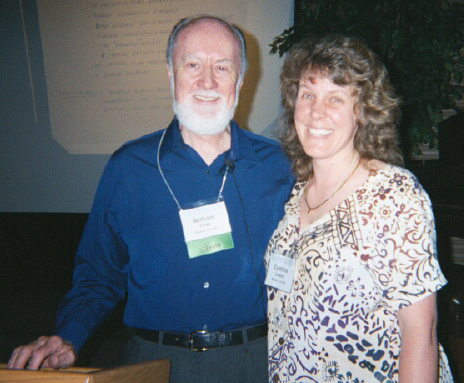
William
Tiller and Cynthia Sue Larson

William Tiller and Cynthia Sue Larson


I was extremely fortunate to meet William Tiller at the International Conference on Science and Consciousness (ICSC). Tiller is a teacher, researcher, author and consultant, and is currently Professor Emeritus of the Department of Materials Science and Engineering at Stanford University. He previously worked as an advisory physicist at Westinghouse Research Laboratories, and has published 275 scientific papers and three technical books in the field of materials science. Tiller has explored the area of spiritual development and the physics of psycho-energetic phenomena, which inspired him to write an additional 80 scientific papers as well as his book Science and Human Transformation: Subtle Energies, Intentionality, and Consciousness. Tiller is a founding director of both The Academy of Parapsychology and Medicine, and The Institute of Noetic Sciences.

At the ICSC conference, William Tiller presented the theoretical side of his work after explaining the experiments involving robust interactions between intention and inanimate/animate systems. Tiller's enthusiasm shone through as he reminded us of the "bodysuit metaphor," in which we are all spirits having a physical experience as we go down the river of life -- and we are intended to become co-creators with our spiritual creators. He then continued on to explain that we can think of ourselves as having many layers from the electric monopole layer of physical reality to the magnetic monopole, emotion domain, and mind domains. The spirit inside of us drives us, and living is a process of building an infrastructure which allows more spirit to enter dense matter.

Tiller's eyes sparkled as he exclaimed,

    "Spirit drives this biobodysuit vehicle! After all, 99.999% of all physical 'matter' consists of vacuum, with BIG spaces between electrons and nucleus. The energy potential, or latent energy, stored in one single Hydrogen atom is equivalent to one trillion times all the energy in our universe! If our consciousness could interact with the vacuum, we could have some very BIG effects. We'll be able to use the physics of the vacuum to get to the stars."


In the 1920's, Dirac wanted to know where electrons came from, and he astonished the scientific world with his discovery that when an electron popped out of its atom, it leaves a "hole" or positron behind. Antimatter can therefore be thought of as "defects" in the sense that the holes in the substratum are calculated to contain huge energy density, in a very chaotic structure with lots of interference going on.

Tiller was excited to point out:
    "If we can do this for electron particles, we can do it for atoms and molecules!"


The vacuum is critically important to us, and De Broglie's proposal that every particle had a "pilot" that guided it lead us to contemplate the "deltron" particle.

Tiller described the deltron as "an emotional particle that serves as a coupling ingredient for faster than light and slower than light velocities," and gave the equation c squared = (velocity of particle) * (velocity of pilot wave) with an illustration that showed four quadrants with velocity expressed on the x-axis and energy on the y-axis. The upper left-hand quadrant is the Physical branch, the lower right-hand quadrant is the Etheric branch, the upper right hand quadrant is the electric superluminal (tachyon) branch, and the lower left hand quadrant is the magnetic subliminal branch (imaginary particles).

The nodal network model works like transponders with hexagonal close-packed (HCP) symmetry. Tiller pointed out that "We need to practice other cognitive domains ... we need to learn how to play with reciprocal space blocks." He continued to say that "Reciprocal space patterns create our immediate future! Everything is already there."

You can read more about these theories in Tiller's book, Conscious Acts of Creation.

Conscious Acts of Creation


 ref link  
http://realityshifters.com/pages/articles/williamtillervacuum.html

Wednesday, 7 November 2012

Recording "Other-Worldly" Experiences....

EHE Network

          The Exceptional Human Experience Network, Inc. (EHEN) is an educational, research, and information resource organization studying all types of anomalous (out of the ordinary) experiences. Because these experiences are primarily subjective, scientists tend to ignore them. They do not fit into today’s scientific theory, and our culture typically does not have a way to understand and deal with them. People who have these types of experiences are often not believed, or are considered odd or strange.           The EHE Network was founded by Rhea White. Rhea took a very different approach to these types of experiences. For Rhea and other members of the Network such experiences are potential starting points for positive, personal, life-enriching, life-changing growth. We believe that by valuing these experiences in new ways, and sharing them (even anonymously) with other experiencers, we all gain meaningful insights into ourselves and our world. When these insights occur and we find a way to grow in a way that enables us to integrate and internalize them, what was an anomaly becomes an Exceptional Human Experience, or EHE.           Rhea White passed away in February of 2007, but her vision and understanding will live on. Scroll down for some remembrances of Rhea. And by all means surf this site.           To read the Parapsychology Foundation’s tribute to Rhea White, please click here.
 

This website is owned and managed by PARAPSYCHOLOGY FOUNDATION, INC
Back issues of the EHE Newsletter and Journal are available at PSI-MART.COM
Exceptional Human Experience Network


I am so saddened to convey that Rhea White, founder of the Exceptional Human Experience Network, died this morning, February 24, 2007. I'd like to include, below, a notice that her longtime friend and associate Dr. Charles Tart, sent out today.
Palyne, Webmaster and Friend.


Dr. Charles T. Tart wrote: Today I was quite saddened to hear that Rhea White, friend and colleague, the recipient of an Honorary Doctorate from [ITP] last year, had died this morning. Here is the text of the announcement about it that ITP put out:

Institute of Transpersonal Psychology Awards Honorary Doctorate to Rhea White Palo Alto, CA: The Institute of Transpersonal Psychology (ITP) announced today that it has awarded an honorary doctorate to Rhea White. "White has greatly contributed to the fields of transpersonal psychology, parapsychology and related fields," said ITP core faculty member, Charles T. Tart. In 1952, Rhea White was forcibly "drafted" into transpersonal psychology, even though there was no such field yet. In her junior year of college, she had a near-death experience resulting from an auto crash that completely changed her life. She has devoted her life to trying to understand "where" she was when she found herself seemingly above the earth, bathed in a sense of unity, peace and aliveness while her body lay unconscious on the hood of her car. She thought she had died--and it was wonderful! Rhea heard a voice tell her that "nothing that ever lived could possibly die." She felt the "everlasting arms" enfold her. Then she awakened on the hood of her car, unable to move, and in great pain. After recovering from 11 fractures, Rhea began her studies of mysticism, religion, psychology, psychiatry, philosophy, and literary criticism. She wanted to understand what she had experienced in those few moments and where she could have been and who could have "spoken" to her and why it was so incredibly meaningful. She began with a scientific approach and studied for four years at Duke University. After Duke, she went to New York as a Research and Editorial Associate at the American Society for Psychical Research, under the direction of one of America's leading psychologists, Gardner Murphy. Rhea founded the Parapsychology Source of Information center, and began to publish an abstracting and indexing service, Parapsychology Abstracts International. She also became editor of one of the major parapsychology journals, the Journal of the American Society for Psychical Research, a position she held for many years. In 1984 she was elected as president of the international society of professional parapsychologists, the Parapsychological Association. In 1992 the Parapsychological Association honored Rhea with its Outstanding Lifetime Research Award. After nearly forty years of study, Rhea realized that if she wanted to understand her near-death experience, science was not going to show her. In 1990 she decided to go back and study the basic data of parapsychology--the actual experiences people report. However, she soon realized that these data could not be viewed properly without considering them along with all the other sorts of nonordinary and anomalous experiences people have. In a vision she saw the need to study all of them as a single class of experience, which she called "Exceptional Human Experiences." She has been pursuing this aim ever since. Several ITP students have drawn heavily on her work here as part of their dissertation research.

We made Rhea very, very happy by recognizing her work with our Honorary Doctorate. Rhea had been ill with a poorly diagnosed illness for several years now, having more and more difficulty breathing, but working as hard as she could on her EHE projects. She fell recently and broke her hip, but was eventually allowed to come home as her good friends would make sure she got the home care she needed in her recovery. As one of my correspondents put it, "...she was 'Rhea' to the end, doing what she wanted to do, feeling happy ("the best time of her life," as she put it, all those later years when she was exploring consciousness, dreams, EHEs, including the end, and even as in age she grew older, ... her spirit thrived more and more, lighter and lighter)." If any of you had students who worked with her EHE material you might want to let them know. Charley

Esoteric Experiences

Esoterica


ENTERESOTERICA
For Our Latest Publication, Click Enter


THE SECOND VOLUME IN THE STUDIES IN ESOTERICISM BOOK SERIES IS NOW AVAILABLE. CLICK “ENTER” ABOVE FOR DETAILS OR GOHERE FOR LINKS TO PURCHASE THE BOOK.

A peer-reviewed academic journal devoted to the transdisciplinary study of Western esotericism: Western esoteric traditions including alchemy, astrology, Gnosticism, gnosis, magic, mysticism, Rosicrucianism, and secret societies, and their ramifications in art history, history, literature, and politics.
Mailing Address:
Esoterica 
Religious Studies
116 Morrill Hall.
Michigan State University
East Lansing, MI 48824
USA

Primary Sponsor:Office of the Vice President for Research and Graduate Studies
Michigan State University


This website <http://www.esoteric.msu.edu> and all its contents are copyright of 
Esoterica

unless otherwise stated; all rights reserved.
ISSN: 1523-1224 © 19

"Scientific Mysticism" of Michael Whiteman

  The previous post gave reference to the book below by an academic. It is similiar but not identical to the ideas of my paradigm known as ...