Thursday, 2 March 2023

Sikh Meditation and Surat Shabd Yoga? Two Basic Points of View.

 1.    SIKH MEDITATION


What follows maybe of interest to some..


".........Guru Nanak Dev ji has described five different spiritual stages as the soul of a devotee progresses towards "Union with God". Guru ji mentions thse stages as "Khands........I must tell you at the very outset that these Khands are not the living abodes for a soul after death, as is wrongly believed by  many. Khands are simply the measures of self-assessment in the process of  God Realisation. Thus Khands are actual levels of  Spiritual  Elevation on the path of God Realisation...." (ie. subjective) 


Ref  to the above page 82 - 83. "Essence of Jap Ji Shahib", Bhai Sahib, Rajinder Singh Gill, published by the Central Gurdwara, London, 2002.


The above is undertaken by Simran or repetition notably via the famous central mantra of Sikhism of  Wahi Guru. The inner Sound or Word of God may also be heard after many many years of practise. The key 5 Sounds of the Panch Shabd may be also be heard simultaneously in the vast "Five Regions."  


2.    THE MEDITATION OF INNER LIGHT AND SOUND OR SURAT SHABD YOGA 


In contrast to the Sikh Meditation the practioner of Surat Shabd Yoga believes that there is to some extent a shared objective spiritual spiritual reality within oneself. In other words, it is not purely subjective and this seems to be indicated by the Saints of the Sant Mat tradition whose writings incidently appear to a high  degree in the Guru Granth Sahib the sacred scripture of the Sikhs! Moreover, the instructions for a follower of Shabd Yoga is given very basic instructions as to how these largely "objective" worlds " may look like." 


Moreover, the actual inner Sound and indeed the inner Light is used to "ascend" into higher worlds of superconciousness. In other words, it plays a critical role in spiritual self-transformation making the soul become purer and purer. This "locomotive" aspect of meditation (ie. dying while living or an advanced form of "controlled" astral projection) does not seem to appear in Sikhism per se. Maybe for some highly advanced Sikh this may come about as an intuitive spiritual realisation and the process happens automatically to varying extents.


Sikh Meditation and Out of Body Experiences


Google search listings


More info


Visions in Sikh Meditation


The following below comes from a site simply called Sant Mat.


Guru Nanak Chart of the Heavens -- The Five Khands

“Iik Ong Kaar Sat Naam” [Ekonkar Satnam] (“There is One God — Truth is His Name.”)

(5) Sach Khand or the realm of Truth [Eternal Spiritual Realm, God].

(4) Karam Khand or the Realm of Grace.

(3) Saram Khand or the Realm of Spiritual Efforts: Humility and Ecstasy.

(2) Gian Khand or the Realm of Knowledge (Gnosis).

(1) Dharm Khand or the Realm of Action [Physical Plane].

1. Dharam Khand: The Realm of Action — This Khand refers to the karmic life of beings on earth and their daily tryst with Karma. Guru ji [Guru Nanak] has called earth a Dharamshal (a home of Dharma).

Guru Nanak: “The earth is a place where day, night, and date have been created along with air, water, fire and the sky. There is so much variety of living beings on earth. As are their deeds and actions, so is their result. The law of karma thus is behind their life circumstances. The result of karma may look unjustified outwardly but is a corrective justice of the law, as in HIS true court only truth prevails. It is also the karma done while living on earth that attracts the Nadar (Grace), which is the sign that the person is now open to dwell in next Khand. The Sikh [disciple] receives the fruit of his thought and action and goes ahead through Jap (meditation) and Simran. Such is the Dharma in the Dharam Khand.” (Naamaukhad’s Sikh Translation)

“Creating the day and the night, the months and the seasons,
The fire, the wind, the water and the nether regions,
Amidst all these, He set up the earth as Dharm Khand
or the arena of action.
And He peopled it with creatures of many colours and many forms,
Creatures of whom there is no count.
All are judged according to their deeds,
For true is the Lord and immaculate His Law.
Those acceptable to Him are honoured in His Court,
And it is only through His Grace that one may gain that distinction.
The imperfect are perfected there,(1)
O Nanak! It is there that this mystery is revealed.” (Kirpal Singh’s Translation)

(1) The last two lines — “Kach pakai uthe pa-aye, Nanak gia japey ja-aye” have been invariably interpreted by various translators, as stating that the true and the false are known there and can no longer deceive. But this does not appear to stand as it apparently ignores the fact that the lines follow on the reference to those honoured by God and the metaphor of “raw and ripe” suggests immaturity and maturity, rather than falsehood and truth.

“The first is the Realm of Dharm, which the soul must fully realise before it can rise to the next higher spiritual plane above it. This is the stage where the embodied souls must work fully cognisant that it is He who made the world phenomena with all the immutable laws which bind one and all. The law of cause and effect nobody can escape. What a man sows, he must reap. There is none outside His domain. Men’s actions go with them after their death and are weighed in the scales of God’s Justice. Those found wanting are sent for judgment according to their actions. The only thing acceptable at his Court is ‘communion with and practice of the Divine Word.’ Those who adhere to it, are honoured.” (Kirpal Singh’s Commentary)

2. Gyan Khand: The Realm of Knowledge (Spiritual Knowledge/Gnosis) — The Gurbani, although simple, has subtle meanings behind each and every word. As Vichar is done the Gurbani opens up doors and more doors of knowledge and wisdom. First, let us see how Guruji [Guru Nanak] has described the Gyan Khand:

Guru Nanak: “So many winds, waters and fires; so many Krishnas and Shivas. So many Brahmas, fashioning forms of great beauty, adorned and dressed in many colors. So many worlds and lands for working out karma. So very many lessons to be learned! So many Indras, so many moons and suns, so many worlds and lands. So many Siddhas and Buddhas, so many Yogic masters. So many goddesses of various kinds. So many demi-gods and demons, so many silent sages. So many oceans of jewels. So many ways of life, so many languages. So many dynasties of rulers. So many aware people, so many devotees, says O Nanak, His limit has no limit! In the realm of wisdom, spiritual wisdom reigns supreme. The Sound-current of the Naad vibrates, amidst the sounds and the sights of bliss.” (Naamaukhad’s Sikh Translation)

“Thus much of the Realm of Dharma;
And now Gian Khand, the Realm of Knowledge;
Countless its elements, air, water and fire,
And countless Krishnas and Sivas,
And countless the Brahmas fashioning various creations
of countless forms and countless hues.
Countless the Fields of Action,(1) countless the golden mountains,(2)
And countless the Dhrus(3) meditating therein.
Countless the Indras, countless the suns and moons,
and countless the earthly and stellar regions;
Countless the Siddhas, the Buddhas, the Naths, and countless
the gods and goddesses.
Countless the Danus(4) and the Sages, and countless
the bejewelled oceans.
Countless the sources of creation, countless the harmonies,
countless those that listen unto them,
And countless the devotees of the Word,
Endless and unending, O Nanak! this Realm.” (Kirpal Singh’s Translation)

[(1) Karam Bhumi: A place where one is endowed with a free will, and reaps the fruits of his own actions. This world is termed as Karm Bhumi for here reigns the principle of action and reaction or cause and effect. (2) Sumer: The golden mountain seen in this spiritual plane by the devotees. (3) Dhru: A saint proverbial for his steadfast meditation. (4) Danu: Demigods.]

“Nanak, in this stanza describes the immense expansion of the soul’s horizon when it enters “Gian Khand” or the Realm of Knowledge. Here the devotee sees the manifold nature with all created things. Here he begins to hear the rapturous strains of Melodious Song resounding through the whole creation. Here he feels excessive joy at the conception of Nature with her immutable laws, her infinity of forms and phenomena, multifarious creations and manifold blessings that he finds.” (Kirpal Singh’s Commentary)

3. Saram Khand or the Realm of Spiritual Efforts: Humility and Ecstasy

Guru Nanak: “In the realm of humility, the Word becomes forms. These are fashioned with incomparable distinctness here. These things cannot be described. One who tries to speak of these regrets the past. The surat (awareness), intellect and understanding of the mind are shaped here. The consciousness of the spiritual warriors of spiritual perfection, are shaped here.” (Naamaukhad’s Sikh Translation)

“Divine Knowledge illumines all in the Realm of Knowledge,
While Divine symphonies play unending music,
and Joy and Bliss reign supreme,
Next, the Realm of Ecstasy, where the Word is enrapturing.
Everything created here is marvelously strange,
and beyond description,
Whoever tries to describe the same, must repent his folly.
Herein the mind, reason and understanding are etherealised,
the self comes to its own, and develops the penetration of the
gods and the sages.” (Kirpal Singh’s Translation)

“From the description of Gian Khand or the Realm of Knowledge, Nanak proceeds to describe, “Sarm Khand,” or the Seal of ecstasy. Here everything is enchantingly beautiful and marvelously strange, and words are of no consequence. It is here that the soul becomes etherealised by the power of the Word and one gets an insight into the real nature of things.” (Kirpal Singh’s Commentary)

4. Karam Khand: The Realm of Grace

Guru Nanak: “In the Realm of Karam, the Word is the Effort. No one else dwells here, except the great spiritual heroes. They are totally imbued with the oneness consciousness. They are sewn together with the creator filled with awe of HIS glory. Their form (mind) cannot be described. They do not die (do not reincarnate) and so neither are deceived (by maya) when within whose minds the Lord abides. Here (in Karam Khand) devotees of many worlds dwell. They are in anand (spiritual joy) as the True Lord abides in their mind.” (Naamaukhad’s Sikh Translation)

“Higher still stands Karm Khand, the Realm of Grace,
Here the Word is all in all, and nothing else prevails.
Here dwell the bravest of the brave, the conquerors of the mind,
filled with the love Divine,
Here dwell devotees with devotion, incomparable as Sita’s.(1)
Illumined with beauty ineffable,
All hearts filled with God, they live beyond the reach of death
and of delusion.(2)
Here dwell the Bhagats or Sages drawn from all regions,
Who rejoice in the True One and live in perpetual bliss.” (Kirpal Singh’s Translation)

[(1) Sita: The wife of Rama known for her great devotion. (2) The word delusion here refers to the delusion of maya or matter.]

“In the Realm of Grace, man rises above the evanescent charms of the phenomenal world. He sees all nature standing submissively to serve at God’s Feet. His Word purifies the soul of its sins and awakens the latent energies in it. Matter no longer blinds the inner vision. For him, the Lord pervades everywhere and he is now fully conscious of Him. Here one comes face to face with the Word in Its pure substance. And he now knows himself and his true origin, for he sees himself as of the same substance as God.” (Kirpal Singh’s Commentary)

5. Sach Khand: The Timeless Realm of Eternal Truth and Oneness — God

Guru Nanak: “In the Realm of Truth, the Formless Lord abides. Having created the creation, HE watches over it and HIS Nadar (Glance of Grace) bestows happiness (to the devotee). There are planets, solar systems and galaxies. If one speaks of them, there is no limit, no end. There are worlds upon worlds of His Creation. As is HIS commands, so they operate.” (Naamaukhad’s Sikh Translation)

“Sach Khand or the Realm of Truth is the seat of the Formless One.
Here He creates all creations, rejoicing in creating.
Here are many regions, heavenly systems and universes,
To count which were to count the countless,
Here, out of the Formless,
The heavenly plateaux and all else come into form,
All destined to move according to His Will.
He who is blessed with this vision, rejoices in its contemplation.
But, O Nanak, such is its beauty that to try to describe it
is to attempt the impossible.”(3) (Kirpal Singh’s Translation)

[(3) Karara Sar: Literally it means, hard as iron; metaphorically, impossible.]

“Finally, the pilgrim soul reaches Sach Khand or the Abode of Truth. Here complete Oneness is realized and it sees all universes functioning according to His Will in devout awe and adoration. Even remembrance of such a vision is blissful, but the vision itself is such that no eye has ever seen, the heart cannot conceive and the tongue cannot describe.” (Kirpal Singh’s Commentary)


RS.

Tuesday, 17 January 2023

The Emergent Phenomenology Research Consortium (EPRC)


It is believed that this organisation and the Essentia Foundation drew something of its inspiration from Multi-Dimensional Science. However, they take on a far more academic and more cautious "scientific" approach towards phenomenology  as presented in MDS. See Multi-Dimensional Science 


https://theeprc.org/

What many might call “spiritual”, “mystical”, “energetic”, etc. experiences and effects, we refer to as emergent phenomena. We refer to practices designed to lead to emergent phenomena, such as meditation, psychedelics, yoga, prayer, etc., as emergent practices.

As emergent practices continue to scale up in society, our aim is to give health care systems, mental health providers, and those who are helping to teach and promote various practices the information they need in order to make better decisions about how to both promote the benefits of these practices and manage the various effects that they can produce.

The Emergent Phenomenology Research Consortium’s mission is to use ontologically-agnostic, multidisciplinary, first-person, psychometric,  neurophenomenological, biochemical, and clinical scientific methods to conduct studies on emergent practices and phenomena to generate clinically-relevant information that can add value to practitioners, patients, clinicians, and healthcare systems.

By finding the skilfull overlap of the perspectives of science, spirituality, religion, clinical medicine, and mental health, we can generate outcomes that are as beneficial as possible for all concerned.

                                           '''''''''''''''''''''''''''''''''''''''''''''''''''''''''''''


The Emergent Phenomenology Research Consortium (EPRC) is a multidisciplinary, multinational alliance of researchers, clinicians, and patrons who share a vision of bringing scientific methods and clinical sensibilities to the rigorous, ethical, ontologically-agnostic study of emergent phenomena.

Emergent Phenomena

For the moment, and perhaps until we have something better, we use the neutral term “emergent phenomena” to describe a range of effects and experiences, both potentially beneficial and challenging, that would often be referred to as “spiritual”, “mystical”, “energetic”, “magical”, etc. in less scientific and less clinical contexts.

Emergent practices, therapies, and other circumstances likely to yield emergent phenomena, such as meditation, psychedelics, yoga, prayer, and many others are scaling rapidly in many societies, yet clinical medicine and mental health have failed to keep pace with these increasingly popular activities and reports of their diverse effects.

Challenging Emergent Phenomena

The current state of mainstream functional clinical knowledge of the diagnosis and management of emergent phenomena is inchoate at best and sometimes even counterproductive when it exists at all.

For example, leading textbooks of emergency medicine and emergency psychiatry don’t mention emergent phenomena at all.

There are no diagnostic codes in The DSM-5, ICD-10/11, or similar guides in other cultures that are adequate to reflecting the wide range of challenging emergent phenomena.

Thus, there are no mainstream standards of care, no trials comparing management strategies, no standard diagnostic criteria or protocols, and no ways to track the incidence, prevalence, and impact, both good and bad, of emergent phenomena on patients, practitioners, healthcare systems, and societies.

Given the severe knowledge gap we face with regard to emergent phenomena, we’re at risk of violating basic medical and therapeutic ethics when it comes to dealing with these phenomena in practice. There is no way to have an ethical conversation about the risks, benefits, and alternatives of emergent practices and therapies, nor about management strategies for challenging emergent experiences, as these are all functionally unknown to mainstream clinical medicine and mental health.

Desired Emergent Phenomena

Most people doing emergent practices and other activities likely to yield emergent phenomena have little idea of the full range of experiences and effects, both good and bad, that these practices may produce.

Comparisons of the efficacy of emergent practices and therapies to produce various emergent benefits efficiently and with minimal risks and unwanted side effects are lacking.

While many remarkable claims for the possible benefits of emergent phenomena have been made for millennia, the full range of what might be possible in human development from emergent practices has yet to be rigorously studied.

Neuroimaging techniques have advanced to the point that they might be able to do what has previously been impossible in human history, namely the objective external measurement of internal states and emergent experiences to understand their underlying mechanisms and pathways and perhaps even verify various claims by emergent practitioners, such as to have attained to various beneficial states or to have somehow altered their perception and consciousness.

It is likely that biofeedback and other techniques derived from an increased knowledge of the underlying neurophysiology of emergent phenomena will likely be able to significantly enhance the ability to cultivate and sustain beneficial emergent experiences and effects.

This fundamental and applied scientific work is likely to have significant positive benefits for patients, practitioners, healthcare systems, and societies.

Our Mission

The EPRC is dedicated to gathering together scientists, clinicians, therapists, patients, and practitioners, as well as healthcare systems, governments, and other related institutions to finally solve these significant knowledge and practice deficits and to globally distribute this knowledge and communicate and apply that knowledge to promote good clinical, personal, societal, and systems-wide outcomes.

Curious?

If you are interested in helping with this ethically-mandated, practical, fascinating work, please contact us at info@theeprc.org.

Thanks very much for your interest and attention.

If you are interested in reading the complete white paper, hosted on ZenKit Hypernotes to take advantage of its hyperlink, graphical, and filtering capabilities, please click here.

Quantum physics and the first-person perspectiveSeeing | Quantum physics Markus Müller, PhD | 2022-10-23


770-402_BEX_Banner_Essentia Foundation_1920x1080px

The Nobel Prize in physics this year (2022) went the scientists who, for over 40 years, have carried out a series of experiments indicating that, contrary to materialist expectations, physical entities do not have standalone existence but are, in fact, products of observation. This result is extraordinarily relevant to our understanding of the nature of reality, and so Essentia Foundation’s conference this year is organized in collaboration with the Institute for Quantum Optics and Quantum Information, Vienna (IQOQI-Vienna), of the Austrian Academy of Sciences. The  IQOQI-Vienna is home to Prof. Anton Zeilinger, one of this year’s Nobel Laureates in physics. The conference will be hosted by IQOQI-Vienna’s Dr. Markus Müller and feature seven other speakers. You can attend the conference online, for free, without need for registration, by using this link: https://webinar.cue-support.nl/essentiafoundation. So set the dates in your calendars: 17 and 18 November 2022, between 2:00pm and 5:45pm (Central European Standard Time, CEST).

Classical physics describes the objective and deterministic evolution of a unique external world composed of material entities. One of its main characteristics is to keep the observer out of the description, and this commitment has historically, without doubt, been an important methodological strength. However, quantum physics challenges this commitment: for example, the measurement problem attributes special significance to the act of observation, and Bell’s theorem challenges the assumption that measurements always reveal preexisting properties of the world.

Are some ‘laws of nature’ better interpreted as agents’ betting strategies than facts of the world? Should we think of quantum theory as relational, and if so, as specifically relative to an observer, as Wigner’s friend-type thought experiments may suggest? At this conference, we will discuss whether, and if so, how, the first-person perspective is an irreducible part of quantum physics, and what this may tell us about the paradigm of materialism.

You can watch the conference live via this link: https://webinar.cue-support.nl/essentiafoundation.

Maharshi Adhyatma Vishwavidyalay conducts novel spiritual research

 Home > Uniqueness of Sanatan > Spiritual Research > Research regarding religious acts > Research regarding Shraddha > Maharshi Adhyatma Vishwavidyalay conducts novel spiritual research


Scientific research conducted by Maharshi
Adhyatma Vishwavidyalay using Universal Aura Scanner (UAS)


Many positive changes taking place in the pinda for the
ancestors upon performing Shraddha ritual during the Pitrupaksha

The young generation of the present scientific age has misconceptions about the Shraddha ritual (A special ritual performed for the departed ancestors). They consider it unscientific and unrealistic presentation of Karmakanda (Spiritual practice of rites, rituals and observances). People who do not believe in ritualistic worship or Shraddha-paksha or those who believe that only social work is superior, say that instead of performing Shraddha for ancestors, we will donate food to the poor or help some school.

The Indian culture says that just as we care for our parents and our loved ones when they are alive, we have a duty towards them even after their death. The Shraddha ritual gives us an opportunity to fulfil this duty and thus, repay the debt unto the ancestors. To scientifically study what is the effect on the pinda (Balls of rice used in the Shraddha ritual) during the Shraddha ritual during Pitrupaksha, an experiment was conducted on 27.9.2018 in Sanatan’s Ashram at Ramnathi, Goa, by Maharshi Adhyatma Vishwavidyalay (MAV) using Universal Aura Scanner (UAS). The nature of this experiment, the readings and their analysis are given ahead.


1. Nature of the experiment

UAS readings of the pindas used in the Shraddha ritual were recorded before and after the ritual. A comparative study was done.


2. What is a pinda ?

Pindas are smooth balls of the size of lemons made by mixing sesame water, vada and kheer (A liquidy sweet dish) with cooked rice and kneading them together, so that they do not break or crack. It is customary to make slightly larger pindas for the triad of ancestors. This custom is a symbol of gratitude. The Scriptures say that small portions of the food cooked on this day should be incorporated into the pinda.’ (Reference : Sanatan’s Spiritual text – ‘Importance of Shraddha and its underlying Science’)

Note for the readers : Due to space constraints, introduction to the UAS device, components of the experiment through the device and their description, measuring the aura of the component, method of testing and precautionary measures taken to ensure uniformity in the experiment are given on the Sanatan Sanstha’s website – goo.gl/tBjGXa. Some letters in this link are capitalized.


3. Readings and their analysis

3 A. Analysis of the records pertaining to negative energy –

Complete absence of negative energy in the pinda

The negative energies (Infrared and Ultraviolet) were not found in the pinda before or after the Shraddha ritual.

3 B. Analysis of the records pertaining to positive energy

3 B 1. Large amount positive energy present in the pindas even before the Shraddha ritual increased further after the ritual

Not all people, premises or objects necessarily have positive energy. There was positive energy in the pindas even before commencing the Shraddha ritual. This was indicated by the arms of the UA scanner opening 1800 during the reading taken before commencing the Shraddha ritual. Hence, we were able to measure the aura of the positive energy in the pinda. It was 1.7 metres. The aura of the positive energy in the pinda  measured 2 metres after the Shraddha ritual, showing an increase of 0.3 metres.

3 C. Analysis of the readings pertaining to the total aura

3 C 1. Increase in the total aura of the pinda after the Shraddha ritual

The total aura for an average individual or an object is approximately 1 metre. The total aura for the pinda before the Shraddha ritual was 2.60 metres. This means that it was much more than that of an average object. The total aura of the pinda after the Shraddha ritual measured 3.6 metres, indicating an increase of 1 metre.

Spiritual analysis of all the above mentioned points is given in Point 4.


4. Spiritual analysis of the recorded reading

4 A. Importance of Pindadan (Offering of pindas) during the Shraddha ritual

Pindadan carries a lot of importance in the Shraddha ritual. Pindas are made of cooked rice. When the rice is cooked, the Raja component in it increases. It becomes easier for a subtle-body to enter the environment around this Raja predominant pinda. Thus, the subtle body benefits from the environment charged with the recitation of mantras and obtains subtle strength, making it easier for the subtle-body to gain further momentum.

(Ref. : Sanatan’s Spiritual text – ‘Spiritual science underlying the rituals performed during Shraddha’)

4 B. As a result of the Shraddha ritual, a protective sheath develops around the
subtle-body of the pitar (Deceased ancestor) which helps it in gaining further momentum

The waves generated through the mantras recited during the Shraddha, blessings of Brahmans, goodwill of relatives, Pindadan and other such ritualistic worship yield extraordinary results, which cannot be explained logically. Shraddha creates a protective sheath around the subtle-body of the pitar which helps it in gaining further momentum. These rituals provide benefits in the Hell region, the Nether region, the region of pitars and Heaven.

4 C. pitars they remain satisfied throughout the year

If Mahalaya shraddha is performed for the pitars during this fortnight, they remain satisfied throughout the year, and the family members get their blessings too.

(Ref.: Sanatan’s Spiritual text – ‘Importance of Shraddha and its underlying science’)

4 D. Positive energy and total measured aura of pindas increasing
due to the blessings of ancestors obtained after performing the Shraddha ritual

An increase in the aura of positive energy and the total measured aura of the pindas was observed in the readings of the pindas taken after performing the Shraddha ritual. This means that the pindas were charged with positive energy due to the Shraddha ritual. The readings before the Shraddha ritual were taken at 3.50 p.m. and those after the ritual were taken at 8.15 p.m. In the interim four and half hours, the pindas had become stale. Pindas are made of cooked rice. Fresh food is sattvik. As the food becomes stale, the sattvikata in it decreases. So, it was expected that after four and half hours, the positive energy and the aura of the pinda would reduce. On the contrary, the increase in the positive energy and aura in the pinda indicates a positive effect of the Shraddha ritual on the pindas. The positive effect observed on the pindas was due to the Shraddha rituals performed and the blessings obtained from the ancestors.

4 E. Other components that assist in making the Shraddha ritual effective

1. Shraddha was performed in the sattvik environment of the Sanatan Ashram.

2. The priest performing the Shraddha ritual, Shri. Damodar Vaze Guruji, performs regular spiritual practice and is at the spiritual level of 61%.

Note – Importance of 61% spiritual level : If it is assumed that the spiritual level of God is 100% and that of an inanimate object is 1%, then the spiritual level of an average human being in today’s times is 20%. An individual at this spiritual level thinks only about his own happiness-sorrow. He has nothing to do with the society and his line of thinking is – ‘I do everything’. When the spiritual level reaches 30%, the individual begins to accept God’s existence to a little extent and starts performing spiritual practice and seva. When the attraction to Maya (Worldly life) and Spirituality is the same, the individual reaches the spiritual level of 50%. When the spiritual level reaches 60%, the individual begins to detach himself from Maya. Dissolution of his mind commences and he can imbibe the thoughts from the Universal Mind. After death, such an individual is freed from the bondage of life-death and gets a place in Maharlok (The fourth higher positive subtle region of the Universe).

– Paratpar Guru (Dr.) Athavale

From all the above points, it is observed that there is increase in the aura of positive energy and the total measured aura of the pinda after the Shraddha ritual. This scientific experiment proves that the Shraddha ritual is not fabricated but has an underlying spiritual science.

– Dr. (Mrs.) Nandini Samant, Maharshi Adhyatma Vishwavidyalay, Goa. (2.10.2018)

E-mail : mav.research2014@gmail.com  

Source : Dainik Sanatan Prabhat

Spiritual features of a subtle picture drawn by an artist lady-seeker as part of her spiritual practice, meaning, ‘Art for God-realisation’ and not ‘Art for the sake of art’

 Home > Uniqueness of Sanatan > Spiritual Research > Research regarding Spirituality > Spiritual features of a subtle picture drawn by an artist lady-seeker as part of her spiritual practice, meaning, ‘Art for God-realisation’ and not ‘Art for the sake of art’


Scientific experiment conducted by Maharshi Adhyatma
Vishwavidyalay  using ‘PIP’ (Polycontrast Interference hotography) technology

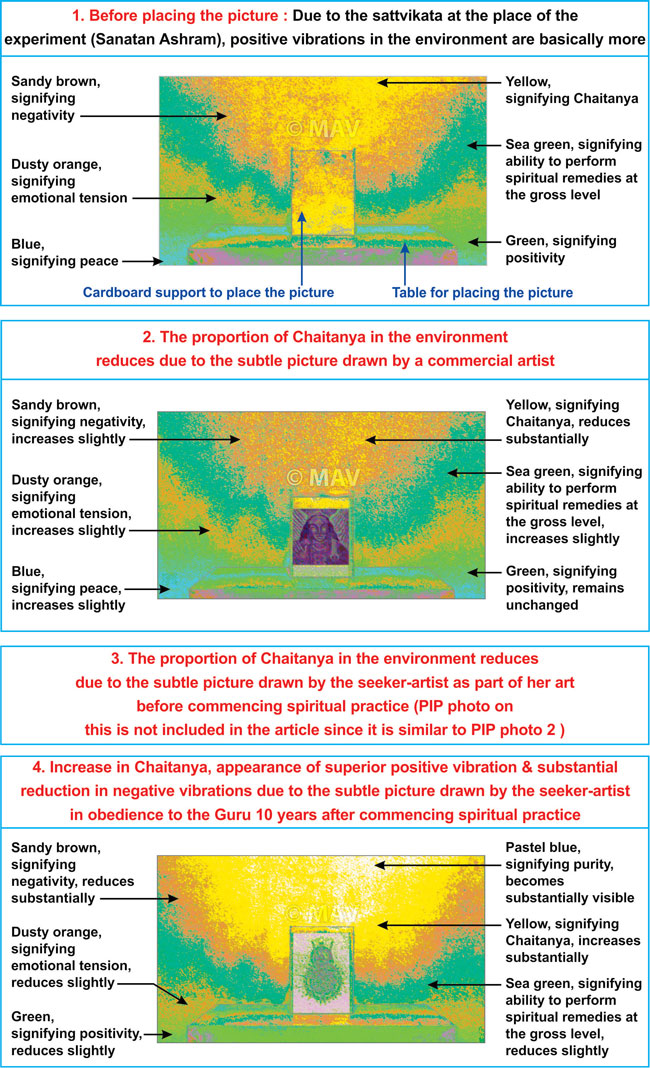
‘Subtle’ is that which is beyond the comprehension of the five gross sense organs (Nose, tongue, eyes, skin and ears), mind and intellect. ‘Subtle world’ is that which cannot be comprehended by the five gross sense organs, but its existence can be experienced. After studying the pictures and sculptures in ancient structures such as caves, pyramids, religious places, mansions, etc. we realise that almost all cultures in the world have curiosity about the subtle world. ‘Subtle pictures’ satisfy this curiosity to some extent. ‘Subtle picture’ or ‘Picture based on subtle knowledge’ is a drawing made on paper by an individual who has subtle perception ability to depict the spiritual phenomenon he perceives and sees with his subtle vision about a specific subject. Some artists draw subtle pictures with a commercial intent; whereas, some draw them as hobby. One artist lady-seeker began to draw subtle pictures as a part of her spiritual practice under the guidance of a Guru. On 6.10.2017, an experiment was conducted at Sanatan’s Ashram in Ramnathi, Goa using the PIP (Polycontrast Interference Photography) technology to study the changes that have taken place in the vibrations emitting from a subtle picture drawn by the artist lady-seeker due to the spiritual practice she performs. PIP technology is useful in studying the energy field (Aura) around an object and individual. The observations of this experiment and their analysis are given ahead.


1. Nature of the experiment

In this experiment, a blank sheet of paper was placed on the table and a photo of the environment was clicked by using PIP technology. This is termed as the ‘Baseline reading’. Then, one-by-one, PIP photos of a subtle picture drawn by a commercial artist, a subtle picture drawn by an artist lady-seeker before she commenced spiritual practice and a subtle picture of a Saint drawn by the same artist lady-seeker 10 years after commencing spiritual practice under the guidance of the Guru were clicked after placing them on a table. A comparative study of these photos helped us understand the impact of vibrations emitting from these three subtle pictures on the environment.


2. Information about the subtle pictures used in the experiment

2A. A subtle picture drawn by an artist with a commercial intent

This subtle picture drawn by an artist with a commercial intent is of an energy from the subtle world.

2B. Subtle picture drawn as part of her art by
an artist lady-seeker before commencing spiritual practice

This subtle picture is drawn by artist lady-seeker Mrs. Yoya Vallee (Now H.H. [Mrs.] Yoya Vallee) as part of her art in 1999 before commencing spiritual practice. The subtle picture is of some energy from the subtle world.

2C. Subtle picture drawn by the artist lady-seeker in obedience to the
Guru 10 years after commencing spiritual practice under the guidance of the Guru

This subtle picture of a Saint is drawn by artist lady-seeker Mrs. Yoya Vallee in 2009 in obedience to and under the guidance of her Guru 10 years after commencing spiritual practice.


3. The observations and their analysis

3A. Baseline reading

Proportion of positive vibrations being higher in Sanatan Ashram due to its sattvik environment : In the aura of the Baseline reading (Meaning, in the aura of the environment noticed before setting the experiment samples on the table) the total positive vibrations were 68% and total negative vibrations were 32%.

In Kaliyug, the proportion of emission of negative vibrations from a common premises is higher than that of positive vibrations.

This experiment was conducted in the very sattvik Sanatan Ashram; therefore, during the Baseline reading (Before placing the subtle pictures for the experiment) the proportion of total positive vibrations in the aura of the environment was higher than that of the total negative vibrations. In the readings given ahead, auras of the samples used in the experiment are compared with the aura of the ‘Baseline reading’.

3B. Due to the subtle picture drawn by an artist with a
commercial intent, the proportion of positive vibrations and
Chaitanya (Divine consciousness) in the environment reducing

In the aura of this picture, total positive vibrations were 62% and total negative vibrations were 38%. This means the positive vibrations in the aura of this picture had reduced by 6% when compared with the Baseline reading. In the aura of the Baseline reading, the yellow of Chaitanya was 26%; whereas, in the aura of this subtle picture it was 10%. From this it becomes clear that the proportion of Chaitanya in this subtle picture drawn by the commercial artist reduced greatly. In short, due to this subtle picture, proportion of negative vibrations in the environment increased and proportion of positive vibrations reduced; additionally, proportion of the emission of Chaitanya also reduced when compared with the Baseline reading.

3C. Due to the subtle picture drawn as part of her art by
the artist lady-seeker before commencing spiritual practice, the
proportion of positive vibrations and Chaitanya in the environment reducing

In the aura of the picture drawn as part of her art by an artist lady-seeker before commencing spiritual practice, the total positive vibrations were 64% and total negative vibrations were 36%. In the aura of this picture, the yellow of Chaitanya was 13%, which means it had reduced when compared with the yellow of Chaitanya (26%) in the Baseline reading. From this it becomes clear that due to this subtle picture, the proportion of positive vibrations and Chaitanya in the environment reduced. (Here, the PIP Photo is not provided since it is similar to Photo number 2.)

3D. Due to the subtle picture drawn by the
artist lady-seeker in obedience to her Guru, 10
years after commencing spiritual practice under the
guidance of her Guru, the proportion of positive vibrations
and proportion of vibrations of purity and haitanya significantly
increasing and proportion of negative vibrations significantly reducing

In the aura of the subtle picture drawn by the artist lady-seeker in obedience to her Guru, 10 years after commencing spiritual practice and under the guidance of her Guru, the total positive vibrations were 77% and negative vibrations were 23%. In the aura of this subtle picture, the yellow of Chaitanya was 44%, which means it had significantly increased when compared with the yellow of Chaitanya (26%) in the Baseline reading.

Additionally, in the aura of this subtle picture, pastel blue which indicates the presence of superior level positive vibrations (Purity and sanctity) than the yellow of Chaitanya was visible to the extent of 10%. In short, we understood that due to this subtle picture, the proportion of positive vibrations, as also the proportion of purity and Chaitanya in the environment significantly increased when compared with the Baseline reading.

The spiritual analysis of all the above observations is given in the ‘Point 4’.


4. Spiritual analysis of the observations

4A. The reason underlying the phenomenon of emission
of moderate level positive vibrations from the subtle picture
drawn by a commercial artist and the subtle picture drawn by
an artist lady-seeker as art before commencing her spiritual practice

A principle in Spirituality states that ‘Word, touch, form, taste, fragrance and their energies co-exist’. Accordingly, the vibrations (Energy) co-existed with the subtle pictures (Form) drawn by both the artists. The vibrations in any picture drawn by an artist depend on various factors such as intention with which the picture has been drawn, subject of the picture, whether or not the artist is performing spiritual practice, the artist’s individual spiritual practice and the Guru’s guidance to the artist performing spiritual practice, etc.

The commercial artist had drawn the subtle picture with the intention of gaining wealth and fame; whereas, the artist lady-seeker, Mrs. Yoya Vallee, had drawn the subtle picture only as her art before commencing spiritual practice. The subject of both the subtle pictures was – ‘Energy from the subtle world’. Both the artists were not performing spiritual practice. In short, the intent of both the artists in drawing these subtle pictures was worldly and both lacked the foundation of spiritual practice; therefore, moderate level positive vibrations were emitting from their subtle pictures.

4B. Emission of superior level positive
vibrations from the subtle picture drawn under
the guidance of the Guru by the artist lady-seeker 10 years after
commencing spiritual practice being the outcome of her spiritual practice

The artist lady-seeker, Mrs. Yoya Vallee, commenced spiritual practice in 1999. Realising her exceptional subtle perception ability, Paratpar Guru (Dr.) Athavale guided her on ‘Art for God-realisation’ and not ‘Art for the sake of art’. He gave her the knowledge on how a subtle picture can be illusory, imaginary, artistic or true. In short, due to the Guru’s guidance, this lady seeker’s spiritual practice got the right direction at the right time. She continued her spiritual practice with yearning.

While performing the satseva of drawing the subtle pictures as part of her spiritual practice, her sattvikata (Spiritual purity) increased and she progressed spiritually. As she progressed spiritually, the accuracy of the subtle pictures drawn by her began to increase. After performing spiritual practice for 10 years in this manner in obedience to her Guru, she drew a subtle picture of a Saint. This picture was used in this experiment. Hence, this picture (drawn by her as a part of her spiritual practice) emitted superior level positive vibrations in significantly high proportion when compared with the subtle picture drawn by her 10 years earlier. This happened because of her spiritual practice and her Guru’s blessings.

In the next few years, this lady-seeker progressed spiritually and attained Sainthood.

Seeker-artists who draw pictures as a part of their spiritual practice for God-realisation, meaning, who draw with a sattvik intent, progress spiritually. Society receives unique knowledge and guidance from their drawings. Spiritually beneficial vibrations are emitted by such pictures. Conversely, society does not benefit spiritually from the pictures drawn as a hobby or with a commercial intent. According to authorities in Spirituality, in the absence of the foundation obtained from spiritual practice, subtle-artists can experience distress caused by negative energies.

Hence, it is necessary for artists to perform spiritual practice and seek guidance of a Guru.

– Mr. Rupesh Laxman Redkar, Maharshi Adhyatma Vishwavidyalay, Goa. (14.2.2018)

E-mail : savv.research@gmail.com

Note 1 : While comparing PIP Photos 2 & 4 with the Baseline aura (PIP Photo 1), the colours of the area specifically covered by the Photo and table have not been taken into consideration as the PIP technology primarily measures the Aura around an object or a person.

Note 2 : In a PIP Photo, if light green or pastel blue that represent superior level positive vibrations are seen, the proportions of yellow, dark green or green that represent moderate level positive vibrations reduce or these colours completely vanish. This is considered to be a good sign; because, then, the moderate level vibrations have been replaced by superior level vibrations.

‘Subtle world’ is that which cannot be comprehended by the five gross sense organs, but its existence can be experienced !

Source : Dainik Sanatan Prabhat

"Scientific Mysticism" of Michael Whiteman

  The previous post gave reference to the book below by an academic. It is similiar but not identical to the ideas of my paradigm known as ...